

Termination of Employment Contract in Bahrain is not simply a letter sent by an employee or employer to end an employment relationship. It is a legal step that may lead to compensation, an employment claim, or a dispute before the competent authorities.
Therefore, before writing that you wish to terminate your employment contract, you should first know: Do you have a lawful reason? Are you required to give notice? Can you leave work immediately? Can the other party claim compensation from you?
In this guide, we explain the conditions for Termination of Employment Contract in Bahrain, when an employee may terminate the contract, when an employer may proceed with Termination of Employment Contract in Bahrain without compensation, how compensation is calculated, and a practical template that may be used as a reference before taking any action.
Are you facing the termination of your employment contract and worried about losing years of service or your financial entitlements?
Contact an Employment Lawyer NowOr continue reading to learn about the legal grounds for termination first.
Table of Content
What Does Termination of Employment Contract in Bahrain Mean?
In practical terms, Termination of Employment Contract in Bahrain means ending the employment relationship between an employee and an employer. This may happen at the employee’s initiative, the employer’s initiative, by mutual agreement, or because one party has committed a serious breach.
From a legal perspective, it is important to note that Bahrain Labour Law generally uses terms such as expiration or termination of the employment contract. Therefore, when preparing notices or legal claims, it is usually better to use the term “termination of employment contract” while clearly stating the legal ground.
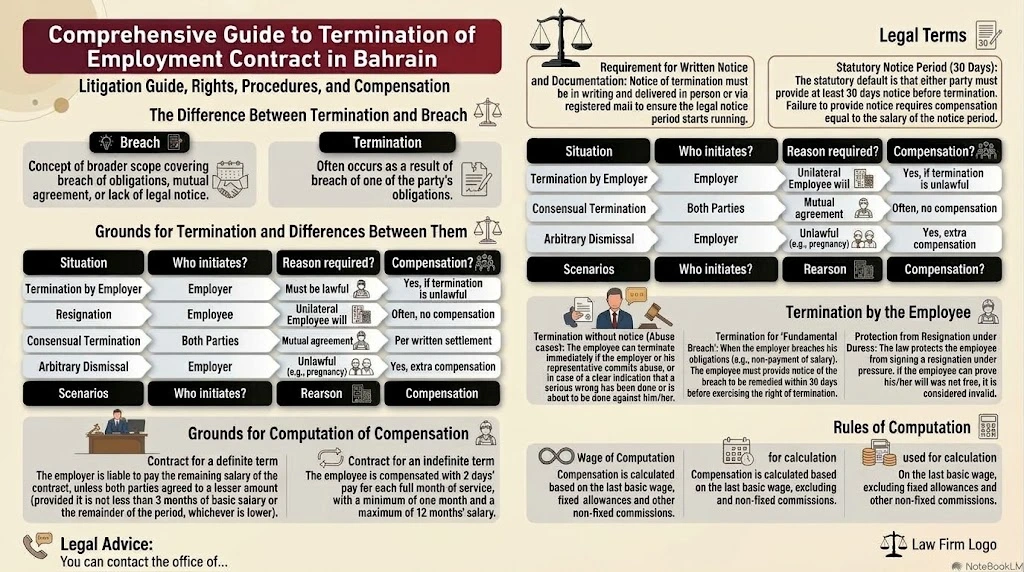
The Difference Between Rescission and Termination of an Employment Contract
Rescission is commonly used when a breach or specific reason leads one party to end the contract, such as failure to pay wages, assault, absence, disclosure of confidential business information, or failure to perform essential duties.
Termination is broader. It may occur because the contract term expires, notice is given, both parties agree, or an employer dismisses an employee for a lawful reason.
Simply put: every rescission will generally result in the employment relationship ending, but not every termination results from wrongdoing or a dispute.
The Difference Between Dismissal, Rescission, Resignation, and Mutual Termination
The following table explains the practical differences between these terms:
| Situation | Who Starts the Process? | Is a Reason Required? | Is Compensation Payable? | Practical Example |
|---|---|---|---|---|
| Termination by the employee | Employee | It may be for a reason or through ordinary notice | Depends on the reason and notice | An employee leaves after giving 30 days’ notice |
| Dismissal or termination by the employer | Employer | It should be lawful to avoid compensation liability | The employee may receive compensation if the termination is unlawful | A company terminates an employee without a clear reason |
| Resignation | Employee | Usually based on the employee’s own decision | The employee may not receive compensation and may need to give notice | An employee resigns to join another employer |
| Mutual termination | Both parties | Mutual agreement | Depends on the written settlement | The parties agree on the final working day and financial entitlements |
| Arbitrary dismissal | Employer | The reason is unlawful or prohibited by law | Yes, the employee may be entitled to compensation | Dismissal because of an employment complaint, pregnancy, or trade union activity |
Conditions for Termination of Employment Contract in Bahrain
For Termination of Employment Contract in Bahrain to be legally sound, three main factors should be considered: having a lawful reason where required, complying with the notice period, and documenting the notice in writing.
1. Having a Lawful or Legitimate Reason for Termination
Not every termination of an employment contract automatically creates a right to compensation. If the termination is based on a lawful and properly established reason, the likelihood of a dispute is lower. However, if the employer ends the contract without a reason or for an unlawful reason, the employee may be entitled to compensation. Under Bahrain Labour Law, the employer generally bears the burden of proving that the termination was lawful.
For this reason, one common mistake is for an employer to rely on a vague statement such as “your services are no longer required” without documenting the reason or the steps taken beforehand, particularly in cases involving poor performance or disciplinary misconduct.
2. The Termination Notice Must Be in Writing
It is generally not enough for an employee or employer to say verbally that the contract has ended. The notice should be in writing and delivered to the other party or their representative against acknowledgment of receipt, or sent by registered mail with acknowledgment of delivery to the last address provided by that party.
The notice period begins from the date the notice is received, or from the date the recipient refuses to accept it, depending on the circumstances.
In practice, it is advisable to keep a copy of the notice, record the date of delivery, and avoid emotional wording or allegations that cannot be proved.
3. Complying With the Notice Period When Required
The notice period is the period that the party wishing to end the contract must give the other party before the employment relationship ends. It allows the employee time to search for another job and gives the employer time to arrange a suitable replacement.
When Is the Notice Period 30 Days?
As a general rule under Bahrain Labour Law, either party may terminate the contract by giving the other party at least 30 days’ notice. The employment contract remains in force throughout the notice period, and both parties must continue to perform their obligations.
Can the Parties Agree on a Longer Notice Period?
Yes. If the termination is initiated by the employer, the parties may agree on a notice period longer than 30 days.
However, an agreement that exempts the employer from giving notice or reduces the notice period below the legal requirement is invalid. On the other hand, if the employee initiates the termination, the employer may exempt the employee from all or part of the notice period.
What Happens if a Party Does Not Comply With the Notice Period?
If the contract is terminated without observing the required notice period, the terminating party must pay the other party compensation equal to the employee’s wages for the full notice period or the remaining part of it.
If the employer terminates the contract, the notice period is included in the employee’s length of service. If the employee terminates the contract, the employment relationship ends when the employee stops working.
Termination of an Employment Contract by the Employee in Bahrain
Yes, an employee may terminate an employment contract in Bahrain, but the legal consequences depend on how it is done.
The employee may terminate the contract through ordinary notice, without notice in specific cases, or after notifying the employer when there is a serious breach or fraud.
The Employee’s Right to Terminate the Contract by Giving Notice
An employee may terminate the employment contract after notifying the employer in accordance with the statutory or agreed notice period.
In this case, the employee must continue working throughout the notice period unless the employer waives that requirement.
This is generally the safest option where there is no serious dispute or where the employee simply wishes to move to another job without entering into legal proceedings.
When May an Employee Terminate the Contract Without Notice?
Bahrain Labour Law allows an employee to terminate the employment contract without notice in two main situations:
- If the employer or the employer’s representative assaults the employee during or because of work by words or actions punishable by law.
- If the employer or the employer’s representative commits an act against public morals toward the employee or a member of the employee’s family.
In these two cases, termination is treated as arbitrary dismissal by the employer.
When May an Employee Terminate the Contract After Notifying the Employer?
An employee may terminate the contract after notifying the employer if the employer breaches an essential obligation imposed by law, the employment contract, or workplace regulations.
The same applies if the employer or its representative commits fraud regarding the terms or conditions of employment and the fraud is serious enough that, had the employee known the truth, the employee would not have entered into the contract.
Before giving notice of termination, however, the employee must first request in writing that the employer remedy the breach or fraud within a period not exceeding 30 days from the date of the request.
- The employer breaches an essential obligation: Examples may include failure to pay wages, making a fundamental change to the nature of the employee’s work without legal justification, breaching essential contractual terms, or failing to provide a safe working environment depending on the circumstances.
- The employer commits fraud regarding employment terms or conditions: Fraud may arise when an employee is persuaded to accept a job based on false information concerning salary, job title, duties, or working conditions, provided that the misrepresentation is serious and materially affected the employee’s decision.
What Should You Do if You Are Pressured to Resign?
If you are an employee and are being pressured to resign, do not rush into signing anything. A written resignation may later be used as evidence that you ended the employment relationship voluntarily.
It is better to document what happened, keep messages or recordings where legally permitted, and avoid signing a final settlement or resignation before reviewing your legal position.
Most importantly, contact a specialist employment lawyer immediately. You may request legal advice from Abdulrahman Khalifa Law Firm by using the WhatsApp button at the bottom of the screen.
Termination of an Employment Contract by the Employer in Bahrain
An employer has the right to terminate an employment contract in Bahrain, but that right is not unlimited. The law balances the interests of the business with the employee’s right to job stability and protection against unlawful termination.
When May an Employer Terminate an Employment Contract for a Lawful Reason?
As a general rule, the employer bears the burden of proving that the termination was lawful. For this reason, termination decisions should be supported by documents such as warnings, performance evaluations, investigation reports, disciplinary regulations, and attendance records.
The main situations include the following:
Termination Due to Poor Competence or Performance
An employer may not immediately terminate an employee’s contract simply because of poor competence or performance.
The employer must first notify the employee of the areas in which performance or competence is deficient and give the employee a suitable opportunity and period of at least 60 days to reach the required standard.
If the employee still fails to improve, the employer may terminate the employment contract after giving notice in accordance with the law and approved regulations. The process should generally include the following:
- Notify the employee of the areas of poor competence: The notice should not be vague. It should explain the shortcomings clearly enough, such as low productivity, repeated mistakes, delays in completing tasks, or failure to meet required standards.
- Give the employee a reasonable period to improve performance: This period should not be treated as a formality. It should provide a genuine opportunity to improve, and any training, guidance, or performance reviews provided during that period should preferably be documented.
When Does Termination Become Lawful After the Employee Fails to Improve?
If the improvement period ends without sufficient progress, and the employer has properly documented the shortcomings, notices, and opportunity provided to the employee, the employer’s legal position becomes stronger when terminating the contract, provided that the required notice and other procedures are followed.
Termination for Economic or Organisational Reasons
Some businesses may need to terminate employment contracts because of total or partial closure, a reduction in business activity, or replacing one production system with another in a way that affects workforce requirements.
In such cases, the Ministry must be informed of the reason for termination at least 30 days before the employee is notified. The employee is entitled to an award equal to half of the compensation referred to in Article 111.
Cases in Which an Employer May Terminate an Employment Contract Without Notice or Compensation
Bahrain Labour Law allows an employer to terminate an employment contract without notice or compensation in certain cases, including:
- The employee assumes a false identity or submits forged certificates.
- The employee commits a mistake resulting in serious financial loss, provided the competent authorities are notified within two working days.
- The employee violates occupational safety instructions despite receiving a written warning.
- The employee is absent without lawful justification for more than 20 non-consecutive days or 10 consecutive days in one year, subject to the required warning.
- The employee fails to perform essential obligations or discloses confidential business information.
- A final judgment is issued against the employee for a felony or misdemeanour involving honour, honesty, or public morals.
- The employee is intoxicated or under the influence of drugs during working hours.
- The employee commits an assault, violates rules governing strikes, or loses the legal or professional qualification required to perform the work for a reason attributable to the employee.
Also read: What Is the End-of-Service Benefit Under Bahrain Labour Law?.
What Should You Do if You Are an Employer and Want to Terminate a Contract Without Incurring Unnecessary Compensation?
Start by reviewing the reason for termination:
- Is it disciplinary?
- Is it due to poor performance?
- Is it an economic reason?
- Is it absence?
- Is it a serious breach?
Then review the employee’s file, warnings, employment contract, disciplinary regulations, and attendance records.
Do not send a brief termination letter before confirming that you are following the correct procedure, because even a small mistake in notice or evidence may expose the business to an employment compensation claim.
Compensation for Termination of Employment Contract in Bahrain
Compensation is one of the most important issues for both employees and employers when dealing with Termination of Employment Contract in Bahrain.
Employees want to know what they are entitled to, while employers want to understand the risks of termination.
The answer depends on the type of contract, the reason for termination, the employee’s length of service, and whether the termination was lawful or unlawful.
When Is an Employee Entitled to Compensation for Termination?
An employee may be entitled to compensation if the employer terminates the employment contract without a reason or for an unlawful reason, or if the termination amounts to arbitrary dismissal under the law.
If it is established that the termination was based on a lawful reason, the employee may not be entitled to termination compensation. However, other rights may remain payable, including outstanding wages and payment for unused leave, depending on the circumstances.
Compensation Under an Indefinite-Term Employment Contract
Compensation varies depending on the circumstances and employment conditions.
Termination During the First Three Months
If an employer terminates an indefinite-term employment contract during the first three months of employment, the employee is not entitled to compensation unless the termination amounts to arbitrary dismissal under the law.
In that case, the employee is entitled to compensation equal to one month’s wages.
Termination After the First Three Months of Employment
If the employer terminates an indefinite-term employment contract without a reason or for an unlawful reason after the first three months, the employer must compensate the employee at a rate equivalent to two days’ wages for each month of service.
Minimum and Maximum Compensation
In this situation, compensation must not be less than one month’s wages and must not exceed 12 months’ wages.
Any fraction of a month is treated as a full month for the purpose of calculating compensation.
Compensation Under a Fixed-Term Employment Contract
The rules differ for a fixed-term contract:
- Compensation for the remaining contract period: If the employer terminates a fixed-term employment contract without a reason or for an unlawful reason, the employer must compensate the employee in an amount equal to the wages for the remaining period of the contract.
- Can the parties agree on lower compensation? Yes. The parties may agree on a lower amount, provided that the agreed compensation is not less than three months’ wages or the wages for the remaining contract period, whichever is less.
Compensation Under an Employment Contract for a Specific Task
If the employment contract was concluded for the completion of a specific task and the employer terminates it without a reason or for an unlawful reason, the employer may be required to compensate the employee in an amount equal to the wages for the remaining period needed to complete the agreed work.
This depends on the nature of the work and is subject to the minimum compensation requirement where the parties have agreed on a lower amount.
Additional Compensation in Cases of Arbitrary Dismissal
If Termination of Employment Contract in Bahrain amounts to arbitrary dismissal under the circumstances specified by law, such as termination based on sex, colour, religion, marital status, pregnancy, childbirth, breastfeeding, trade union activity, or the filing of a non-malicious complaint or legal action against the employer, the employee may be entitled to additional compensation in accordance with the law.
Compensation When an Employee Terminates the Employment Contract
The law protects the employer’s rights just as it protects the employee’s rights.
Does an Employee Have to Pay Compensation to the Employer When Terminating the Contract?
As a general rule, when an employee terminates the employment contract or proceeds with Termination of Employment Contract in Bahrain, the employee is not required to compensate the employer except in specific cases provided by law.
These cases include:
- If the employee terminates the contract at a time that is unsuitable for the circumstances of the work, making it difficult for the employer to obtain a qualified replacement.
- If the termination is intended to cause harm to the employer.
- If the termination causes serious damage to the employer.
In all cases, the employer will only be entitled to compensation if the employee terminated the contract without complying with the required notice period.
Who Determines Compensation if a Dispute Arises?
The competent court determines the amount of compensation payable to the employer, upon request, based on the circumstances of the case and the evidence submitted.
Does the Method of Calculating Compensation Change if the Employee Receives Commission or Variable Pay?
Yes.
Some employee entitlements, including compensation related to Articles 99 and 111, are calculated based on the employee’s most recent basic wage plus the social allowance, if applicable.
If the employee is paid by piecework, production, commission, or percentage, the calculation is based on the employee’s average wage during the last three months.
Template for Termination of an Employment Contract by an Employee in Bahrain
The following is a simple guidance template that may be adapted depending on the circumstances.
Do not use it in cases involving disputes, serious breaches, or pressure to resign before obtaining legal advice.
Information That Should Be Included in a Termination Letter
A letter terminating an employment contract should include:
the employee’s name, employer’s name, job title, employment contract date, notice date, final working day, reason for termination if applicable, reference to the notice period, a request to settle outstanding entitlements, and the employee’s signature.
Employment Contract Termination Template
Please note that this is a general template and may not be suitable for every situation. For this reason, you should consult a lawyer in Bahrain. We are ready to help; simply use the WhatsApp button below.
Subject: Notice of Termination of Employment Contract
Dear [Company Name],
Greetings,
I, the undersigned, [Employee Name], am employed by your company as [Job Title] under the employment contract dated [Contract Date].
I hereby notify you of my intention to terminate my employment contract. My final working day will be [Date], subject to compliance with the notice period required by law or agreed in the employment contract.
Please take the necessary steps to settle all of my financial entitlements, including outstanding wages, payment for any unused leave balance, if applicable, and any other rights due under the law or the employment contract. I also request written confirmation that the employment relationship has ended.
Yours sincerely,
Name: [Employee Name]
Signature: [Signature]
Date: [Date]
Mistakes to Avoid Before Sending the Letter
To avoid unnecessary legal problems:
- Do not send a letter containing allegations that you cannot prove.
- Do not leave work immediately if a notice period is required.
- Do not sign a final settlement before reviewing your financial entitlements.
- Do not rely on a general template if the termination results from assault, fraud, or a serious breach by the employer.
We recommend consulting a lawyer or booking an employment law consultation before taking any action that could create a legal problem or expose you to losses you were not prepared for.
When Do You Need an Employment Contract Termination Lawyer in Bahrain?
You may need an employment lawyer in Bahrain if you are unsure whether the termination is lawful or arbitrary, if you are an employee who has been dismissed without a clear reason, or if you are an employer seeking to terminate an employee’s contract without incurring unnecessary compensation.
- If you are an employee who has been dismissed or pressured to resign: Pressure to resign may be an attempt to avoid having the termination classified as dismissal. In this situation, do not rush into signing anything. Ask for a legal assessment of the facts and documents first.
- If you are an employer seeking to terminate a contract without incurring unnecessary compensation: A lawyer can help you choose the correct legal route, whether through ordinary notice, disciplinary proceedings, termination for poor performance, or applying a lawful ground for termination without notice or compensation. The difference between these routes may completely change the outcome of a dispute.
- If there is a dispute over compensation or the notice period: Compensation is not calculated in the same way in every case. It depends on the type of contract, length of service, reason for termination, and basic or average wage where the employee receives commission or variable pay.
Do not hesitate to seek advice from Abdulrahman Khalifa Law Firm regarding Termination of Employment Contract in Bahrain or whenever you believe a legal issue requires professional guidance. This can help protect your legal position.
Frequently Asked Questions
Must the termination notice be in writing?
Yes. A notice to terminate an employment contract must be in writing. It should be delivered to the other party or sent by registered mail with acknowledgment of receipt. The notice period starts from the date the notice is received or from the date the recipient refuses to accept it.
Can the parties agree on a longer notice period?
Yes. If the termination is initiated by the employer, the parties may agree on a notice period longer than 30 days. However, an agreement that exempts the employer from giving notice or reduces the statutory notice period in violation of the law is not valid.
Is an employee entitled to compensation if they were pressured to resign?
The employee may be entitled to make a claim if they can prove that the resignation was not given voluntarily, or that the termination was effectively initiated by the employer in an unlawful manner. Therefore, an employee should avoid signing a resignation or settlement under pressure before obtaining legal advice.
When must an employee’s dues be paid after the employment relationship ends?
When the employment relationship ends, the employee’s wages and all other amounts due should be paid immediately. However, if the employee leaves the job voluntarily, the employer must pay the employee’s wages and all outstanding entitlements within no more than seven days from the date the employee leaves work.
Termination of Employment Contract in Bahrain may be legally valid when carried out in accordance with the law, but it may turn into an employment dispute if it is handled without notice, without a lawful reason, or without proper documentation.
An employee needs to know when they are legally entitled to leave work, while an employer needs to make sure that the termination decision is supported by a valid reason and proper procedure.
Before sending an employment contract termination letter or signing a final settlement, review the type of contract, reason for termination, notice period, supporting documents, and method of calculating compensation.
If the situation involves sudden dismissal, pressure to resign, an allegation of serious misconduct, or a compensation claim, consulting an employment lawyer in Bahrain from Abdulrahman Khalifa Law Firm is an important step in protecting your legal position. Simply use the WhatsApp button at the bottom of the screen.
You may also read: Assault Under Bahrain Labour Law: A Detailed Overview.

A Bahraini lawyer and the founder of a legal consultancy firm established in February 2019. He holds a Higher Degree in Sharia and Law from Al-Azhar University. He has extensive experience in court representation and providing legal advice in criminal, personal status, civil, and commercial matters. He is known for delivering clear, practical, and effective legal advice aimed at protecting his clients’ rights and interests, and has achieved tangible results in notable cases, including commercial litigation and inheritance matters
