

The Bahraini Penal Code treats insult and defamation separately, and it sets a different penalty for each case. The penalty depends on what was said, how it was said and the circumstances around it.
This guide explains the insult penalty in Bahrain, the cases where the penalty is heavier, and the cases where no crime exists under the conditions of the law. A criminal lawyer can then guide you on the practical steps for a complaint.
Insulted or defamed, or facing an unfair complaint? Do not wait while your reputation or your freedom is at stake. Our lawyers act fast to protect your rights.
Table of Content
Insult and Defamation Under the Bahraini Penal Code
The Penal Code (Decree-Law No. 15 of 1976) separates defamation from insult. Defamation means attributing a specific fact to a person that could expose them to punishment or contempt (Article 364). Insult means harming a person’s honor or reputation without attributing a specific fact to them (Article 365).
This difference matters because the law treats each case in separate articles, with its own penalty and conditions.
What Is the Insult Penalty in Bahrain?
Insult in Public (Article 365)
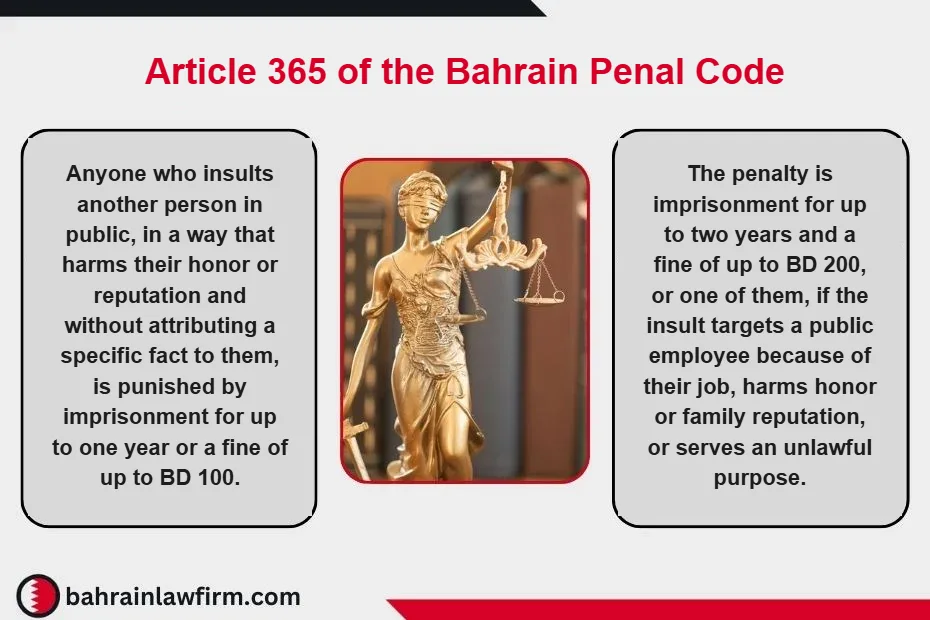
Article 365 covers an insult made in public that harms a person’s honor or reputation, without attributing a specific fact to them. The penalty is imprisonment for up to one year or a fine of up to BD 100.
The penalty is heavier in some cases. It becomes imprisonment for up to two years and a fine of up to BD 200, or one of them. This applies if the insult targets a public employee during or because of their job, harms honor or the reputation of families, or serves an unlawful purpose.
An insult published in a newspaper or other publication is also an aggravating circumstance under the same article.
Insult by Phone or Face to Face (Article 366)
Article 366 covers other forms of defamation and insult. If it is made by phone, or face to face without provocation and in front of another person, the penalty is imprisonment for up to six months or a fine of up to BD 50.
If it is made face to face, without provocation and with no one else present, the penalty is a fine of up to BD 50. The act is an aggravating circumstance if it targets a public employee because of their job, harms honor or family reputation, or serves an unlawful purpose.
Defamation (Article 364)
Defamation made in public is punished by imprisonment for up to two years or a fine of up to BD 200. The penalty becomes imprisonment and a fine, or one of them, in the same aggravated cases. Defamation published in a newspaper or other publication is an aggravating circumstance.
When Is the Penalty Heavier?
The penalty does not depend only on the words used. The circumstances also matter, and the law names several that make the case more serious:
- The insult targets a public employee during or because of their job.
- The act harms a person’s honor or the reputation of families.
- The act serves an unlawful purpose.
- The insult is published in a newspaper or other publication (Article 365).
For this reason, no single insult penalty in Bahrain applies to every case. The court looks at the description of the act, the circumstances and the article that applies.
When Is There No Crime? (Articles 367 to 369)
Article 367 does not make defamation or insult lawful in every case just because the words are true. It covers a special case.
The statement is directed at a public employee or a person assigned to a public service, and it relates to the job or service. In that case there is no crime if the offender proves the fact, under the conditions of the law.
Proof is not allowed if more than ten years have passed since the fact, if the crime has expired by a legal ground, or if the judgment issued in it has lapsed. The offender may also prove an insult that comes from him and is linked to the defamation.
Article 368 says there is no crime in defamation or insult contained in the oral or written defense of the parties before the courts or investigation authorities, within the limits of the right of defense. Article 369 says there is no crime in reporting to judicial or administrative authorities, in good faith, a matter that makes its doer liable. These cases depend on their legal conditions, so they do not make insult lawful in general.
Frequently Asked Questions About Insult and Defamation in Bahrain
What is the punishment for insulting someone in Bahrain?
It depends on how the insult was made. A public insult under Article 365 carries imprisonment for up to one year or a fine of up to BD 100, and in some cases up to two years and BD 200, or one of them. Article 366 covers insults by phone or face to face, with lower penalties.
How much is the fine for an insult in Bahrain?
There is no single fine. The law sets a fine of up to BD 50 in some cases under Article 366, up to BD 100 under Article 365, and up to BD 200 in the aggravated cases of Article 365. The court first decides which article applies to the facts.
What is the difference between defamation and insult in Bahrain?
Defamation attributes a specific fact to a person that could expose them to punishment or contempt (Article 364). Insult harms a person’s honor or reputation without attributing a specific fact (Article 365).
Is an insult by phone punishable in Bahrain?
Yes. Article 366 covers defamation or insult made by phone. The penalty is imprisonment for up to six months or a fine of up to BD 50.
In conclusion, the insult penalty in Bahrain depends on the words used, the way they were said and the circumstances. Before taking any step, it is important to know which article applies to the facts.
This guide explained the main penalties and the cases where no crime exists. For more help, speak to an experienced criminal lawyer in Bahrain.

A Bahraini lawyer and the founder of a legal consultancy firm established in February 2019. He holds a Higher Degree in Sharia and Law from Al-Azhar University. He has extensive experience in court representation and providing legal advice in criminal, personal status, civil, and commercial matters. He is known for delivering clear, practical, and effective legal advice aimed at protecting his clients’ rights and interests, and has achieved tangible results in notable cases, including commercial litigation and inheritance matters
