
Many business owners and individuals search for the difference between embezzlement and theft in Bahrain after a money dispute, a shortage in a cash account, or an unlawful act by an employee, partner or collection agent.
A common mistake is to call every taking of money theft. The Bahraini Penal Code separates three cases: money taken against the owner’s will, money handed over voluntarily in trust, and money held because of a job or position.
In simple terms, the difference between embezzlement and theft in Bahrain lies in how the money reached the offender’s hands, and in his capacity at that moment. Embezzlement is covered by Article 194 when a public official commits it, and by Article 424 when a worker or board member of a private legal person commits it.
Not sure whether your case is theft, embezzlement or breach of trust?
Table of Content
Why Does the Legal Description Matter?
The correct legal description decides these points:
- The exact criminal charge that fits the facts.
- The competent criminal court, lower or higher.
- The type of offense, misdemeanor or felony, and the possible penalty.
- The financial documents and accounting reports needed to prove or deny the offense.
- The strategy for reporting the case, or for building the defense from the first investigation.
A wrong description can weaken the report, lead the Public Prosecution to drop the charge, or turn the whole dispute into a civil case that takes years. It can also lead to a charge whose elements do not fit the documents.
What Is the Difference Between Embezzlement and Theft in Bahrain?
In practice, the Public Prosecution and the courts first ask two questions. How did the money reach the offender, and what was his capacity when the act happened?
Based on the papers, the legal description follows these rules:
- Possession is taken secretly, without the owner’s knowledge or consent: the description is theft.
- A public official holds the money because of his job: the description is embezzlement of public money.
- A worker or board member of a private legal person holds the money because of his work or position: the description is embezzlement in the private sector under Article 424.
- The owner handed over the money voluntarily under a civil or commercial contract, such as a deposit or an agency: the description is breach of trust.
Theft: Taking Possession Without Consent
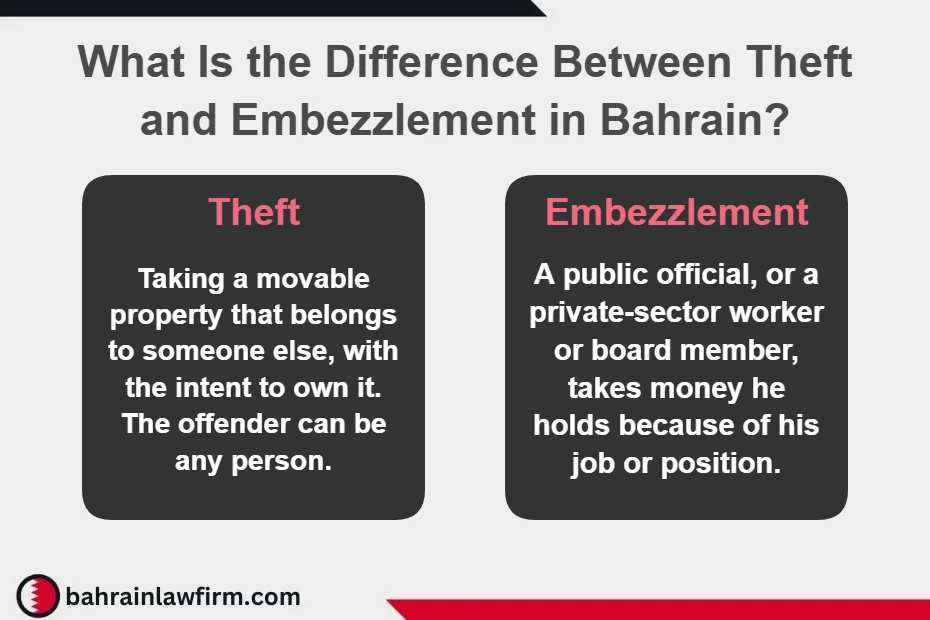
Under Article 373 of the Penal Code, theft takes place by taking a movable property that belongs to someone other than the offender, with the intent to own it. The property was not handed to the offender before. This is the key to telling theft from embezzlement and breach of trust.
For the penalties, read our guide to the theft penalty in Bahrain.
Embezzlement: Using a Job or Work Custody
Embezzlement exists when the money is lawfully in the offender’s hands because of his job or work, and he then turns this temporary custody into personal ownership. The law has two forms.
- Public money: Article 194 punishes a public official, or a person entrusted with a public service, who embezzles money or papers that he holds because of his job.
- Private sector and companies: Article 424 punishes a worker or a board member of a private legal person who embezzles money, bonds or papers of financial, commercial or moral value that he holds because of his work or position.
If you face a case like this, you can contact the office of lawyer Abdulrahman Khalifa through the WhatsApp button on this page.
Breach of Trust: Breaking a Trust Contract
Breach of trust exists when the owner hands over his movable property voluntarily under a civil or commercial contract, and the receiver then embezzles or wastes it. Article 395 punishes with imprisonment anyone who embezzles, uses or wastes money, bonds or any other movable property to the harm of those entitled to it, when it was handed to him as a deposit, a lease, a pledge, a loan for use or an agency.
The same article treats a partner who holds joint property, a person who manages another’s affairs without authority, and anyone who receives something for a specific use as if he were an agent.
How Do the Courts Tell the Cases Apart in Practice?
The courts look at how the money reached the offender and what his position was when the act happened. Three examples show the difference between embezzlement and theft in Bahrain.
- Theft: a stranger enters the premises at night, breaks the accountant’s drawer and takes the cash. Possession was taken completely, without consent or an earlier handover.
- Embezzlement: an accountant is responsible for the daily revenue and the bank deposits. He takes part of the money for himself and falsifies the entries, so possession was handed to him because of his job.
- Breach of trust: a merchant gives goods to a sales agent under an agency contract to distribute them. The agent sells them, keeps the money and denies receiving it, so the handover was voluntary under a specific trust contract.
Penalties for Money Crimes in Bahrain
Penalties differ with the article that applies, the circumstances and the offender’s capacity. The difference between embezzlement and theft in Bahrain is also clear in the type and length of the penalty.
Embezzlement of Public Money
Article 194 provides a prison term for a public official who embezzles money held because of his job. The penalty is life imprisonment if the offender is a collector or his deputy, a trustee of deposits or a cashier, and the money was handed to him in that capacity.
Under Article 201, the court also orders restitution and a fine equal to the value of the money, and not less than 100 dinars.
Embezzlement in the Private Sector
Under Article 424, as replaced by Law 5 of 2019, the penalty is imprisonment of up to ten years, and the offender must return the embezzled property. It is an aggravating circumstance if the offender is a collector or his deputy, a trustee of deposits or a cashier, and the money was handed to him in that capacity.
Breach of Trust
Article 395 punishes breach of trust with imprisonment. Under Article 54, imprisonment ranges from ten days to three years, unless the law says otherwise. The time limit for the criminal case starts only when the victim learns of the act and of the offender, unless an investigation began before that.
Theft
Simple theft is punished by imprisonment of up to two years (Article 381). The law provides heavier penalties for aggravated theft. Articles 374 to 378 provide prison terms, up to life imprisonment, when circumstances such as night, two or more offenders, a weapon, force or a threat come together.
Is Every Money Dispute a Crime?
Not every money dispute is a crime. Partners may disagree on the annual accounts, a debtor may be late in paying a bill of exchange, or a supply contract may not be fully performed.
In these cases, if there is no clear criminal intent, such as the intent to own the money or to waste it on purpose, the dispute leaves the criminal law. The right route is then the civil or commercial court, through a claim for rescission or compensation.
How Does a Lawyer Build the Defense in an Embezzlement Case?
A lawyer who handles embezzlement cases builds the defense on a review of the documents and the financial reports, before the statements are taken. Criminal work needs the inventory minutes, the reports of the financial experts appointed by the court, the messages between the parties and the employment contracts.
The defense usually rests on these points:
- The offender’s capacity: show that the accused is not a public official, or is not a worker or board member under Article 424, which changes the charge completely.
- The reason for possession: show that the money was not in his hands because of his job or direct powers.
- No criminal intent: show that a shortage comes from an accounting error, overlapping entries, force majeure or a delay in handing over, with no intent to seize or waste the money.
- The inventory and the audit: challenge how the shortage was calculated, the dates and the soundness of the documents behind the charge.
- A civil dispute: show that the relationship is a money claim or an account settlement between partners, without the elements of a crime.
When he represents the victim, a company or an individual, a lawyer in Bahrain arranges the report to prove the contract relationship, the documented handover, the clear act of waste and the later behavior of the offender, such as denial or evasion.
Frequently Asked Questions About Embezzlement and Theft
Here are short answers to common questions about the difference between embezzlement and theft in Bahrain.
What is the difference between theft and embezzlement?
Theft is taking a movable property that belongs to someone else, without consent and with the intent to own it, and the offender can be any person. Embezzlement is when a public official, or a worker or board member of a private legal person, takes money that he holds because of his job or position.
What does embezzlement mean in Bahraini law?
It means that a person who holds money lawfully because of his job or work treats it as his own. Article 194 covers public officials, with a prison term and life imprisonment for collectors, cashiers and similar roles, while Article 424 covers the private sector, with imprisonment of up to ten years.
Is embezzlement theft?
No. Embezzlement is a different money offense. The money is already in the offender's lawful hands because of his job, while in theft the offender takes possession without consent.
Is a company manager in the private sector an embezzler or a breach of trust offender?
It depends on his capacity. If he is a de facto manager or a board member of a private legal person, and the money was in his hands because of his position and powers, Article 424 applies. If he received money in a personal capacity under a special agency or deposit contract, the description may be breach of trust.
Does returning the money end the criminal liability automatically?
Returning the money can improve the legal position of the accused, but it does not end the criminal case automatically. In the felonies of embezzlement of public money, Article 201 requires restitution and a fine in addition to the penalty.
In short, the difference between embezzlement and theft in Bahrain lies in the nature of the offense and the capacity of the offender. Understanding these differences helps you protect your rights.
Do not hesitate to ask for advice from a criminal lawyer in Bahrain if you face a case of breach of trust, theft or embezzlement, whether you are the accused or the victim.

A Bahraini lawyer and the founder of a legal consultancy firm established in February 2019. He holds a Higher Degree in Sharia and Law from Al-Azhar University. He has extensive experience in court representation and providing legal advice in criminal, personal status, civil, and commercial matters. He is known for delivering clear, practical, and effective legal advice aimed at protecting his clients’ rights and interests, and has achieved tangible results in notable cases, including commercial litigation and inheritance matters
