
Guardianship of Minors in Bahrain is a legal system that protects a child’s rights and money when the parents have died or cannot care for the child. It sets who may manage the minor’s property and what that person is allowed to do. Every important step stays under official supervision.
Many families ask about Guardianship of Minors in Bahrain: what legal guardianship means, who can become a guardian and what a guardian must do. They also ask how the Guardianship Council handles disputes and how a minor’s rights are protected during this sensitive period.
This guide explains Guardianship of Minors in Bahrain based on the Guardianship of Property Law (Decree-Law 7 of 1986). A lawyer who handles guardianship cases can help you follow the procedure and protect the minor’s interest.
Are you facing a hard family situation, with frozen bank accounts or no access to your minor children’s money? Do not deal with the courts and the minors’ funds alone. Our lawyers can guide you through the guardianship steps safely.
Table of Content
Guardianship of Minors in Bahrain Under the Law
The subject is regulated by the Guardianship of Property Law, issued by Decree-Law 7 of 1986. The law protects the minor’s interests and money when there is no capable natural guardian, or when the Council decides to appoint a guardian.
Two bodies are involved. The Minors’ Funds Administration belongs to the Ministry of Justice, Islamic Affairs and Waqf and supervises the management of minors’ money (Article 9), while the Guardianship Council decides on appointments, permissions and removals. The Council is an administrative body with judicial jurisdiction, chaired by the Minister of Justice, Islamic Affairs and Waqf (Article 2).
The Administration supervises natural guardians and guardians (Article 10). If no one is available, it can take over the guardianship itself by a decision of the Council (Article 11). This means a minor’s money is never managed without official oversight.
The law separates two roles. The natural guardian is the father, or the paternal grandfather if the father did not choose a guardian (Article 14), while a guardian is a person chosen by the father or appointed by the Council. In this guide, the word guardian means the second role.
The main rules that apply to a minor’s property are:
- Age of majority: 21 full Gregorian years. A person who reaches it has full capacity, unless the Council decided earlier that guardianship continues (Article 13).
- Natural guardian: the father, then the paternal grandfather. He must carry out the role and cannot step aside without the Council’s permission (Article 14).
- Powers: the natural guardian cares for and manages the minor’s money, and may dispose of it within the limits of the law (Article 16).
- Permission: the natural guardian needs the Council’s permission to dispose of the minor’s real estate, business or securities, to lend or borrow the minor’s money, to lease property for more than two years, or to mortgage or donate it (Article 18).
Who Can Be a Guardian and How Is One Appointed?
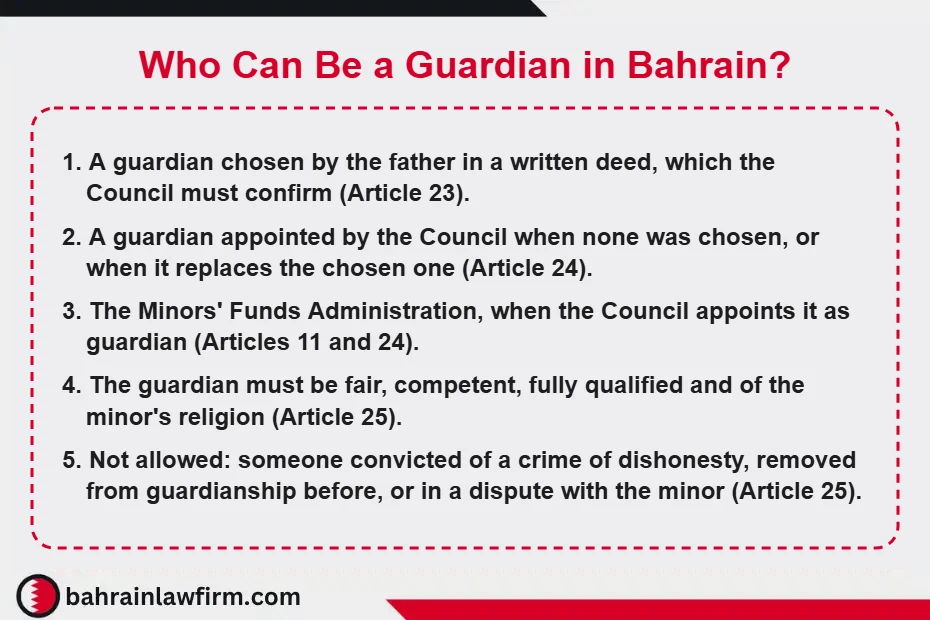
Under the rules on Guardianship of Minors in Bahrain, a guardian is needed when neither the father nor the paternal grandfather acts as natural guardian, or when the natural guardian’s authority is removed or suspended (Articles 14, 19 and 27). The law then offers three routes:
- A guardian chosen by the father: the father may choose a guardian for his minor child or unborn child. The choice must be made in a certified document, a private document with a certified signature, or a handwritten and signed document, and the Council must confirm it (Article 23).
- A guardian appointed by the Council: the Council appoints the guardian if none was chosen, or if it decides to appoint a different person (Article 24).
- The Administration: the Council may appoint the Administration as guardian at any time, on its own decision or at the request of interested parties (Article 24).
The guardian must be fair, competent, fully qualified and of the minor’s religion (Article 25). The law bars certain people from being appointed, including:
- A person convicted of a crime of dishonor or breach of trust, unless his reputation was restored by a final judgment and the Council waives the condition when necessary.
- A person known for bad conduct, or convicted of a bankruptcy offence until his reputation is restored.
- A person whose guardianship was removed before, or who was removed from the guardianship of another minor.
- A person whom the father barred before his death for strong reasons that the Council accepts.
- A person who, or whose ascendants, descendants or spouse, has a court dispute or hostility with the minor or the minor’s family that threatens the minor’s interest.
The graphic below summarizes who can be a guardian.
Duties of the Guardian
A guardian is more than a title. Under Guardianship of Minors in Bahrain, every guardian has clear duties toward the minor and the minor’s property.
Managing the Minor’s Money With Care
The guardian receives the minor’s money and manages it under the supervision of the Administration. He must show the care expected from an agent (Article 29).
Depositing Money in the Minor’s Name
The guardian must deposit all cash he collects in the minor’s name, in the bank the Council designates, within 15 days of receiving it. Only the approved allowance and the sum the Council sets for management costs are kept out, and he cannot withdraw anything without the Council’s permission (Article 32).
Submitting an Annual Account
The guardian must submit an account supported by documents before 1 January each year. He is exempt if the minor’s money does not exceed BD 5,000, unless the Council decides otherwise, and a replaced guardian must submit an account within 30 days of the end of his guardianship (Article 33).
Asking for the Council’s Permission
The guardian may not carry out major acts without the Council’s permission (Article 30). They include creating or transferring rights over real estate, disposing of movables or securities beyond ordinary management, settlement and arbitration, investing or liquidating funds, and borrowing or lending. Leases of more than one year for buildings, or more than three years for agricultural land, also need permission.
If the inherited property includes a minor’s share, read our guide on selling inherited property in Bahrain.
Representing the Minor in Lawsuits
Filing a lawsuit needs the Council’s permission, except where delay would harm the minor or cause a loss of rights. The guardian must refer to the Council without delay any lawsuit he filed, any lawsuit filed against the minor and any enforcement step taken against the minor, and follow its orders (Articles 30 and 31).
No Exploitation or Personal Benefit
The guardian may not donate the minor’s money, except for a limited amount for a family or humanitarian duty, when the minor’s estate can bear it and the Council permits. He also may not lease the minor’s property to himself, to his wife, to her relatives up to the fourth degree or to a person he represents, unless the Council permits (Article 30). Guardianship is unpaid unless the Council, at the guardian’s request, sets a fee or a reward for a specific task (Article 34).
The aim of these duties is to prevent anyone from using the minor’s money for personal benefit, and to keep every major step under the supervision of the Council and the Administration.
Disputes Over Guardianship and Removal of a Guardian
When someone objects to a guardian or the parties dispute the guardianship, the matter goes to the Guardianship Council. In cases of Guardianship of Minors in Bahrain, the law gives the Council these powers:
- Appoint another guardian: the Council may appoint a different guardian at any time, including in place of the Administration (Article 24).
- Appoint a special guardian: for a defined task, for example when the minor’s interest conflicts with that of the natural guardian, his spouse or his ascendants or descendants, or when a contract is made between them and the minor (Article 26).
- Appoint a temporary guardian: when the natural guardian or guardian is suspended or temporarily unable to act, and a litigation guardian when the minor’s interest requires it (Article 27).
- Limit or remove the natural guardian’s authority: when the minor’s property is at risk because of mismanagement or another reason, at the request of the Administration or interested parties (Article 19).
- Remove a guardian: if a ground in Article 25 applies, even if it existed at appointment, if he mismanaged or neglected the property, if his stay endangers the minor, or for another reason the Council finds sufficient. Removing a guardian chosen by the father needs the approval of two thirds of the Council’s members sitting together (Article 36).
If you suspect mismanagement, gather evidence and submit it to the Administration so it can bring the matter before the Council.
End of Guardianship and Handover of the Money
The guardian’s role ends when the minor reaches 21, unless the Council decides before then that guardianship continues. It also ends when the natural guardian’s authority returns, when the guardian is removed or his resignation is accepted, when he loses capacity or is declared absent, or when the guardian or the minor dies (Articles 13 and 35).
Within 30 days of the end of guardianship, the guardian must hand over the money against a record, under the supervision of the Administration, and submit his account. The Administration then presents the account and the handover record to the Council for review and approval (Article 37). The Council stays competent to decide on the account and the handover even after the minor reaches majority (Article 8).
Rights of the Minor During Guardianship
The rules on Guardianship of Minors in Bahrain protect the minor in several ways:
- Major acts on the minor’s property need the Council’s permission, and cash is deposited in the minor’s name and cannot be withdrawn without permission (Articles 30 and 32).
- The guardian submits a documented account, and the Council reviews and approves it when guardianship ends (Articles 33 and 37).
- A minor who is 18 may be allowed by the Council to receive and manage all or part of his money, and may trade only at 18 with the Council’s permission (Article 39).
- A minor who is 16 may be allowed to sign an employment contract under the Labor Law, and can dispose of what he earns from work (Article 44).
- The minor’s basic rights to education, health and care remain protected by the Child Law (Law 37 of 2012).
These rules make guardianship a supervised protection system, not unlimited power for the guardian. If the minor is also an heir, the shares are set under the inheritance rules, which we explain in our guide to the inheritance law in Bahrain.
How a Lawyer Helps in Guardianship Cases
Guardianship cases combine legal, financial and family issues. A lawyer in Bahrain from our office can help with Guardianship of Minors in Bahrain cases, draft the requests, guide you through the steps before the competent authorities and protect the minor’s interest.
- Draft the requests carefully and meet the legal conditions, which reduces the risk of rejection for formal errors.
- Present the minor’s interest to the Council and file the documents and evidence.
- Follow up on decisions, monitor the guardian’s performance, and ask to limit authority or remove the guardian if he fails his duties.
- Advise whether a step needs the Council’s permission before it is taken.
- Represent the minor’s family before administrative and supervisory bodies to protect the minor or object to harmful decisions.
If the minor’s money comes from inheritance, you can also consult our inheritance lawyer in Bahrain.
Frequently Asked Questions
Can a guardian use the minor's money for personal expenses?
The guardian cannot use it for personal expenses. He manages the minor's money under the supervision of the Minors' Funds Administration (Article 29), he may donate only within narrow limits and with the Council's permission, and he must deposit cash in the minor's name in the bank the Council designates and cannot withdraw anything without permission (Articles 30 and 32). Breaching these duties can lead to his removal under Article 36.
What can be done if the guardian mismanages the minor's money?
The Council may remove a guardian who mismanaged or neglected the property, or whose stay endangers the minor (Article 36). It is advisable to submit evidence of the mismanagement to the Minors' Funds Administration so that it can bring the matter before the Council. Removing a guardian chosen by the father needs the approval of two thirds of the Council's members sitting together, and the Council may appoint another guardian (Article 24).
When does guardianship over a minor end?
It ends when the minor reaches 21 full Gregorian years, unless the Council decides before then that guardianship continues. It also ends when the natural guardian's authority returns, when the guardian is removed or his resignation is accepted, when he loses capacity or is declared absent, or when the guardian or the minor dies (Articles 13 and 35). The guardian must then hand over the money within 30 days (Article 37).
What is the difference between natural guardianship and appointed guardianship?
Natural guardianship over a minor's money belongs to the father, then to the paternal grandfather if the father did not choose a guardian (Article 14), and the natural guardian manages and disposes of the money within the limits of the law (Article 16). An appointed guardian is chosen by the father or appointed by the Council when none was chosen (Articles 23 and 24), is supervised by the Administration and needs the Council's permission for major acts (Articles 29 and 30).
Guardianship of Minors in Bahrain is a complete system that protects the legal and financial rights of the minor through precise supervision with limited powers. It works only when the guardian follows the law, manages the minor’s money openly and cooperates with the supervising bodies.
You can read the official text on the Guardianship of Property Law page of the Legislation and Legal Opinion Commission portal. For professional advice, contact Bahrain Law Firm.

A Bahraini lawyer and the founder of a legal consultancy firm established in February 2019. He holds a Higher Degree in Sharia and Law from Al-Azhar University. He has extensive experience in court representation and providing legal advice in criminal, personal status, civil, and commercial matters. He is known for delivering clear, practical, and effective legal advice aimed at protecting his clients’ rights and interests, and has achieved tangible results in notable cases, including commercial litigation and inheritance matters
