

Can you appeal an enforcement judge decision in Bahrain? If so, what does the law say about appealing enforcement decisions? Here are the main points of Law No. (22) of 2021, which covers every detail of appealing enforcement decisions in Bahrain.
To appeal an enforcement judge decision in Bahrain, read the full text of Decree-Law No. (22) of 2021 Promulgating the Enforcement Law in Civil and Commercial Matters (unofficial English translation) (official Arabic text).
Has an enforcement decision suddenly been issued against you, and you fear attachment procedures or a travel ban? Don’t leave your legal position to chance.
Consult an enforcement lawyer to stop the decision nowOr keep reading to learn the legal conditions for appeal first.
Table of Content
How to Appeal an Enforcement Judge Decision in Bahrain
Law No. (22) of 2021 Promulgating the Enforcement Law in Civil and Commercial Matters allows certain decisions issued by the enforcement court judge in the Kingdom of Bahrain to be challenged, as follows:
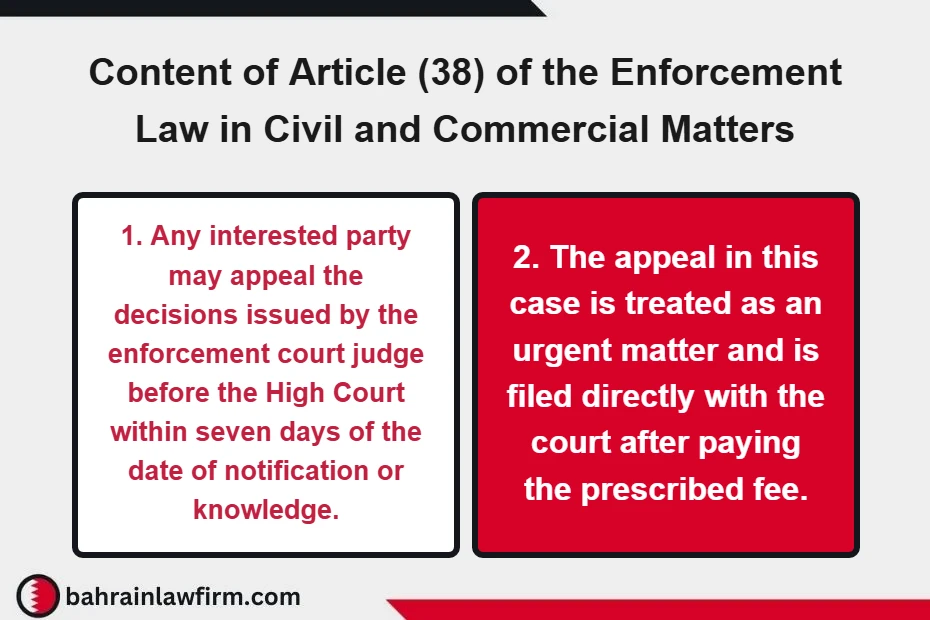
- The right to appeal an enforcement judge’s decision: Article (38) of the Law allows decisions issued by the enforcement court judge, as set out in Article (37), to be appealed before the High Court.
- Deadline for filing the appeal: The appeal must be filed within seven days of notifying the concerned party of the decision or from the date they learn of it.
- Nature of the appeal: The appeal is treated as an urgent matter and is filed directly with the court after paying the prescribed fee.
- How the appeal is heard: The High Court reviews the appeal on the papers, unless it decides it should be heard in another way.
- Finality of the High Court’s decision: The High Court’s decision on this matter is final.
- Grounds for objecting to attachment procedures: Article (37) of the same Law sets out the cases in which attachment procedures may be challenged before the enforcement court judge, including:
- Attachment of assets that are not owned by the debtor, wholly or partly.
- Rights over the attached assets that equal or exceed their value.
- Assets that may not be sold under the law.
- An attachment amount that exceeds what may be attached from the debtor’s assets.
- Deadline for objecting to attachment procedures: The objection must be filed within seven days of notice of the attachment or from the date the debtor learns of it.
- Effect of appealing the enforcement judge’s decision: Article (39) of the Law provides that, except for attachment procedures, appealing an enforcement court judge’s decision referred to in Article (38) suspends execution of the appealed decision until the High Court rules on it.
For legal advice from a lawyer in Bahrain, you can contact the Law Office of Abdulrahman Khalifa by pressing the WhatsApp button at the bottom of the screen.
If you already have a judgment in your favor that has not been enforced yet, you can present your file to a judgment enforcement lawyer to review the right steps for your case.
To see which court handles enforcement requests in the first place, read our guide to the jurisdiction of the enforcement court in Bahrain.
FAQs About Appealing an Enforcement Judge’s Decision in Bahrain
Can an enforcement decision be appealed in Bahrain?
Yes. Enforcement decisions can be appealed in line with Bahrain's Enforcement Law.
When can an enforcement judge's decision be appealed?
An enforcement judge's decision can be appealed where: (1) the attachment falls on property that does not belong to the debtor, wholly or partly; (2) there are further rights over the attached property that equal or exceed its value; (3) the property cannot be sold from a legal standpoint; (4) the attachment amount is larger than the amount that may be attached.
That brings us to the end of our article on appealing an enforcement judge’s decision in Bahrain. We covered the key information on how to appeal an enforcement decision and whether an enforcement judge’s decisions can be appealed at all. You may also be interested in the conditions and procedures of appealing a judgment in Bahrain.

A Bahraini lawyer and the founder of a legal consultancy firm established in February 2019. He holds a Higher Degree in Sharia and Law from Al-Azhar University. He has extensive experience in court representation and providing legal advice in criminal, personal status, civil, and commercial matters. He is known for delivering clear, practical, and effective legal advice aimed at protecting his clients’ rights and interests, and has achieved tangible results in notable cases, including commercial litigation and inheritance matters
