
Say an employer keeps a worker’s passport, or pays his salary months late. Many people call that human trafficking straight away. The law is more careful than that.
This guide explains human trafficking law in Bahrain in plain words. You will see how the crime is defined, what the penalties are, how a case is proven, and how it differs from a labour law violation.
Accused of human trafficking after a labour dispute or a held passport? Or a victim who needs protection? Don’t take chances with your freedom.
Table of Content
What Does Human Trafficking Law in Bahrain Say?
Bahrain deals with this crime in a separate law: Law No. (1) of 2008 on Combating Trafficking in Persons. It sets out the acts that count, the means used and the purpose of exploitation. It also covers penalties, the liability of companies and the protection of victims.
An unofficial English translation of the law is available as a Word file.
In simple terms, trafficking means recruiting, transporting, transferring, harbouring or receiving a person in order to exploit them. The law applies when this is done through force, threats, deception, abuse of a job or position, or any other unlawful means, direct or indirect.
Exploitation covers prostitution and other forms of sexual exploitation or abuse. It also covers forced labour or services, slavery or similar practices, servitude and the removal of organs.
The crime can happen inside Bahrain. It does not have to involve travel or crossing a border, as long as the acts and the other elements in the law are there.
What Are the Elements of Human Trafficking in Bahrain?
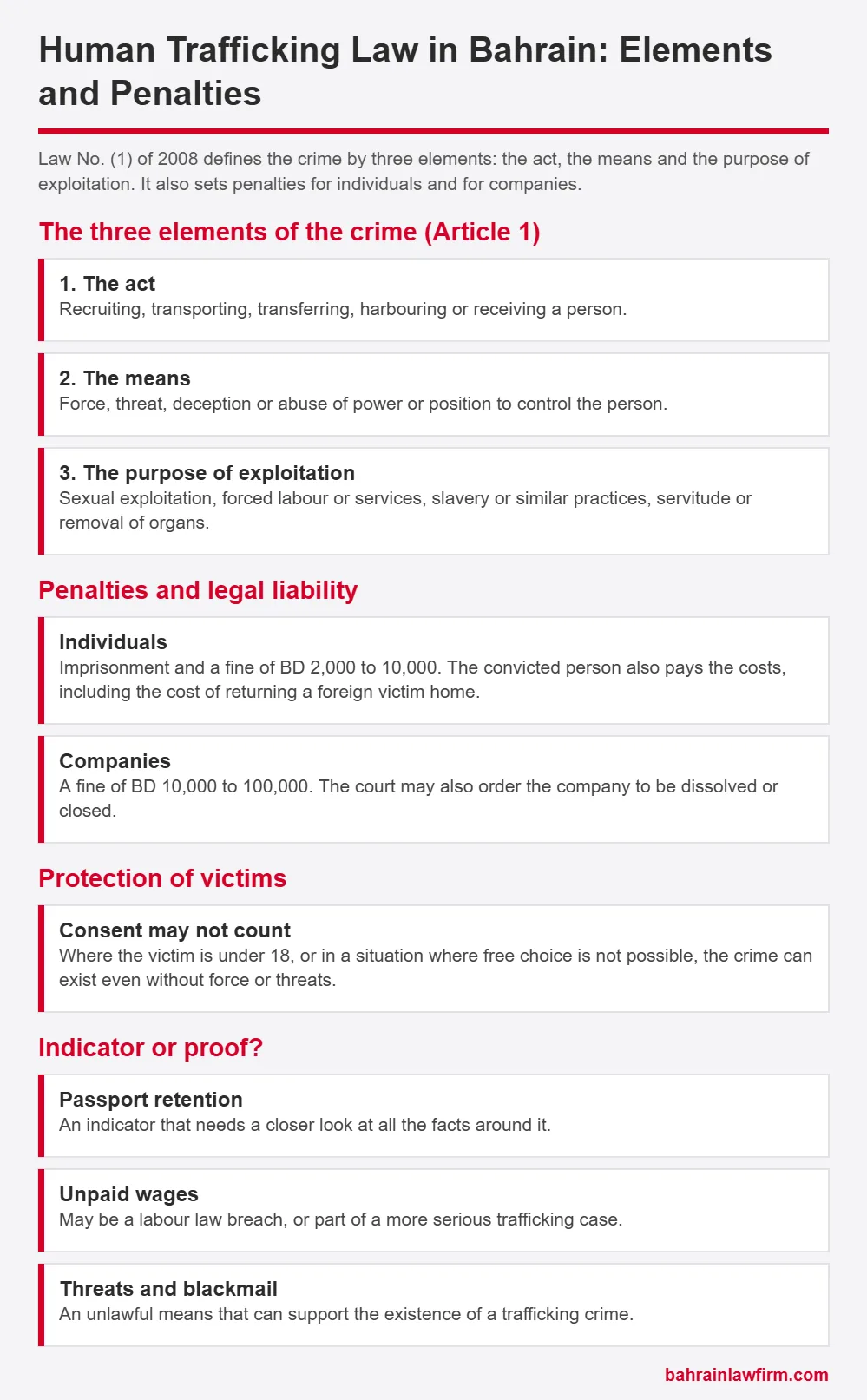
The usual case rests on three connected elements, taken from Article 1 of the law:
- The act: recruiting, transporting, transferring, harbouring or receiving a person.
- The means: force, threats, deception, abuse of power and other unlawful means.
- The purpose: aiming to exploit the person in one of the forms listed in the law.
The material side of the crime shows in the acts and means used against the victim. The mental side is the offender’s intention to do this, with the purpose of exploitation behind it.
That is why a case needs the full picture. A legal job, a transfer or a housing arrangement is not a crime in itself. It can become one when force, deception or similar means are used to exploit the person.
When Is Consent Not a Defence?
Human trafficking law in Bahrain has a special rule for anyone under 18. It also covers people in a situation where their consent or free choice can’t be taken at face value.
If such a person is recruited, transported, transferred, harboured or received in order to be exploited, trafficking can exist even without the usual means, such as force or deception. The law also presumes that the offender knew the real age of a victim who is under 18.
So the first question is not always “was there force?”. Often it starts with who the victim is and what situation they were in. Then the court looks at the act and the purpose of exploitation.
Is Holding a Passport or Not Paying Wages Human Trafficking?
Not automatically. The law does not turn every held passport or unpaid salary into a trafficking crime.
Still, the Labour Market Regulatory Authority (LMRA) lists several warning signs on its End Trafficking page. They include being unable to move freely, passport and ID retention, unpaid or partly paid wages, threats and blackmail, and violence or insults. They also include fake job promises, very long hours without leave, bad living conditions, no proper medical care, and being forced to pay a debt to the employer, or told that a debt exists.
A warning sign is not proof. Unpaid wages may be only a labour dispute, handled under worker rights in Bahrain labour law. It can become part of a more serious case if it comes with blocking the worker from leaving, or with threats to force them to keep working.
The same goes for a held passport. On its own it does not prove trafficking, so it is checked together with all the other facts. This is our reading of the legal definition together with the LMRA warning signs.
What Is the Penalty for Human Trafficking in Bahrain?
Under human trafficking law in Bahrain, Article 2 punishes the offender with imprisonment and a fine of BD 2,000 to BD 10,000. This applies without prejudice to any heavier penalty in the Penal Code or another law.
The law also lists aggravating circumstances in Article 4. They include a crime committed by a criminal group, a victim under 15, a woman or a person with special needs, and a crime with a cross-border character. They also include an offender who is a relative of the victim or has authority over them, and a victim left with an incurable disease because of the crime.
So the final penalty depends on the facts of the case, and not only on the basic fine.
Confiscation and Costs
If the person is convicted, they must pay the costs of the case. This includes the cost of sending a foreign victim back to their country.
The court must also order the confiscation of money, belongings and tools used, or meant to be used, in the crime, or gained from it.
Company Liability for Human Trafficking in Bahrain
Human trafficking law in Bahrain applies to companies too. Suppose the crime is committed in its name, for its account or for its benefit by a chairman, a board member, a manager, an employee or anyone acting in that role. Then the company faces a fine of BD 10,000 to BD 100,000.
That does not remove the responsibility of the individuals who did it. The court may also order the company to be dissolved or closed, fully or for a period, and the order extends to its branches.
The company is also liable, along with the individual, for the costs of the case, including the cost of returning a foreign victim home.
How Is Human Trafficking Proven in Bahrain?
Proof under human trafficking law in Bahrain starts with the elements in the law: the act, the means and the purpose of exploitation. In cases involving a protected victim, the focus is on the act and the purpose, because the means are not required in the same way.
The law does not give a closed list of evidence that must exist in every case. Evidence differs from one file to another. Its job is to show what really happened and whether the elements of the law are met.
Don’t rely on one fact alone. A held passport or unpaid pay may deserve investigation, but it can’t replace proof of the other elements.
Human Trafficking vs Labour Law Violation
Bahrain’s legal system treats a labour violation and a trafficking crime differently. This table sets out the main differences:
| Human trafficking | Labour-related violation |
|---|---|
| Needs the elements set out in the anti-trafficking law | May come from breaching one of the duties of the employment relationship |
| Linked to the purpose of exploiting the person | The purpose does not have to be exploitation in the trafficking sense |
| May involve force, threats or deception, depending on the victim’s situation | These means are not needed for the violation to exist |
| Carries the criminal penalties of the anti-trafficking law | Handled under the legal rules that fit its nature |
The LMRA warning signs help spot cases that need a closer look. But one sign does not turn a breach of Bahrain labour law into a trafficking case automatically.
What Happens When Human Trafficking Is Suspected?
It starts with a report, or with the case being discovered. The facts are then checked to see if they show signs of trafficking, and the next steps follow criminal procedure in Bahrain.
During the investigation and the trial, the law requires steps that protect the victim. We list them in the next section.
The LMRA also points people to the Expat Protection Centre in Northern Sehla, and to the National Human Trafficking Hotline, which its page lists as +973 995.
Rights of the Victim in a Human Trafficking Case
The law gives the victim several guarantees during the investigation and the trial. The victim is not just a source of information for the case.
These include:
- Being told their legal rights in a language they understand.
- Being able to explain their legal, physical, psychological and social situation as a victim.
- Seeing a specialist doctor if they ask, or if they need medical or psychological care.
- Being placed in a medical or psychological rehabilitation centre, or a care home, if their condition or age calls for it.
- Shelter, rehabilitation or housing with an approved body, if they need it.
- Security protection when the situation calls for it.
- For a foreign victim who needs to work, a request to the head of the committee set up under Article 7, to remove obstacles.
A lawyer who attends with the victim before the prosecution helps make sure these rights are respected.
Role of a Lawyer in Human Trafficking Cases
A criminal lawyer in Bahrain reviews the facts and documents to find the right legal description. He also checks whether the elements of the crime are really there.
The lawyer studies the evidence and the surrounding circumstances too. This matters most when signs of exploitation overlap with a labour dispute, a held document, threats or limits on the worker’s freedom.
At Attorney Abdulrahman Khalifa’s office, we help with criminal cases by:
- Studying the facts and checking whether the crime applies.
- Reviewing the documents and evidence behind the accusation or the report.
- Telling human trafficking apart from a labour violation or any other criminal charge.
- Following the investigation and the hearings before the competent authorities.
- Representing the accused or the victim, depending on the case.
- Preparing legal memos and defences based on the facts of the file.
Speaking to a lawyer in Bahrain early helps you understand your legal position and pick the right step. You can tap the WhatsApp button at the bottom of the screen at any time.
Frequently Asked Questions about Human Trafficking Law in Bahrain
Is not paying a salary human trafficking in Bahrain?
No, not automatically. The LMRA lists unpaid or partly paid wages among the warning signs of exploitation, but the other facts must be checked to see if the elements of trafficking are met. Otherwise it stays a violation linked to the employment relationship.
Is holding a worker's passport human trafficking?
A held passport does not prove the crime on its own, but the LMRA lists it as a warning sign. It matters more when it comes with limits on movement, threats or forcing the person to keep working in order to exploit them.
Must the victim be moved from one country to another?
No. The legal definition covers recruiting, transporting, transferring, harbouring and receiving a person. It does not make crossing an international border a separate condition, so the crime can happen inside Bahrain if its legal elements are met.
Does the victim's consent mean it is not human trafficking?
There is no single answer for all cases. The law gives special protection to people under 18 and to people in a situation where their consent or free choice can't be relied on. In those cases the crime can exist with the purpose of exploitation, without the means normally required.
What is the penalty for human trafficking in Bahrain?
The law sets imprisonment and a fine of BD 2,000 to BD 10,000, without prejudice to a heavier penalty under another law. It also provides for confiscation, and for making the offender pay the costs if convicted.
What is the penalty for a company involved in human trafficking?
The fine for a company is BD 10,000 to BD 100,000 when the crime is committed in its name, for its account or for its benefit in the cases set out in the law. The court may also order the company to be dissolved or closed, fully or for a period.
What is the difference between human trafficking and forced labour?
Forced labour or services is one of the forms of exploitation covered by the definition of human trafficking. But calling a case trafficking means applying the elements of the law to the facts: how the person was put to work, the means used and the purpose of exploitation, not just the working conditions.
Human trafficking law in Bahrain looks at the full facts, not at a single event such as late pay or a held passport. It sets the acts, the means and the purpose of exploitation, and adds penalties for individuals and companies.
It also protects victims during the investigation and the trial. If the case involves exploitation, threats or limits on freedom, a specialist lawyer can help you understand your position. You can also contact our office to ask for a criminal consultation.
Official References
- Law No. (1) of 2008 on Combating Trafficking in Persons, Articles 1 to 7: Legislation and Legal Opinion Commission (Arabic) and an unofficial English translation
- Labour Market Regulatory Authority: End Trafficking

A Bahraini lawyer and the founder of a legal consultancy firm established in February 2019. He holds a Higher Degree in Sharia and Law from Al-Azhar University. He has extensive experience in court representation and providing legal advice in criminal, personal status, civil, and commercial matters. He is known for delivering clear, practical, and effective legal advice aimed at protecting his clients’ rights and interests, and has achieved tangible results in notable cases, including commercial litigation and inheritance matters
