
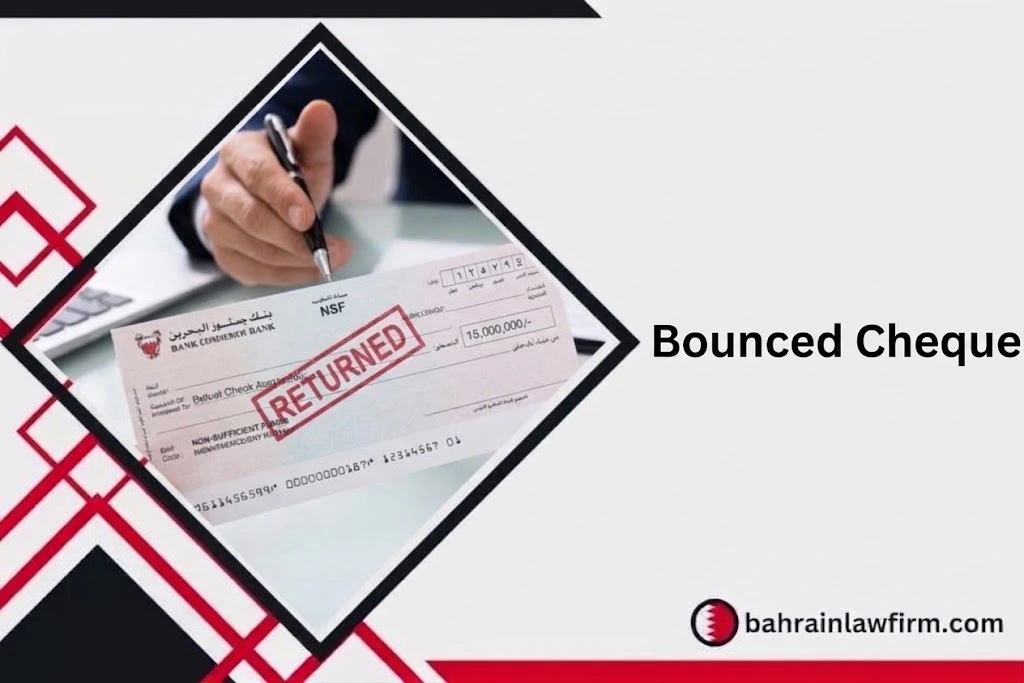
Have you received a cheque that the bank refused to pay, or are you facing legal action over a Bounced Cheque?
Prefer to learn more first? Keep reading to understand your legal position.
Table of Content
When Does a Bounced Cheque Become a Criminal Offence in Bahrain?
A Bounced Cheque is generally a cheque that the bank cannot honour because the account does not have sufficient funds available for payment. However, a returned cheque does not automatically prove that a criminal offence has occurred. The circumstances must be examined to determine whether the legal conditions for criminal liability are met.
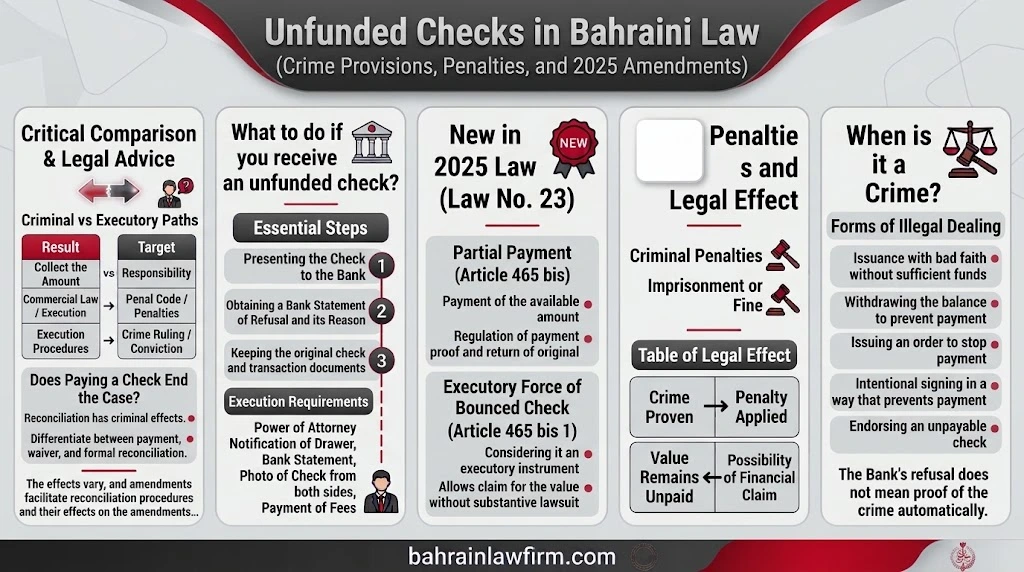
Article 393 of the Bahraini Penal Code addresses several unlawful acts involving cheques, including:
- Issuing a cheque in bad faith without sufficient funds available for payment.
- Withdrawing all or part of the account balance after issuing a cheque, leaving insufficient funds to cover it.
- Instructing the bank not to honour a cheque in circumstances that constitute a criminal offence.
- Deliberately writing or signing a cheque in a way that prevents the bank from paying it.
- Endorsing or transferring a cheque while knowing that it cannot be honoured.
A bank’s refusal to honour a cheque does not automatically establish a criminal offence. Criminal liability depends on whether the conduct falls within the acts prohibited by law and whether the required legal conditions are met, taking into account the reason for non-payment and the available evidence.
What Is the Penalty for a Bounced Cheque in Bahrain?
Article 393 of the Bahraini Penal Code provides criminal penalties for certain acts involving cheques issued without sufficient funds. Depending on the applicable legal provisions, the penalty may include imprisonment or a fine. The court determines the appropriate penalty based on the established facts and the law governing the offence.
It is important to distinguish criminal punishment from financial liability. Even when the cheque issuer faces a criminal penalty, the cheque holder may still have the right to claim the unpaid amount.
| Situation | Legal Consequence |
|---|---|
| The criminal offence is proven | The court may impose the penalty provided by law. |
| The cheque amount remains unpaid | The holder may pursue payment through the available legal procedures. |
| Criminal liability is not established | The underlying financial obligation does not necessarily come to an end. |
Investigations, trials, and the rights of the parties are governed by Bahrain’s Criminal Procedure Law. The applicable steps depend on the stage of the case. In situations involving criminal proceedings, criminal lawyers in Bahrain can explain how the legal process applies to the circumstances.
What Changed Under Bahrain’s Cheque Law in 2025?
Law No. 23 of 2025 introduced significant amendments to Bahrain’s Commercial Law. These changes address partial cheque payments and grant certain dishonoured cheques the legal status of enforceable instruments.
Partial Payment of a Cheque
The law introduced Article 465 bis, which requires the bank to pay the available balance when it is lower than the cheque amount, unless the holder refuses partial payment.
The provision also regulates how the bank records the amount paid, returns the original cheque to its holder, and issues a certificate confirming the partial payment. The practical application of these rules remains subject to the conditions, regulations, and implementation stages determined by the Central Bank of Bahrain.
Enforceability of a Dishonoured Cheque
Article 465 bis 1 gives a cheque marked as having insufficient funds, or one that has been partially paid, the status of an enforceable instrument under Bahrain’s Enforcement Law in Civil and Commercial Matters.
Bahraini law gives certain dishonoured cheques the status of enforceable instruments. This allows the holder to seek enforcement of the unpaid amount without first filing a separate substantive lawsuit to establish the debt, provided the legal and procedural requirements are satisfied.
These provisions are set out in Law No. 23 of 2025, published by Bahrain’s Legislation and Legal Opinion Commission.
What Should You Do If You Receive a Bounced Cheque?
If the bank refuses to honour a cheque, start by obtaining proof of why payment was rejected. Keep the relevant documents safe before taking further legal action, as they may be necessary to support your claim.
The main steps include:
- Present the cheque to the bank: Make sure you comply with the applicable legal time limits.
- Obtain proof of non-payment: Request an official bank statement or certificate explaining why the cheque was not honoured.
- Keep supporting documents: Retain the original cheque and any records relating to the underlying transaction.
- Confirm the outstanding amount: Account for any previous payments or amounts already paid through partial settlement.
- Choose the appropriate legal procedure: Check whether the cheque meets the requirements for enforcement or whether another legal action is needed.
Decision No. 6 of 2026 regulates the enforcement of cheques marked as having insufficient funds. It allows applications to be submitted through the enforcement case filing service on Bahrain’s National Portal.
The documents specified in the decision include:
- A power of attorney issued by the enforcement applicant, where applicable.
- A notice requesting payment from the cheque issuer.
- A bank certificate confirming insufficient funds.
- Copies of both sides of the original cheque.
- Proof that the required fees have been paid.
Failure to provide the required documents may result in the enforcement application being rejected under the relevant decision. The duration of the process may also vary depending on whether the documents are complete and whether any disputes or related applications arise. There is no single timeframe that applies to every case.
What Is the Difference Between a Criminal Complaint and Cheque Enforcement?
Criminal proceedings and enforcement proceedings serve different purposes. A criminal complaint concerns liability for an offence, while enforcement proceedings focus on recovering the amount owed under the cheque.
| Comparison | Criminal Proceedings | Enforcement Proceedings |
|---|---|---|
| Purpose | Determine criminal liability. | Recover the outstanding cheque amount. |
| Legal Basis | Bahraini Penal Code. | Commercial Law and Enforcement Law. |
| Possible Outcome | A decision or judgment on criminal responsibility. | Legal measures to recover the unpaid amount. |
Starting one type of proceeding does not automatically bring the other to an end. The legal position depends on the applicable provisions and the particular facts of the case.
Does Paying a Bounced Cheque Bring the Case to an End?
A settlement may affect criminal proceedings if the legal requirements are satisfied. However, paying the cheque amount, withdrawing a financial claim, and formally recording a settlement are not necessarily the same thing.
Any settlement agreement should clearly identify the amount paid, the outstanding balance, the payment terms, and the status of any ongoing legal proceedings. Do not assume that a verbal agreement alone will bring the case to an end.
The effect of a settlement on criminal proceedings depends on the law governing the offence and the stage reached in the case. For this reason, the parties should establish what has been agreed and how it affects their remaining legal rights.
Frequently Asked Questions About a Bounced Cheque
Does Every Bounced Cheque Lead to Imprisonment?
No, a Bounced Cheque does not automatically lead to imprisonment. The legal conditions for a criminal offence under the Bahraini Penal Code must be met. The evidence surrounding the issuance of the cheque and the reason for non-payment must also be examined. The court determines criminal liability and the appropriate penalty based on the applicable law and the circumstances of the case. Non-payment alone is not enough to establish every element of the offence.
Can the Cheque Holder Recover Part of the Cheque Amount?
Yes. Law No. 23 of 2025 introduced rules allowing partial payment when the available balance is lower than the cheque amount, unless the holder refuses it. The holder retains the right to claim the outstanding balance under the applicable law. The process must also follow the Central Bank of Bahrain's decisions on implementation stages, proof of partial payment, and required banking documents.
Can a Blank Cheque Be Issued as Security?
Article 491 of the Bahraini Commercial Law, as amended, prohibits obtaining blank cheques for use as credit or security instruments. Article 491 bis also introduces fines for specified violations. The law distinguishes between a blank cheque and one with completed details. The legal consequences depend on how the cheque was issued, its intended use, and the circumstances surrounding the transaction.
Can a Bounced Cheque Be Enforced Without Filing a Lawsuit?
Yes. Bahraini law allows certain dishonoured cheques to be enforced directly as enforceable instruments, provided they meet the legal requirements. Decision No. 6 of 2026 sets out the procedure for applying to enforce cheques marked as having insufficient funds, including the required documents. However, not every Bounced Cheque automatically qualifies for enforcement. The relevant legal and procedural conditions must first be satisfied.
Does a Settlement Lead to the Dismissal of a Bounced Cheque Case?
A settlement may affect criminal proceedings if the legal requirements are met. However, reaching an agreement to repay the amount or signing an acknowledgment of debt does not necessarily have the same legal effect as a formal settlement. The applicable legal provisions, the stage of the case, and how the settlement is documented must be reviewed before considering the criminal proceedings concluded.
The legal consequences of issuing a Bounced Cheque in Bahrain depend on why the bank refused payment, whether the elements of a criminal offence are established, and whether the financial obligation remains outstanding.
Recent legislative changes have also introduced rules on partial payment and the direct enforcement of certain dishonoured cheques. Reviewing the available documents is therefore an important step before choosing how to proceed.
Reviewing the cheque and the bank’s refusal notice with a lawyer in Bahrain can help clarify your legal position, identify ways to recover the outstanding amount, or address possible criminal liability. The appropriate approach will always depend on the facts of your case.
Official Legal Sources
Legal Disclaimer: This article provides general legal information for educational purposes only. It does not constitute legal advice for an individual case, and reading it does not create a lawyer-client relationship. Every case must be assessed according to its facts, supporting documents, and the laws in force when legal action is taken.

A Bahraini lawyer and the founder of a legal consultancy firm established in February 2019. He holds a Higher Degree in Sharia and Law from Al-Azhar University. He has extensive experience in court representation and providing legal advice in criminal, personal status, civil, and commercial matters. He is known for delivering clear, practical, and effective legal advice aimed at protecting his clients’ rights and interests, and has achieved tangible results in notable cases, including commercial litigation and inheritance matters
