
A litigant started his case on his own through the online portal. He uploaded the documents, paid the fees, and got a case number within minutes. He thought the hard part was over.
But at the first hearing, he found out the problem was not the platform. He had picked a request that did not fit the facts of the dispute, and he attached his documents without saying what each one proved. The case slowed down. He had to change course after paying fees and spending time he could have saved.
Bahrain has made it easier to reach Court and Legal Case Services through digital government channels. You can now start a number of procedures, follow your file, submit some requests, and check on your case online. But remember: the platform makes the procedure easier. It does not choose the right legal request for you, and it does not write your defence.
So press the WhatsApp button at the bottom of the screen to book a consultation with lawyer Abdulrahman Khalifa before you file a case or submit a memo that could affect your rights.
Do the complications of court procedures wear you out? Are you afraid of losing your case because of a legal mistake?
Table of Content
How to Use the Government Portal
This table shows you where to start in the guide to Court and Legal Case Services, without jumping between pages you don’t need:
| What do you want? | Start here | Watch out for |
|---|---|---|
| Check the status of an existing case | Case inquiry service | Read the latest decision, not just the hearing date |
| File a new claim | File a lawsuit service | Decide the court, the opponent, and your requests before you register |
| Reply to a memo | Submit case memos service | Tie your reply to the opponent’s defences and documents |
| Collect a judgment amount | Enforcement services | Make sure the judgment can be enforced |
| Follow a case at the Public Prosecution | Public Prosecution services | Use the Prosecution’s own service, not the civil case portal |
The national portal brings together Court and Legal Case Services: filing cases, checking on them, submitting requests and memos, and calculating fees, along with enforcement, notification, and payment services.
Court and Legal Case Services in Bahrain
Court and Legal Case Services let citizens and residents start a number of court transactions and follow them through official channels. The steps change with the type of case, the applicant’s capacity, and the stage of the dispute.
The main services include the following:
- Calculating the expected fees to file a case.
- Registering a lawsuit under the available categories.
- Checking on cases and the requests filed in them.
- Submitting memos, requests, and documents.
- Following some court expert procedures.
- Opening enforcement files and following them.
- Paying fees or amounts through the relevant service.
- Attending hearings remotely when the court allows it.
The Ministry of Justice also offers an e-court service and a service for judicial data tied to courts, enforcement, notarization, and minors’ affairs. The judicial authorities run these services through a system that joins judicial, administrative, and technical work. That’s why understanding court administration in Bahrain helps you see the difference between the role of the court circuit, the clerk’s office, the enforcement department, and the notarization department, instead of visiting an office that can’t handle your request.
Which court hears the dispute?
The right authority depends on the nature of the case and its level. Bahrain’s judicial structure includes the Court of Cassation, the High Court of Appeal, the High Court, the Lower Courts, and the enforcement courts, along with specialised circuits that hear certain types of disputes.
The guide to types of courts in Bahrain helps you tell the difference between the court where a case starts, the court that hears the appeal, and the authority that handles challenges or enforcement.
Some users search for the powers of the Court of Cassation in Bahrain under the name “Mahkamat al-Naqd”. But the official name used in the Kingdom is “Mahkamat al-Tamyiz”, not “Mahkamat al-Naqd”.
The Court of Cassation hears the challenges that fall within its jurisdiction under its law and the special provisions that apply to each type of case.
Booking a Court Appointment
The online system lets you book a court appointment to submit documents or attend hearings, which cuts crowding and waiting. You do it like this:
- Go to the official Ministry of Justice e-services page.
- Choose the court service you need and pick an available time.
- Confirm the booking and get a notice of the appointment by email or text message.
- Change or cancel the appointment when you need to.
Professional tip from lawyer Abdulrahman: Get your goal for the appointment ready before you go. Will you submit a document? Follow a notice? Or find out why a request stopped? A clear question helps you reach the right department.
Checking on Cases by Personal Number
Start by signing in to the official inquiry service. It gives you access to case and request data, based on the user’s capacity, permissions, and what the system allows to show.
Some researchers type “case inquiry Bahrain” to reach the service fast. But landing on the right page is not enough. You need to check the case number, the court name, the circuit, and the date of the last update.
Any party to a case can check using the personal number and follow the latest updates easily through Court and Legal Case Services. Here is how:
- Visit the judicial services portal on the official website.
- Enter the personal number and the case number or the unified case number.
- View all the case details, such as hearing dates, judgments, and next steps.
- Print a case status statement when needed.
Understand the decision before you move. Phrases like “for memos,” “for re-notification,” or “to file the expert’s report” tell you what you must do before the next date.
How Do I File a Case in the Sharia Court in Bahrain?
Start by naming the type of Sharia request exactly. A divorce case is different from khula, and a maintenance claim is different from custody, visitation, or proving paternity.
Family Law No. 19 of 2017 governs a main part of marriage, divorce, maintenance, custody, and other matters. The law was issued on July 20, 2017, and you should check its official consolidated version when you study each case.
Follow these steps in practice:
- Gather the marriage contract, birth certificates, and messages.
- Put the facts in order by date.
- State your final request in clear words.
- Write the statement of claim in a calm, direct tone.
- Tie each fact to evidence that supports it.
- Upload the file through the official service.
- Follow the notification, hearings, and new requests.
Family court services in Bahrain cover the tracks tied to maintenance, custody, divorce, khula, visitation, and proving marriage and paternity, depending on the type of request and the competent court.
Some cases need financial documents, while others need family records, reports, or witnesses. Not all family court cases in Bahrain move the same way.
Also read the guide to Sharia court rulings in Bahrain to understand the difference between issuing a judgment, being able to challenge it, and starting its enforcement. Reading the operative part of the judgment alone may not reveal all its reasons and effects.
Lawyer Abdulrahman advises you to explain to the court what happened, when it happened, and what proves it, and then ask for a clear result. This structure helps the court understand the file and cuts distractions.
What Are Judicial E-Government Services?
They are a set of digital services offered by the Ministry of Justice and Islamic Affairs, together with the Information & eGovernment Authority.
They aim to let people manage their legal and judicial affairs remotely, without going in person to courts or legal centres.
Some readers reach this topic by searching for “e-government courts in Bahraini law”. In practice, this means the digital channels that let you register some cases, follow them, submit requests, pay fees, and reach the judicial data available to the user.
Main e-government services linked to cases and courts
In line with global progress in public services, the government in Bahrain also offers a number of online Court and Legal Case Services, including:
1. Case inquiry
- Lets the user know the case status, the competent court, hearing dates, and party names.
- You do the inquiry by entering the case number or the personal number of the interested person.
- The service covers all types of cases: civil, criminal, Sharia, labour, and enforcement.
Review the file after every hearing, and write the latest decision in a separate list so you don’t forget a request or a date. If you face any difficulty, ask a lawyer in Bahrain from Abdulrahman Khalifa’s office.
2. Viewing hearings
- The system shows upcoming hearing dates and any changes to them.
- Data updates daily to avoid unjustified absence.
- You can print the hearing notice online and use it officially.
3. Viewing issued judgments
- After a judgment is issued, the litigant or his authorised lawyer can download an electronic copy of the operative part.
- Judgments show in detail, with the court name and the date of pronouncement.
- The service lets you file online appeals within the legal deadline.
4. Enforcement services
The guide to enforcing judgments in Bahrain explains how to move from the judgment to an enforcement file, which documents to prepare, and how to follow the requests you file in it.
The jurisdiction of the enforcement court in Bahrain relates to enforcing enforceable instruments and supervising the procedures and requests set by the enforcement law. It does not cover a review of the original dispute that the judgment decided. A judgment or judicial decision counts as an enforceable instrument once it meets the required conditions.
- For final judgments in enforcement courts, the claimant can submit an enforcement request online with the documents attached.
- The service covers civil enforcement and the enforcement of maintenance and custody judgments.
- The system lets you follow the enforcement until it closes.
5. Online payment of case fees
- You can pay case registration fees or appeal fees by payment card.
- The service is safe and approved, and it issues an instant official receipt.
6. Requesting an official extract
- Get official copies of the statement of claim, judgments, or documents archived in the judicial file.
- You request them online, and the court delivers them digitally or on paper.
Notarization in Bahrain works through services that differ from getting judgments or copies of case files. The notary’s work includes notarizing documents that the law or the contracting parties require to be notarized, certifying signatures, proving the date, and adding the enforcement formula to documents the law allows to be enforced.
7. Submitting memos and requests
The portal lets you submit memos and requests tied to a number of the cases covered by the service.
The types of legal memos in Bahrain differ by purpose. You may submit an explanatory memo, a reply memo, a comment on an expert’s report, an incidental request, or a closing memo. Choose the type that fits the current stage, instead of repeating the statement of claim.
Write the memo to answer one specific point. Start with your requests, then present the key facts, answer the other side’s defences, and attach the documents in a clear order.
Types of Cases by the Nature of the Dispute
Here is a clear breakdown of cases, with an example for each, in case you don’t know what type your case is:
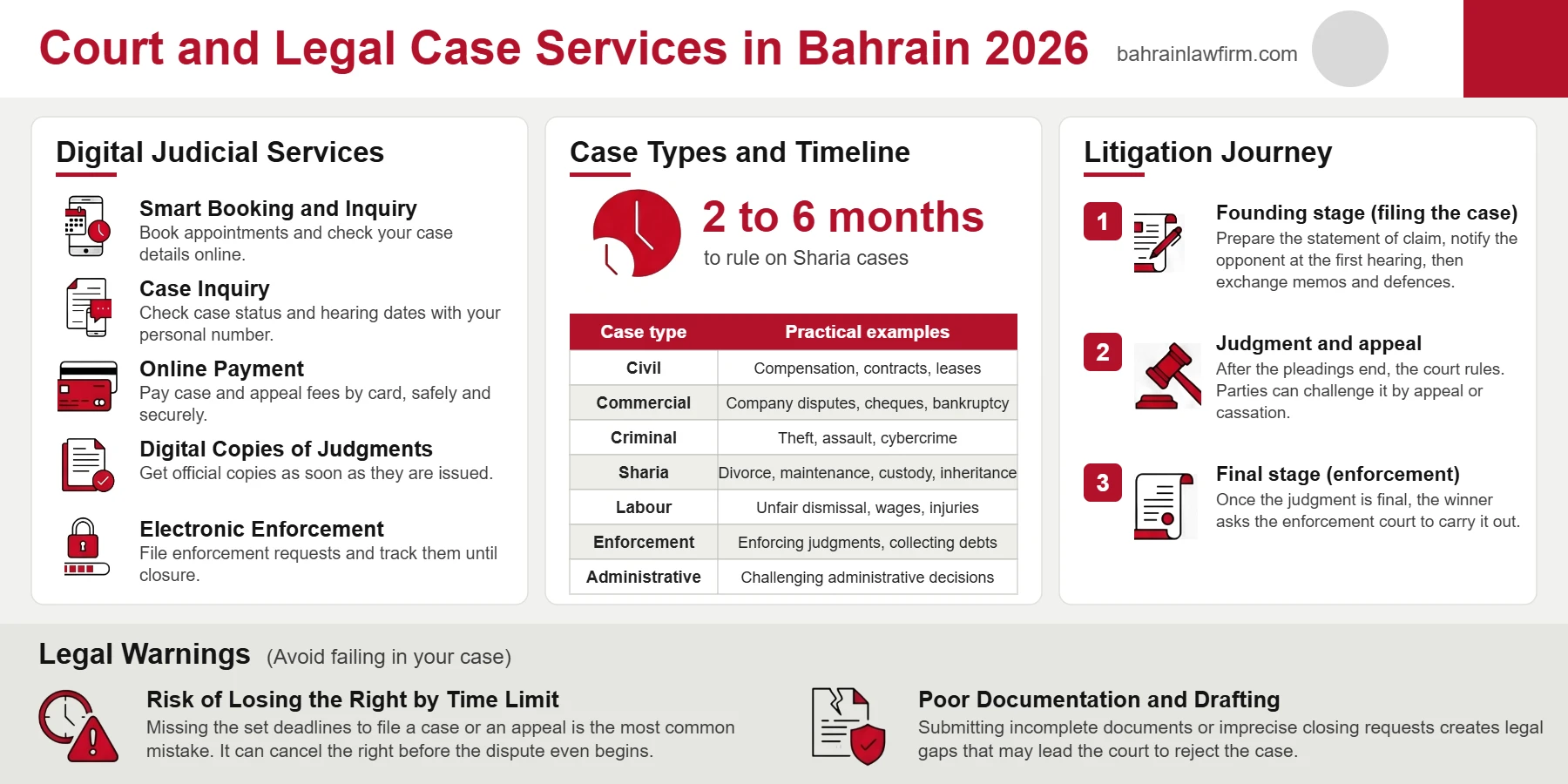
| Case type | Practical examples |
|---|---|
| Civil | Compensation, contracts, leases, ownership |
| Commercial | Company disputes, cheques, commercial contracts, bankruptcy |
| Criminal | Theft, assault, cybercrime, violations |
| Sharia | Divorce, maintenance, custody, inheritance |
| Labour | Unfair dismissal, wages, work injuries |
| Enforcement | Enforcing a judgment, collecting a debt, enforcing maintenance |
| Administrative | Challenging an administrative or job decision |
Consultation Services at Abdulrahman Khalifa’s Office
A consultation gives you the chance to test your position before you pay case fees or take a step that is hard to undo. It also helps you see whether court is the best choice, or whether negotiation or a settlement may bring a better result.
Depending on the topic, the consultation includes:
- Listening to the facts and putting them in order.
- Reviewing contracts and messages.
- Checking judgments and notices.
- Choosing the right court or authority.
- Showing the strong and weak points.
- Spotting missing documents.
- Explaining the next step and the expected risks.
If a client needs ongoing legal follow-up, a legal consultancy contract in Bahrain sets out the scope of service, the tasks, the way to communicate, the fees, and what falls inside and outside the assignment. Read the contract before you sign it, and ask for an explanation of any unclear clause.
How do I get a legal consultation?
Book your appointment with the WhatsApp button at the bottom of the screen. Then send a short summary of the facts and the types of documents you have.
Consultation fees start from 30 Bahraini dinars, depending on the scope of the topic and the time needed for review.
An early consultation may save you the fees of an unsuitable case, stop a weak request from being filed, or reveal a missing document before the other side benefits from its absence.
Book your consultation, which starts from 30 dinars, and get a clear assessment before you spend time and money on the wrong path.
Stages and Steps of Litigation in the Kingdom of Bahrain
A dispute goes through several stages, and not every case reaches all of them. Some files end in a settlement, while others, like criminal cases and penalties, need expertise, an appeal, or enforcement.
The Code of Civil and Commercial Procedure, issued by Decree-Law No. 12 of 1971, governs a basic part of how civil and commercial cases run. It took effect on September 1, 1971, and you should check the current consolidated text when you assess any procedure.
The procedures for filing a lawsuit in Bahrain follow this general path:
- Check jurisdiction, capacity, and interest.
- Prepare the statement of claim and its documents.
- Set your requests precisely.
- Register the file and pay the fees.
- Follow the notification of the opponent.
- Attend the first hearing, prepared.
- Submit memos and replies.
- Follow the expert report or investigation when needed.
- Review the full judgment after it is issued.
- Weigh an appeal or cassation within the deadline.
- Start enforcement when the judgment can be enforced.
Appeal deadlines differ by the type of judgment, how it was issued, how it was notified, and the text that governs the dispute. So don’t rely on a period you heard from someone with another case.
💡 Legal tip from lawyer Abdulrahman: Send the full judgment to your lawyer, with the earlier memos and documents. Sending only the page with the operative part isn’t enough.
Common Mistakes Litigants Make in Court
Most problems start with a small decision the litigant made in a hurry while using online Court and Legal Case Services. Its effect may show up after several hearings, when fixing it gets harder or costs more.
Avoid these mistakes:
- Filing the case before an authority that has no jurisdiction.
- Suing someone who does not have the right capacity.
- Asking for a result that does not fit the facts.
- Submitting a missing or unclear document.
- Using a claim form that does not suit your case.
- Uploading an uncertified translation when one is needed.
- Ignoring the decision of the previous hearing.
- Missing a procedural deadline.
- Hiding important information from your lawyer.
- Writing an emotional reply instead of answering the evidence.
- Starting enforcement before checking that the instrument is valid.
- Refusing a settlement before counting the time and cost.
💡 Legal tip from lawyer Abdulrahman: Review the file as if you were the other side. Look for the question the opponent will ask, the document they may use against you, and the point you haven’t explained.
Review your statement of claim with an accredited lawyer who specialises in the field before you file it, to cut the risk of delay or rejection. Use the WhatsApp button at the bottom of the screen to ask for the review.
Frequently Asked Questions About Court and Legal Case Services
Which types of cases can be filed online in Bahrain?
The cases that can be filed online are:
- Civil cases.
- Sharia cases.
- Labour cases.
- Commercial cases.
- Some simple criminal cases.
Can I change or cancel a court appointment after booking it?
Yes. You can sign in to your account on the Ministry of Justice portal and change or cancel the appointment easily.
How long does a Sharia case take to decide in Bahraini courts?
The time depends on the type of case and how complex it is, but it often takes roughly two to six months.
Can I check on a case without the case number?
Yes. You can use the case inquiry service with your personal number and some other identifying details on the official platform.
Can a dispute be settled without going to court?
Yes. Many legal disputes in Bahrain can be settled without going to court, through what are known as alternative dispute resolution methods. These are officially recognised legal ways used to avoid long court procedures. They include legal mediation, arbitration, and amicable settlement.
How do I follow my case after filing it?
You can follow your case after filing it through the service for checking civil and criminal cases on the national portal. It shows the details of a civil, Sharia, or criminal case, and the requests filed in it. You usually need to sign in with your electronic key.
Do online services replace a lawyer?
The service makes it easier to send and follow a request, but it does not assess the strength of your case, choose the defences, or review the risks for you.
The Ministry of Justice and the judicial authorities in Bahrain work to deliver Court and Legal Case Services with high quality and full transparency, which lets parties follow their legal rights with ease.
Don’t hesitate to use these official services and ask for a legal consultation when you need one, through the WhatsApp button at the bottom of the screen, so your case gets proper follow-up.

A Bahraini lawyer and the founder of a legal consultancy firm established in February 2019. He holds a Higher Degree in Sharia and Law from Al-Azhar University. He has extensive experience in court representation and providing legal advice in criminal, personal status, civil, and commercial matters. He is known for delivering clear, practical, and effective legal advice aimed at protecting his clients’ rights and interests, and has achieved tangible results in notable cases, including commercial litigation and inheritance matters
