

A Divorce Petition for Non-Muslims in Bahrain is a legal pleading filed by either the husband or the wife before the competent court to request a judicial decision ending the marital relationship.
The main questions are: What are the steps for filing a divorce case in Bahrain? What conditions apply to divorce cases involving non-Muslims? You will find these answers and other relevant legal information in this article.
Are you living in Bahrain and unsure which laws will apply to your separation as a non-Muslim? Court procedures and the interaction between different legal rules can make an already difficult situation more complicated.
Table of Content
Sample Divorce Petition for Non-Muslims in Bahrain
If you are looking for a reliable reference to help you prepare a divorce petition in Bahrain, the following sample shows the basic form such a petition may take:
To the Honorable Family Court in …..
Greetings,
Applicant: Mr. ………., Personal Number: …………….., Nationality: …………, Passport No.: ……………, Date of Issue: ……………, Religion: …………, Employed at: ……………….., Monthly Salary: …………, Place of Residence: ………..
Wife’s details: Name: …………., Personal Number: ……….., Nationality: …………….., Passport No.: ……………, Date of Issue: ……………, Employed at: ……………….., Monthly Salary: …………, Religion: ………….., Place of Residence in the City of: ………..
Subject of the Claim: Divorce
Facts of the Case:
I respectfully submit this application seeking separation from my above-mentioned wife, whom I married under Marriage Contract No. …… dated ….. . The request is based on the fact that continuing our marital life has become impossible.
Applicant: ………..
Signature: …………..
Date: …/…/…
It should be noted that a separation initiated by the husband is generally referred to as divorce. Where the wife seeks separation and the husband agrees in return for compensation, the separation may be treated as khul’ depending on the applicable legal framework.
Procedures for Filing a Divorce Case for Non-Muslims in Bahrain
If you are preparing to file a divorce case as a non-Muslim in Bahrain, the procedure generally involves the following steps:
- File the divorce claim before the competent court and attach the documents and evidence supporting the applicant’s case. Depending on the circumstances, this may include documents relating to failure to provide financial support, a physical or mental condition affecting one of the spouses, disappearance, or other facts relevant to the claim.
- The court sets a hearing to consider the parties’ statements, arguments, documents, and evidence. It then decides the case based on the applicable law and the facts established before it.
Requirements for a Divorce Case for Non-Muslims in Bahrain
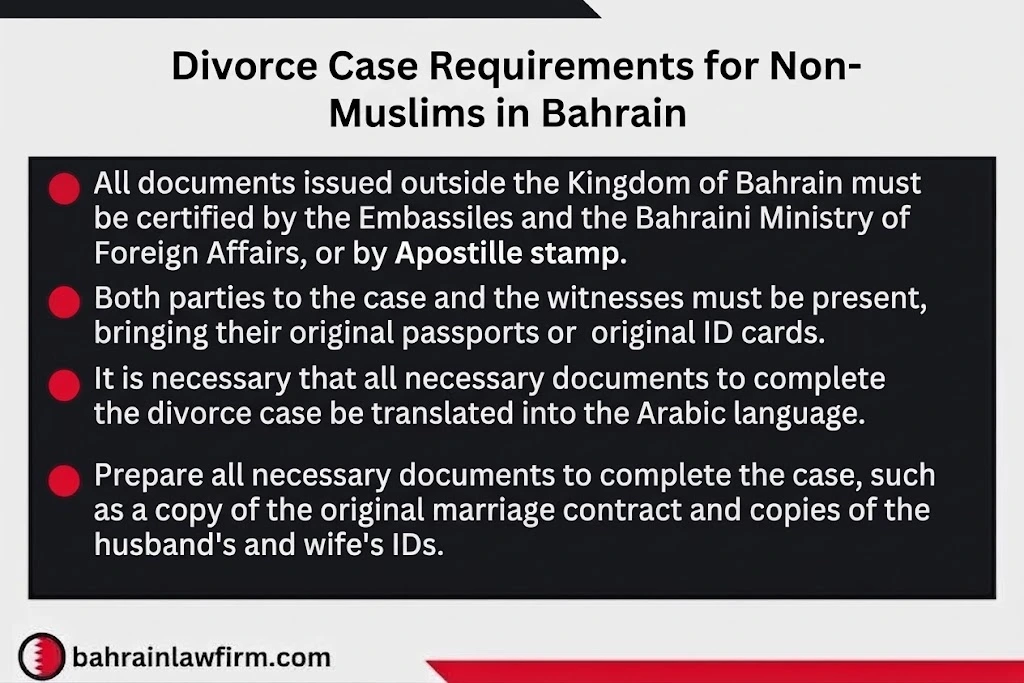
When filing a divorce case for non-Muslims, several documentary and procedural requirements may need to be met:
- Ensure that documents issued outside the Kingdom of Bahrain are properly authenticated through the relevant authorities, the Bahraini Ministry of Foreign Affairs, or by Apostille where applicable.
- Ensure that the parties and witnesses attend when their presence is required and bring their original passports or original identity cards.
- Translate documents required for the divorce case into Arabic where necessary for submission before the Bahraini courts.
- Prepare the documents required for the claim, including a copy of the original marriage certificate and copies of the husband’s and wife’s identification documents.
Judicial Precedents
In relation to a Divorce Petition for Non-Muslims in Bahrain, a Bahraini Court of Cassation judgment issued in 2023 addressed the jurisdiction of the High Civil Court, sitting as a court of first instance, over disputes concerning the personal status of non-Muslims.
The case arose from an appeal involving marital disputes between two members of the Bahá’í faith.
The husband was a Bahraini national, while the wife was a foreign national, and both were residing in the Kingdom of Bahrain. The wife alleged that her husband had mistreated her during the marriage.
According to the circumstances described in the case, the National Spiritual Assembly of the Bahá’ís had issued a decision concerning the couple’s separation. Disputes also arose over financial obligations involving the children, education expenses and other family-related payments.
The dispute further involved housing expenses connected with custody, transportation costs, spousal maintenance, and the wife’s passport.
The Court of Cassation subsequently issued its judgment in relation to the divorce and the financial obligations arising from the dispute.
Why Hire a Lawyer for Non-Muslim Divorce Cases in Bahrain?
Hiring an experienced Bahraini lawyer for a divorce case involving non-Muslims can help the parties understand the legal rules and procedural requirements that apply to their circumstances.
This becomes particularly relevant in Bahrain, where spouses may come from different national, religious, and cultural backgrounds. The legal framework applicable to non-Muslim family matters may differ from the rules governing Muslim personal status cases.
A lawyer can review the marriage documents, determine the appropriate court, identify the law that may govern the dispute, and advise the client on the documents and evidence required before filing the case.
Legal representation may also become important where the divorce involves related issues such as property, financial claims, child custody, maintenance, or other rights arising from the marital relationship.
A lawyer can also help reduce procedural errors that may delay the proceedings or require documents to be resubmitted.
Because determining the law applicable to a non-Muslim divorce may depend on the parties’ circumstances, nationality, documents, and the nature of the claims, the legal position should be reviewed based on the facts of each case.
Frequently Asked Questions
Questions frequently arise about a Divorce Petition for Non-Muslims in Bahrain. Below are answers to some of the most common questions.
How Do I File for Divorce in Bahrain?
You can file for divorce in Bahrain by submitting an application to the competent court and attaching all documents required to proceed with the case, together with any evidence supporting the applicant’s claims.
What Does a Divorce Petition for Non-Muslims in Bahrain Include?
A Divorce Petition for Non-Muslims in Bahrain generally includes the names of the husband and wife, passport numbers, contact details, residential and work addresses, and the grounds for divorce.
Can Non-Muslim Marriage Contracts Be Notarized in Bahrain?
Yes. Non-Muslim marriage contracts can be notarized in Bahrain by booking an appointment with the Central Notarization Directorate, attending in person, and completing the registration and notarization procedures at the office.
What Are the Grounds for Divorce in Bahrain?
Grounds for divorce in Bahrain may include the husband’s failure to provide maintenance, certain mental or physical conditions affecting either spouse, harm, or the husband’s absence or disappearance.
This article covered the main information relating to a Divorce Petition for Non-Muslims in Bahrain, including a sample divorce petition, procedural requirements, and documents that may be needed when filing the case.
It also explained the importance of reviewing the applicable law before starting proceedings and the role of an experienced divorce lawyer in Bahrain from Abdulrahman Khalifa Law Office.
For more information about other types of divorce claims, you can also read:
Divorce Claim for Harm in Bahrain.
Divorce Claim for Failure to Provide Maintenance in Bahrain.
Procedure and Form of a Divorce Claim for Irreconcilable Differences in Bahrain.
Divorce Claim Due to Infertility in Bahrain.
Divorce Claim Due to Husband’s Imprisonment in Bahrain: Form and Requirements.

A Bahraini lawyer and the founder of a legal consultancy firm established in February 2019. He holds a Higher Degree in Sharia and Law from Al-Azhar University. He has extensive experience in court representation and providing legal advice in criminal, personal status, civil, and commercial matters. He is known for delivering clear, practical, and effective legal advice aimed at protecting his clients’ rights and interests, and has achieved tangible results in notable cases, including commercial litigation and inheritance matters
