

Legal Review: This content was written and reviewed by the legal team at Abdulrahman Khalifa Law Firm.
Last Updated: August 31, 2026.
Category: Bahraini Corporate and Commercial Law.
Establishing a financial brokerage company in Bahrain requires a clear understanding of the distinction between commercially registering a company and obtaining the financial regulatory licence required to carry on the proposed activities.
A company that provides regulated financial services—such as arranging deals, dealing in financial instruments as agent or principal, managing financial instruments, or safeguarding client assets—cannot rely on a Commercial Registration alone. It must obtain the appropriate licence from the Central Bank of Bahrain (CBB), depending on the exact nature and scope of its activities.
Identifying the correct licensing category is therefore one of the first practical steps before preparing the constitutional documents, selecting the legal form, or arranging the required capital. An incorrect classification of the proposed activity may delay the application, result in substantial amendments being requested, or lead to rejection of the proposed regulatory route.
Concerned that the Central Bank of Bahrain may reject your application, or unsure which licensing category applies to your proposed financial brokerage business? Regulatory complexity should not become an obstacle to your investment.
Request an Initial Review of Your Financial Licensing Route
Alternatively, continue reading to understand the licensing process and applicable capital requirements in greater detail.
Table of Content
What Does Establishing a Financial Brokerage Company in Bahrain Mean?
Establishing a financial brokerage company in Bahrain means creating a legal entity through which brokerage and investment-related services involving financial instruments may be carried on. Depending on the scope of the business and the licence granted, these activities may include arranging deals, dealing as agent or principal, managing financial instruments, or providing custody or safeguarding services.
Where such services fall within the activities regulated by the Central Bank of Bahrain, the applicable regulatory framework must be observed. It is also important not to confuse financial brokerage with insurance brokerage or ordinary commercial activities, as each is subject to a different legal and regulatory regime.
| Type | General Description | Legal Consideration |
|---|---|---|
| Financial or investment brokerage | Activities relating to financial and investment instruments | Generally subject to the CBB rules governing investment firms or capital markets activities |
| Insurance brokerage | Activities involving insurance products and insurers | Subject to a separate regulatory framework under the CBB insurance rules |
| Ordinary commercial company | Provides products or services that are not regulated financial services | Commercial Registration and standard commercial licences may be sufficient, depending on the activity |
The practical process therefore begins by defining the proposed brokerage activity precisely. Will the company receive client money? Will it execute transactions or merely arrange them? Will it deal in financial instruments as agent or principal? Will it hold or safeguard client assets? Each answer may affect the licensing category, minimum capital, governance arrangements, and compliance obligations.
If the proposed business is primarily limited to advising on financial instruments without engaging in brokerage, arranging transactions, or executing deals, you may also refer to our guide on establishing a financial consultancy company in Bahrain to understand the requirements applicable to that type of business.
Does a Financial Brokerage Business Require a Central Bank of Bahrain Licence?
Yes. Where the proposed activity constitutes a regulated financial service, prior authorisation from the Central Bank of Bahrain is required before the company may carry on the activity or advertise the service to clients.
The Central Bank of Bahrain and Financial Institutions Law No. 64 of 2006 establishes the principal statutory framework governing the CBB’s supervision of financial institutions and regulated financial services in the Kingdom of Bahrain.
Why Is a Commercial Registration Not Enough?
A Commercial Registration establishes the company as a legal entity, but it does not automatically authorise that entity to provide regulated financial services. A licence issued by the Central Bank of Bahrain is a separate regulatory authorisation that determines which financial services the company may provide, the restrictions applicable to those services, and whether the company may receive, hold, or otherwise deal with client money or assets.
Licensing Categories for Financial Brokerage and Investment Firms
Selecting the correct licensing category is one of the most important legal decisions when establishing a financial brokerage company in Bahrain. The applicable category determines the activities the company may carry on, the activities that remain prohibited, the minimum capital requirement, and the level of regulatory supervision and compliance expected from the firm.
Category 1 Investment Firm
A Category 1 Investment Firm licence permits a broad range of regulated investment services. Depending on the licence scope, these may include dealing in financial instruments as principal or agent, arranging deals, managing financial instruments, safeguarding financial instruments, providing investment advice, arranging or advising on credit, and operating a collective investment undertaking.
Category 2 Investment Firm
A Category 2 Investment Firm may conduct a range of regulated investment services but does not include dealing in financial instruments as principal for the firm’s own account. This category may therefore be appropriate for certain brokerage models that do not involve proprietary dealing, subject also to whether the company intends to safeguard or hold client assets.
Category 3 Investment Firm
Category 3 generally covers a narrower range of activities. It may include arranging deals in financial instruments, advising on financial instruments, and arranging or advising on credit, subject to important restrictions concerning client assets, commissions, and the nature of the firm’s relationship with its clients.
Minimum Capital Required to Establish a Financial Brokerage Company
There is no single minimum capital figure that applies to every financial brokerage company in Bahrain. The required capital depends on the CBB licensing category, the services to be provided, and the regulatory risks associated with the proposed business model.
Under the Central Bank of Bahrain Rulebook provisions governing minimum capital for investment firms, the following thresholds apply:
| Investment Firm Category | Minimum Capital |
|---|---|
| Category 1 Investment Firm | BHD 1,000,000 |
| Category 2 Investment Firm | BHD 1,000,000 where the firm provides safeguarding or custody of financial instruments, and BHD 250,000 in other cases |
| Category 3 Investment Firm | BHD 125,000 |
Important legal note: Capital requirements applicable to insurance brokerage or any other financial activity should not be applied to a financial or investment brokerage company. The correct licensing category must first be identified, after which the corresponding capital and regulatory requirements can be determined.
Requirements for Establishing a Financial Brokerage Company in Bahrain
Before submitting a licensing application, the principal requirements should be organised in a clear and verifiable manner so that they can be properly assessed by the regulator.
1. Define the Proposed Activity Precisely
The business model should clearly explain the nature of the brokerage activities to be carried out, such as arranging deals, dealing as agent or principal, managing financial instruments, or safeguarding client assets. This classification forms the basis for determining the relevant licensing category and the regulatory requirements that follow from it.
2. Select the Appropriate Legal Form
The company must adopt a legal form that is compatible with the proposed activity and the applicable licensing requirements. Depending on the category and regulatory framework, the applicant may operate through a Bahraini incorporated company, a branch of a foreign company, or another permitted legal structure.
The provisions of the Bahrain Commercial Companies Law, promulgated by Legislative Decree No. 21 of 2001, together with its subsequent amendments, must also be taken into account.
3. Prepare the Ownership and Controller Structure
The Central Bank of Bahrain considers the identity of shareholders and controllers, the source of funds, and the overall ownership structure. Relevant controllers must be disclosed, particularly persons holding a material percentage of the company’s share capital or voting rights.
4. Appoint Qualified Management
Capital alone is not sufficient. The company must have appropriately qualified management, a suitable board or governance structure, and responsible officers with relevant financial-sector experience and a clear understanding of compliance obligations and the protection of client assets.
5. Establish Compliance and Internal Control Policies
The company should maintain clear policies covering risk management, anti-money laundering and counter-terrorist financing, customer due diligence, conflicts of interest, record keeping, protection of client assets, complaints handling, cybersecurity, and regulatory reporting.
Documents Required Before Submitting the Licence Application
Preparing the documentation at an early stage can reduce repeated requests for additional information and make the regulatory review more efficient. The principal documents typically include the following:
| Document Category | Examples |
|---|---|
| Corporate documents | Draft memorandum of association, articles of association, proposed trade name, legal form, and registered office address |
| Business documentation | Business plan, description of financial services, revenue model, target markets, and client acceptance policies |
| Shareholder documentation | Identification documents, ownership structure, evidence of source of funds, and controller information |
| Management documentation | CVs, qualifications, professional experience, and personal questionnaires for senior officials |
| Compliance documentation | AML/CFT, KYC, CDD, risk management, conflict-of-interest, and client-asset protection policies |
| Financial documentation | Capital arrangements, financial projections, projected budget, and proposed audit and accounting arrangements |
The licensing file should be internally consistent. Inconsistencies between the business plan, constitutional documents, proposed licence scope, and shareholder structure are among the issues most likely to delay the regulator’s review.
Planning to launch a financial brokerage business in Bahrain and concerned that selecting the wrong licence category could tie up your capital and delay operations?
If you prefer to review the regulatory requirements first, continue reading for a detailed overview of the licensing process.
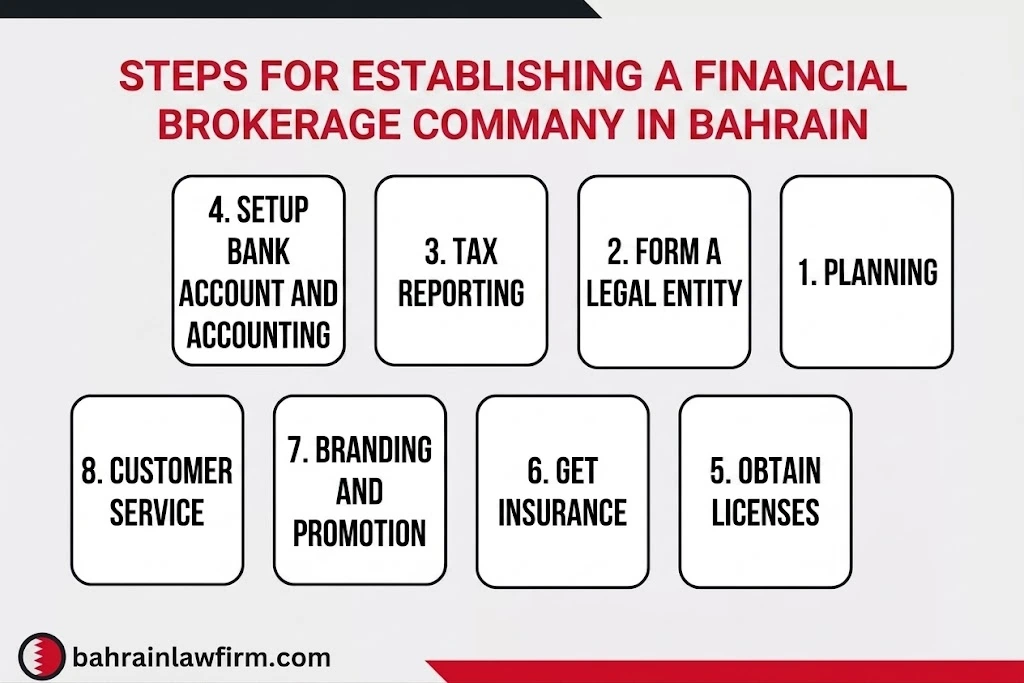
Steps for Establishing a Financial Brokerage Company in Bahrain
Step One: Assess the Business Activity and Licensing Category
The process begins with an analysis of the proposed business model. What brokerage services will the company provide? Who are the target clients? Will the company arrange transactions or deal in financial instruments? Will it receive client funds or hold client assets? The answers to these questions will determine the most appropriate licensing category.
For this reason, obtaining legal advice for companies and entrepreneurs before registering the company or preparing its constitutional documents can help ensure that the structure is aligned with the intended regulatory route.
Step Two: Structure the Commercial Registration Consistently with the Licence
Once the regulatory route has been identified, the legal entity and Commercial Registration should be structured so that they are consistent with the proposed CBB licence. A common mistake is to register an overly broad or inaccurate activity and attempt to amend it only at a later stage.
For further information on incorporation procedures, see our guide to company formation in Bahrain.
Step Three: Prepare the Licensing File
The application file typically includes the relevant CBB forms, business plan, shareholder information, details of directors and senior management, internal policies, capital information, and governance documentation. The file should present a coherent regulatory case rather than a collection of unrelated documents.
At this stage, the assistance of a commercial lawyer in Bahrain can be valuable in reviewing contracts, corporate documents, and the proposed legal structure before the application is submitted.
Step Four: Submit the Application to the Central Bank of Bahrain
Once the application forms and supporting documents have been completed, the application is submitted to the Central Bank of Bahrain. The CBB may request further information, conduct meetings, or assess the suitability of management and shareholders before deciding whether to approve or reject the application.
Step Five: In-Principle Approval and Completion of Outstanding Requirements
The CBB may issue an in-principle approval or preliminary confirmation. However, this does not constitute the final licence and does not permit the applicant to commence regulated activities. The company should therefore not represent itself as licensed, advertise itself as an authorised financial institution, or begin providing regulated services before the final licence is issued.
Step Six: Final Licence and Ongoing Regulatory Compliance
Once the licence has been granted, the company enters the ongoing compliance phase. This includes regulatory reporting, annual fees, audit obligations, updating internal policies, notifying the CBB of material changes, and continuously maintaining the applicable capital and governance requirements.
Licensing Fees and Expected Timeframe
The CBB charges a fixed application fee of BHD 100, which is non-refundable, in addition to annual licensing fees once the application has been approved. Annual fees vary according to the investment firm category.
According to the Central Bank of Bahrain’s licensing and registration information, Category 1 Investment Firms are subject to a variable annual fee ranging from a minimum of BHD 6,000 to a maximum of BHD 24,000. Category 2 Investment Firms are subject to a minimum of BHD 4,000 and a maximum of BHD 12,000, while Category 3 Investment Firms are subject to annual fees ranging from BHD 1,000 to BHD 4,000.
As for the expected timeframe, the CBB indicates that the complete licensing process generally takes approximately three to six months. The actual review period depends on the completeness of the information provided, the complexity of the proposed activity, and the applicant’s responsiveness to regulatory requests.
Common Mistakes That May Delay or Weaken a Licensing Application
Before submitting an application, particular attention should be given to the following issues, as they may lead to delays or repeated requests for additional information:
- Selecting a licensing category that does not correspond to the proposed business model.
- Confusing financial brokerage with insurance brokerage.
- Relying on the Commercial Registration without first examining CBB licensing requirements.
- Submitting a generic business plan that does not adequately explain the revenue model and regulatory risks.
- Failing to explain the source of funds and ownership structure.
- Appointing management whose experience or suitability for the proposed activity is not adequately demonstrated.
- Failing to establish appropriate compliance, client-asset protection, and anti-money laundering policies.
- Relying on minimum capital figures that relate to a different licensing category.
How Can a Bahrain Company Formation Lawyer Assist You?
In a regulatory matter of this nature, a lawyer’s role extends well beyond drafting the memorandum of association. Lawyer Abdulrahman Khalifa and his team assist in developing a coherent legal and regulatory file designed to reduce the risk of avoidable delays or deficiencies in the licensing process.
1. Assessing the Activity Before Incorporation
The proposed business activity is analysed against the relevant licensing categories to determine whether the company requires an investment business licence, a capital-markets-related authorisation, or another regulatory route.
2. Drafting the Constitutional Documents
The memorandum of association, articles of association, and related corporate documents should be drafted in a manner that is consistent with the proposed financial activity, shareholders’ rights, management powers, and applicable regulatory obligations.
Where agreements are required between shareholders, financiers, or service providers, they may also be reviewed as part of our contract lawyer services in Bahrain to help clarify obligations and reduce contractual risk.
3. Reviewing the Shareholder and Management Structure
A lawyer can assist in organising the documentation relating to shareholders, controllers, directors, and senior management, and in identifying potential legal or regulatory issues before they arise during the regulator’s review.
If the proposed company includes shareholders or investors from outside Bahrain, it may also be appropriate to review the requirements for establishing a company in Bahrain for foreign investors before finalising the corporate structure.
4. Preparing the Compliance File
This may include coordinating policies and procedures relating to anti-money laundering, Know Your Customer requirements, conflicts of interest, client-asset protection, and record keeping, in cooperation with specialist advisers where required.
5. Following Up on the Licensing Process
A lawyer may assist with regulatory correspondence and requests for further information while helping ensure that the licensing file remains organised and aligned with the requirements of the competent authority.
If financial claims or disputes later arise in connection with contracts, obligations, or client money, you may also refer to our financial disputes lawyer services in Bahrain for an assessment of the legal position.
If your proposed business involves investors, foreign shareholders, client funds, or regulated investment services, send a summary of the proposed activity through the WhatsApp button at the bottom of the screen to request an initial review of the licensing route by a lawyer in Bahrain.
Frequently Asked Questions
The following are among the frequently asked questions concerning the process of establishing a financial brokerage company in Bahrain:
ما هي شركة الوساطة المالية؟
شركة الوساطة المالية هي شركة تمارس خدمات مرتبطة بالتعامل في الأسواق والأدوات المالية وفق نطاق الترخيص الممنوح لها. وقد يشمل دورها ترتيب الصفقات أو تنفيذ معاملات البيع والشراء للعملاء أو التعامل في الأدوات المالية بصفة وكيل أو أصيل، بحسب فئة الترخيص وطبيعة النشاط.
ما هي الإجراءات القانونية اللازمة لتسجيل شركة وساطة مالية في البحرين؟
تتمثل الإجراءات القانونية اللازمة لتسجيل شركة وساطة مالية في البحرين بما يلي:
1. تقديم طلب التسجيل.
2. الحصول على التصريح الأمني بالنسبة للمستثمرين الأجانب.
3. إرفاق مسودة عقد التأسيس والنظام الأساسي وشهادة إيداع رأس المال وشهادة تقييم من خبير مختص أو من مدقق حسابات.
4. إرفاق أي متطلبات أو مستندات أخرى من الجهات المرخصة للأنشطة التي تحتاج لموافقة من الجهات الرسمية.
Establishing a financial brokerage company in Bahrain is not simply a commercial registration exercise. It is a legal and regulatory process that begins with correctly defining the proposed activity and licensing category, followed by the preparation of the Commercial Registration, constitutional documents, business plan, and compliance policies in a manner consistent with Central Bank of Bahrain requirements.
One of the most important points to understand is that capital requirements, licensing fees, and supporting documentation vary according to the applicable licence category. A Commercial Registration does not replace CBB authorisation where the proposed activity constitutes a regulated financial service. Structuring the application correctly from the outset can therefore provide investors with greater regulatory clarity and reduce the likelihood of delays or repeated requests for additional information.
To begin reviewing your application for establishing a financial brokerage company in Bahrain, send a summary of the proposed activities, the names or details of the shareholders, and the intended financial services through the WhatsApp button at the bottom of the screen so that the appropriate legal and regulatory route can be assessed before the application is submitted.
Request a consultation with a company lawyer in Bahrain before proceeding with the incorporation of your business.

A Bahraini lawyer and the founder of a legal consultancy firm established in February 2019. He holds a Higher Degree in Sharia and Law from Al-Azhar University. He has extensive experience in court representation and providing legal advice in criminal, personal status, civil, and commercial matters. He is known for delivering clear, practical, and effective legal advice aimed at protecting his clients’ rights and interests, and has achieved tangible results in notable cases, including commercial litigation and inheritance matters
