
One tenant fell behind on the rent for a while (we’ve left out the details of the case). His landlord figured he could end the lease and take the property back right away. In another case, the tenant was the one who got hurt. A serious defect made the property hard to use, and he assumed that just walking out would end his obligations automatically.
Both stories show why it pays to understand Lease Agreement Termination in Bahrain the right way. A dispute between a landlord and a tenant doesn’t always mean the lease is over. Termination, eviction, and the end of a lease term are linked legal ideas, but they aren’t the same thing.
Law No. (27) of 2014 Promulgating the Real Estate Rental Law, along with its amendments, mainly governs these matters. It sets out the duties of landlords and tenants, the cases where eviction can be requested, and some cases where a tenant can ask to terminate the lease.
Are you in a rental dispute and need to know where your contract stands before you take any step? You can ask us to review your lease and the facts.
Table of Content
Lease Agreement Termination in Bahrain Under the Rental Law
People who mention the Bahraini rental law usually mean the Real Estate Rental Law issued by Law No. (27) of 2014.
The law was issued on July 24, 2014, and published in Official Gazette No. 3168 (supplement) on August 7, 2014. Article 6 of the promulgating law says it takes effect six months after publication. The official legislation database of the Legislation and Legal Opinion Commission shows two amendments: Law No. (10) of 2020 and Law No. (13) of 2020. The second is the latest amendment listed officially as of this article’s review in August 2026.
Under Article (2), the law applies to properties, or parts of them, meant for housing or for commercial, industrial, professional, craft, and other uses. It makes specific exceptions, such as some industrial facilities, farmland, some hotel and tourism properties, and furnished apartments rented for no more than a month.
Article (3) adds that lease contracts covered by the law must be made in writing and registered. Even so, the fact of renting can still be proven by the evidence methods the text allows.
What’s the Difference Between Lease Agreement Termination in Bahrain, Eviction, and the End of a Lease?
Lease Agreement Termination in Bahrain means ending the contractual relationship because a legal or contractual basis justifies it.
Eviction is different. It means requiring whoever occupies the rented property to hand it back when one of the cases listed by law applies.
Both differ from a lease that simply ends when its term runs out. The law deals with that separately in Article (34).
So someone searching for a sample eviction notice because the term has ended faces a different issue from someone asking whether a breach by one side lets them request termination before the lease ends.
Reasons for Lease Agreement Termination in Bahrain by the Landlord
Article (38) of the Real Estate Rental Law is the main text. It lists the cases where a landlord can ask to evict the tenant.
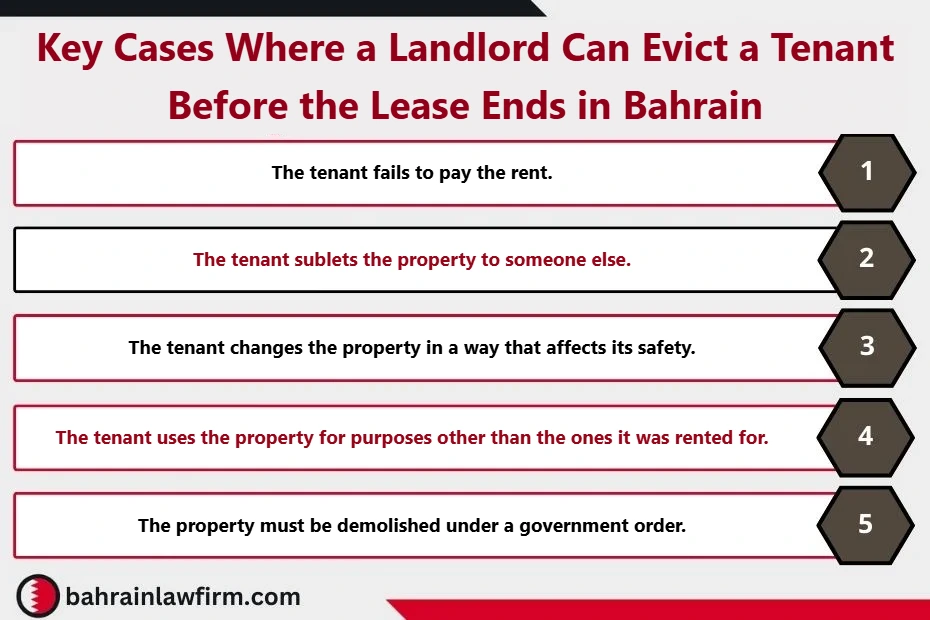
The cases the legislator listed include the following:
- Not paying the rent: The tenant fails to pay the rent on time for two months in a row, under the details and limits the article sets.
- Assigning or subletting without permission: The tenant hands over the lease, sublets all or part of the property, or vacates it to someone else without the owner’s written permission.
- Overcrowding the home: More people live in the residential unit than is customary.
- Misuse of the property: The tenant uses the property, or lets others use it, in a way that goes against the contract terms or its intended purpose, breaks public order or morals, or harms the landlord’s financial interest.
- A property about to collapse or under a demolition order: The residents’ safety is at risk, or the competent municipality issues a final administrative demolition decision.
- Demolishing and rebuilding the property: This applies in the cases and conditions the law sets, including at least twenty-five years passing since the property was built, or a change in the area’s classification.
- The landlord needs to live there: The landlord needs the property to live in, or a first-degree relative does, as long as the legal conditions are met. These include a written agreement and notice before eviction within the period the law sets.
- The owner is returning to live there: In the case the law sets, the owner doesn’t live in the area or is traveling outside the Kingdom and wants to live in the property on return, with the legal conditions met.
- Using the property for another purpose or harming its safety: The tenant uses the property for a purpose other than the one it was rented for, or makes a change that harms its structural safety.
- Abandoning the rented property: The tenant leaves the property for at least one year.
These cases come from Article (38) of the Real Estate Rental Law No. (27) of 2014, subject to later amendments.
Keep in mind that having a legal reason for eviction isn’t the same as carrying out the eviction yourself. When a dispute exists, the High Civil Court now handles the disputes that arise from applying the rental law, after Law No. (13) of 2020 amended Article (5).
Subletting disputes have their own rules and details, so there’s no need to repeat them in this general guide.
Sample Lease Termination Letter From the Landlord
Below is a sample letter for Lease Agreement Termination in Bahrain from the landlord’s side.
First Party: Mr. [Landlord’s name] (referred to as the Landlord).
Second Party: Mr. [Tenant’s name] (referred to as the Tenant).
Subject:
Based on the mutual agreement between both parties, the Landlord, Mr. [Landlord’s name], and the Tenant, Mr. [Tenant’s name], confirm the termination of the lease contract signed between them on [date of the original contract] for the property located at [property address], effective from [agreed termination date].
The Tenant confirms that he has fully vacated the rental unit. From the agreed termination date, he no longer has any right to use or benefit from the property.
Termination terms:
- Settling financial dues:
The Second Party (the Tenant) confirms that he has settled all remaining financial dues, whether overdue rent or any other expenses related to the contract. The First Party (the Landlord) confirms that the Tenant owes nothing further after the termination. - Release of liability:
Both parties confirm that this termination is friendly and free of any legal or financial dispute between them. Neither party may claim any rights or obligations from the other after the termination date. - Additional obligations:
The Second Party must return any keys or property-related items to the Landlord when signing this termination. The Landlord keeps the right to rent the property to any new tenant starting from __/__/____ [termination date].
Signatures of both parties:
Landlord: ________
Tenant: ________
Conditions and Cases for Lease Termination by the Tenant
The Real Estate Rental Law doesn’t limit the right to ask for termination to the landlord. In several articles, it gives the tenant legal options. These can go as far as requesting termination when the landlord breaks their duties, or when the benefit of renting drops in a way the law recognizes.
This general guide shouldn’t get mixed up with specialized articles on tenant letters or individual cases. So the table below sums up the main legal bases without going into the steps or templates for each case:
| Legal case | Article | Right linked to termination |
|---|---|---|
| The property can’t be used as intended, has a major shortage, or poses a serious health risk | 9 | The tenant may ask for termination under the conditions in the text |
| The landlord refuses necessary maintenance after being notified | 10 | The tenant may ask for termination, in addition to the other options the law provides |
| Loss of use because of necessary maintenance | 11 | Termination can be requested in the case the text sets |
| Reduced benefit because of an extension or added floor built by the landlord | 12 | The tenant may ask for termination or a rent reduction |
| Serious shortage in the property’s area | 13 | Termination can be requested if the shortage reaches the level the law sets |
| Serious destruction or damage | 18 | The contract may end automatically, or the tenant may have the right to ask for termination, depending on the case |
| The tenant is deprived of a right or advantage tied to using the property | 20 | The penalty may reach termination if the right or advantage can’t be restored |
Article (9), for example, deals with handing over a property that can’t deliver its intended benefit, or that has a major shortage or a serious health risk. Article (10) covers the landlord’s duty to do necessary maintenance, and the tenant’s rights if the landlord refuses after the legal notice.
Article (18) covers destruction and damage. If the property is completely destroyed before handover for an outside reason, the contract ends automatically. If the destruction or damage is so serious that the tenant wouldn’t have signed had it existed at signing, the tenant may ask for termination.
The goal here is to give a general legal map of the tenant’s rights.
Can You Terminate a Lease Unilaterally?
Wanting out on your own isn’t always enough to end an existing lease.
That doesn’t mean every termination needs the other side’s approval, though. Some events give one party a legal right to ask for termination or eviction. For the landlord, that could be one of the Article (38) cases. For the tenant, it could be one of the cases where the law gives the right to ask for termination.
So you need to tell two situations apart:
- One party simply wants to end the contract, with no legal or contractual reason.
- One party relies on a valid legal reason or contract clause that gives them the right to ask to end the lease, terminate it, or evict.
In the second situation, the legal effect depends on the nature of the reason, how the contract is worded, the rules of the Real Estate Rental Law, and whether a dispute needs a court ruling.
That’s why no single rule says “unilateral termination is always allowed” or “never allowed” without knowing the basis for ending the lease. Talk to an experienced rental lawyer who can give accurate legal advice for your case.
When Is It an Expiry and Not a Termination?
Many people mix up Lease Agreement Termination in Bahrain before the end of the term with a contract that simply ends on its stated date.
Article (34/a) says a lease ends when its fixed term ends. It also covers what happens if the tenant keeps using the property after the term while the landlord knows and doesn’t object.
Article (34/b) sets a special rule on the tenant notifying the landlord when they want to leave at the end of the lease.
Still, the eviction steps at the end of a term, and the wording of the letter or notice, are outside this guide. They make up a separate topic of their own.
How Does the Law Decide Whether Termination Is Possible?
You can understand most disputes over Lease Agreement Termination in Bahrain by asking three main legal questions.
- Does the event fall under a legal text that gives the right to terminate or evict? The basis might be Article (38) for the landlord, or one of the articles on the landlord’s duties and the tenant’s rights.
- Does the contract include a clause about the event in dispute? The contract sets the purpose of the rental, the rent, the term, and each party’s duties, while respecting the legal rules that parties can’t agree to break.
- Is the dispute really about termination, or about the lease ending, eviction, or the breach of a specific obligation? Getting the description right stops you from using the wrong procedure or template for your case.
That’s why the main page shouldn’t turn into a pile of templates and notices. Each document has its own legal job, depending on the cause of the dispute.
Which Court Handles Lease Termination Disputes?
Law No. (13) of 2020 made an important change to the rental dispute system.
It replaced the text of Article (5) of the Real Estate Rental Law, so it now reads:
The High Civil Court has jurisdiction over disputes arising from applying the provisions of the Real Estate Rental Law.
The legislator also replaced the word “Committee” with “Court” throughout the law and canceled the chapter on the Rental Disputes Committee. The amending law was issued on June 11, 2020. It states that it takes effect thirty days after publication, and the Legislation and Legal Opinion Commission recorded its publication date as June 18, 2020.
This change matters when you read old versions of the law, or older legal articles that still mention the “Rental Disputes Committee.”
Don’t forget to contact the office of a lawyer in Bahrain. Call Lawyer Abdulrahman Khalifa to ask for real legal advice.
Frequently Asked Questions About Lease Agreement Termination in Bahrain
Here are some related questions people often ask:
Can you terminate a lease agreement unilaterally in Bahrain?
As a general rule, no. A lease is a binding contract, so neither the landlord nor the tenant can end it alone before it expires. The exception is a legal reason or excuse that gives one party the right to ask for termination or eviction, such as the cases listed in the Real Estate Rental Law.
What are the common reasons for Lease Agreement Termination in Bahrain by the landlord?
The most common reasons are not paying the rent, sub-letting the property without the landlord's approval, and using it for an illegal purpose. Article (38) of the Real Estate Rental Law lists the main cases.
What are the legal effects of terminating a lease?
The parties go back to the position they were in before the contract, and compensation may be due where the law allows it. In ongoing contracts like leases, termination usually has no retroactive effect.
Can the landlord evict a tenant for not paying the rent?
Yes. Article (38/1) allows the landlord to ask for eviction when the tenant doesn't pay the rent for two consecutive months.
What can a tenant do if the landlord refuses to do necessary maintenance?
Article (10) covers this case. If the landlord refuses to do the necessary maintenance after being notified, the tenant can ask for termination, in addition to the other options the law provides, under the conditions in the text.
Can a tenant sub-let the property without the landlord's approval?
As a general rule, no. Article (29) deals with sub-letting, and sub-letting without the landlord's approval can be a reason for eviction under Article (38).
What if the property becomes unfit for use?
If the property can't be used as intended, has a major shortage, or poses a serious health risk, the tenant may ask for termination under the conditions in Article (9).
That wraps up our article on Lease Agreement Termination in Bahrain. We covered the main conditions and reasons that let a landlord terminate a lease, and the legal effects that follow.
Lease Agreement Termination in Bahrain depends on finding a clear legal or contractual reason, and on telling termination, eviction, and the end of the lease term apart.
Article (38) sets out the main cases where a landlord can ask to evict the tenant.
Dear reader, also check out: Conditions for Contract Termination in Bahrain.
Official References
- Real Estate Rental Law (Law No. 27 of 2014) and its amendments: Legislation and Legal Opinion Commission

A Bahraini lawyer and the founder of a legal consultancy firm established in February 2019. He holds a Higher Degree in Sharia and Law from Al-Azhar University. He has extensive experience in court representation and providing legal advice in criminal, personal status, civil, and commercial matters. He is known for delivering clear, practical, and effective legal advice aimed at protecting his clients’ rights and interests, and has achieved tangible results in notable cases, including commercial litigation and inheritance matters
