
Divorce cases are among the most common personal status cases brought before Bahraini courts. In this article, we will explain the main types of divorce, with particular focus on Minor Irrevocable Divorce in Bahrain, and outline the legal rules governing each type under Bahrain’s Family Law.
We will also provide further information about the meaning of minor irrevocable divorce and the situations in which it applies. Read on for the details.
Has the waiting period ended, making the separation a minor irrevocable divorce, and are you unsure about what to do next? Avoid making uncertain decisions during this sensitive transitional stage.
Table of Content
Definition of Minor Irrevocable Divorce in Bahrain
With divorce cases becoming increasingly common before Bahraini courts, along with related matters involving alimony, child custody, visitation, and other family disputes, many citizens and residents want to understand the different types of divorce and the applicable divorce procedures. Below, we provide a clear explanation of the types of divorce recognized in Bahrain and the main differences between them.
Divorce before Bahraini courts is generally divided into two main types. The first is revocable divorce, under which the husband may take his wife back as long as she remains within the legally prescribed waiting period, or iddah. Therefore, this type of divorce does not fully terminate the marriage contract until the waiting period set by Bahraini law has ended.
The second type is irrevocable divorce, which terminates the marriage once it takes effect. Under Sunni jurisprudence, irrevocable divorce is further divided into two forms: minor irrevocable divorce and major irrevocable divorce.
Minor irrevocable divorce may be defined as a divorce in which the divorced woman may only remarry her former husband through a new marriage contract and a new dowry.
Cases of Minor Irrevocable Divorce
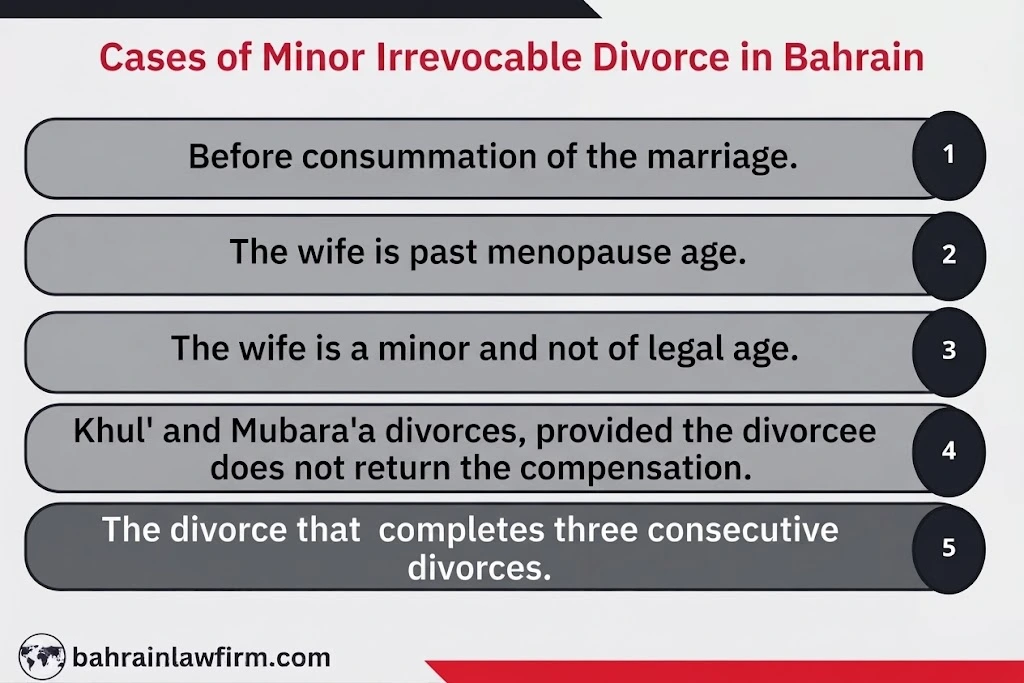
As explained above, minor irrevocable divorce means that a husband cannot take his divorced wife back unless they enter into a new marriage contract and agree on a new dowry. This form of divorce may occur in several situations, including:
- Divorce before consummation of the marriage.
- When the wife has reached menopause.
- When the wife is young and has not yet reached puberty.
- Khul’ divorce and mubara’ah divorce, unless the divorced woman withdraws the compensation she offered.
- A divorce that completes three consecutive divorces.
Legal Rules Governing Minor Irrevocable Divorce
A husband may take back a wife divorced through a minor irrevocable divorce while she is still within the waiting period. Reconciliation may be established through any of the following:
- A verbal statement.
- A written statement.
- An act accompanied by the intention of reconciliation.
Under Article 94 of Bahrain’s Family Law, reconciliation may be proven through the testimony of two reliable witnesses or through confirmation by the wife. It must also be officially documented before the court, and the wife’s permission is not required for such documentation.
If the spouses disagree over whether reconciliation took place after the legally prescribed waiting period has expired, the statement of the party denying that reconciliation occurred will generally be accepted where no evidence proves otherwise.
Article 122 of Bahrain’s Family Law also provides that if the husband dies while the woman is observing the waiting period following an irrevocable divorce, she completes her existing waiting period and is not required to observe a separate waiting period for widowhood.
Under Sunni jurisprudence, however, an exception applies where the divorce took place during the husband’s terminal illness with the intention of depriving the wife of her inheritance rights. In such a case, the woman observes whichever of the two waiting periods ends later.
FAQ Abut Minor Irrevocable Divorce in Bahrain
If you are looking for a clearer understanding of minor irrevocable divorce and the legal rules surrounding it in Bahrain, the following section answers some of the most common questions.
What Is the Difference Between Revocable Divorce and Minor Irrevocable Divorce?
Under the Bahraini Family Law, the difference between these types of divorce is that a minor irrevocable divorce prevents the husband from taking his divorced wife back unless a new marriage contract and a new dowry are concluded. By contrast, in a revocable divorce, the husband may take his wife back as long as she is still within the waiting period (iddah).
How Long Is the Waiting Period for Minor Irrevocable Divorce?
Under the Bahraini Family Law, a divorced woman whose marriage was not consummated is not required to observe a waiting period. If she is pregnant, her waiting period ends upon giving birth. For a non-pregnant woman, the duration of the waiting period varies according to the Sunni and Jaafari schools of jurisprudence. However, the waiting period may not exceed one year.
What Is the Divorce Waiting Period?
The divorce waiting period, known as iddah, is the period during which a divorced or widowed woman must refrain from marrying following separation or the death of her husband. This is provided for under Article 117 of the Bahraini Family Law.
This brings us to the end of our article on Minor Irrevocable Divorce in Bahrain. We explained the meaning of minor irrevocable divorce, the legal rules that apply to it, and the different types of divorce recognized before Bahraini courts.
We also addressed some of the most common questions surrounding this type of divorce. Because the legal consequences may vary depending on the circumstances of each case, it is advisable to consult an experienced lawyer who can explain the applicable divorce rules and provide legal advice based on the details of your case.
Get more legal information about: Divorce Lawyer in Bahrain.

A Bahraini lawyer and the founder of a legal consultancy firm established in February 2019. He holds a Higher Degree in Sharia and Law from Al-Azhar University. He has extensive experience in court representation and providing legal advice in criminal, personal status, civil, and commercial matters. He is known for delivering clear, practical, and effective legal advice aimed at protecting his clients’ rights and interests, and has achieved tangible results in notable cases, including commercial litigation and inheritance matters
