
Inheritance matters require special care because they can have a major impact on family relationships. Many people look for clear information about the Siblings’ share of their sister’s inheritance to make sure the estate is distributed in line with Islamic Sharia and Bahraini law.
In this article, we explain how inheritance shares are distributed, provide practical examples for different situations, and show how a lawyer experienced in inheritance matters can help protect your rights.
Are you facing a dispute or uncertainty about the Siblings’ share of their sister’s inheritance after her death, and has the division of the estate become a source of conflict among the heirs?
Contact an inheritance and estate division lawyer now
You can read the article first to understand the Siblings’ share of their sister’s inheritance under Bahraini law before contacting us.
Table of Content
Siblings’ share of their sister’s inheritance under Bahraini law
Bahraini inheritance rules, which are based on Islamic Sharia principles, determine how an estate is divided according to the heirs’ degree of relationship to the deceased and their legal order of entitlement. The share of a brother and sister may change depending on whether other heirs exist, such as children, a husband, or parents.
Cases involving the Siblings’ share of their sister’s inheritance
Below are some of the most common situations:
1. If the deceased sister has no children or parents:
The inheritance may be distributed between the brother and sister according to the rule that a male receives the share of two females.
For example, if the estate is worth BHD 30,000, the brother would receive BHD 20,000, while the sister would receive BHD 10,000.
2. If there are other heirs, such as a husband or children:
Other heirs receive their prescribed shares first in accordance with the applicable Sharia rules. For example, a husband may receive half of the estate where the deceased leaves no children. The remaining estate is then distributed among the other eligible heirs.
For example, if the estate is worth BHD 50,000 and the husband is entitled to half, he would receive BHD 25,000. The remaining BHD 25,000 may then be distributed between the brother and sister, with two-thirds going to the brother and one-third to the sister, where that distribution applies.
3. If there are half-siblings:
Half-siblings, whether related through the father or the mother, may have inheritance rights depending on the family structure and the presence of other heirs.
For example, where the eligible heirs are paternal half-siblings, distribution may follow the rule that the male receives twice the share of the female, subject to the applicable inheritance rules.
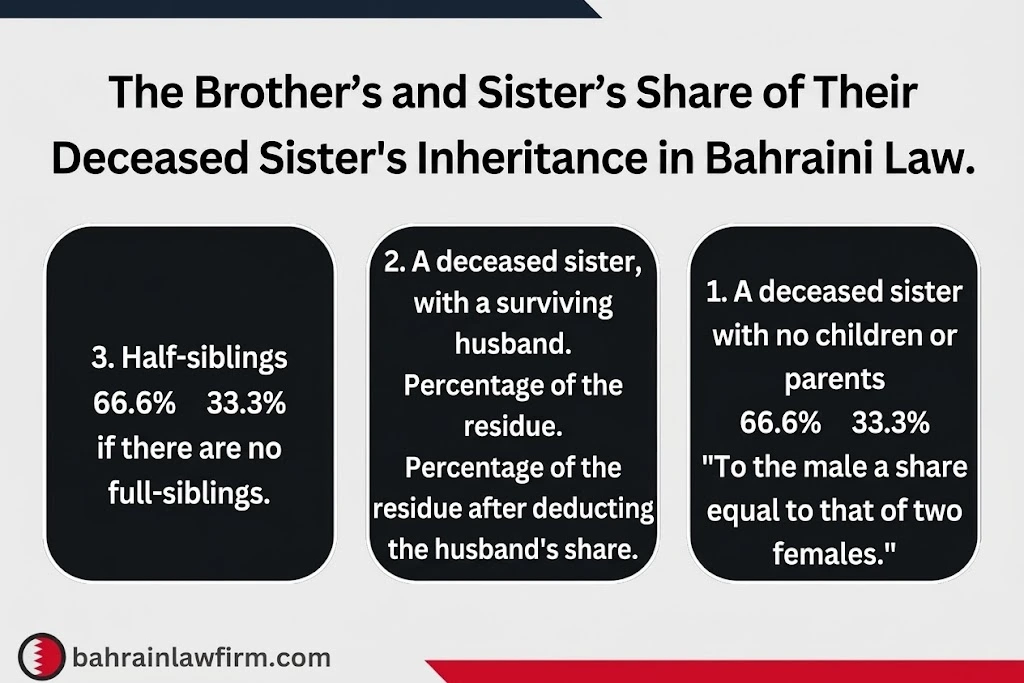
Table showing the brother’s and sister’s inheritance shares
- Deceased sister with no children or parents: brother 66.6%, sister 33.3% — based on the rule that the male receives the share of two females.
- Deceased sister with a surviving husband: the brother and sister receive their applicable shares from the remainder after the husband’s share is deducted.
- Half-siblings: the brother may receive 66.6% and the sister 33.3% in cases where the two-to-one rule applies and no closer heirs prevent or alter their entitlement.
The importance of a lawyer in inheritance cases
Seeking help from a lawyer experienced in inheritance matters can help reduce disputes and ensure that the estate is divided according to the applicable legal and Sharia rules. A lawyer may assist with the following:
Understanding and applying the law
A lawyer reviews the family structure and estate details to help ensure that the inheritance is distributed according to Bahraini law and the relevant principles of Islamic Sharia.
Resolving disputes between heirs
If disagreements arise over the division of the estate, a lawyer can work toward a legal settlement or take the dispute to court when necessary.
Preparing legal documents
A lawyer can prepare inheritance-related documents, establish the heirs’ legal status, and document estate assets so that each heir can receive their share through the proper legal procedures.
Managing large or complex estates
If the estate includes real estate, bank accounts, or several types of assets, a lawyer can help organize the division and reduce legal and procedural complications.
For specialized legal advice, contact us through the WhatsApp button at the bottom of the screen.
Frequently Asked Questions
How is inheritance distributed if the deceased sister has children?
If the deceased sister has children, they generally receive the largest share of the estate. If any portion remains after their shares are allocated, it may be distributed between the brother and sister according to the applicable inheritance rules.
What if there are full siblings and half-siblings?
If both full siblings and half-siblings exist, full siblings generally take priority. Half-siblings may inherit only when there are no full siblings, depending on the circumstances and the applicable inheritance rules.
How do I start the inheritance declaration procedures?
The inheritance declaration process begins by submitting an application to the Sharia Court. It is generally advisable to appoint a lawyer to help facilitate the procedures.
Determining the Siblings’ share of their sister’s inheritance can be a detailed legal matter because the final distribution depends on Islamic Sharia principles, Bahraini law, and the presence of other heirs.
To protect your rights and reduce the risk of inheritance disputes, consider seeking advice from a lawyer who handles inheritance cases. Contact our office through the WhatsApp button at the bottom of the screen for comprehensive legal advice and reliable assistance.
Read also: Children’s share of their mother’s inheritance under Bahraini law.

A Bahraini lawyer and the founder of a legal consultancy firm established in February 2019. He holds a Higher Degree in Sharia and Law from Al-Azhar University. He has extensive experience in court representation and providing legal advice in criminal, personal status, civil, and commercial matters. He is known for delivering clear, practical, and effective legal advice aimed at protecting his clients’ rights and interests, and has achieved tangible results in notable cases, including commercial litigation and inheritance matters
