
Legal Review: This content was written and reviewed by the legal team at Abdulrahman Khalifa Law Firm.
Last Updated: 2026/09/02.
Category: Bahraini Corporate Law.
Company Liquidation in Bahrain is a legal process used when a company decides to bring its existence to an end for various reasons, such as the expiry of its agreed term, accumulated losses, or a decision made by the partners.
This process often raises common questions. How is a company liquidated in Bahrain? What are the main reasons for liquidating a company? And how can the liquidation process be completed correctly?
Company liquidation procedures in Bahrain involve a series of connected legal steps. They begin with issuing the liquidation decision and appointing a liquidator, then move to settling financial liabilities and preparing the required reports. The process ends with completing the Commercial Registration procedures and officially striking the company off the register.
Understanding the steps involved in liquidation therefore helps business owners complete the process properly and reduce the risk of unresolved legal liabilities later.
Are you considering liquidating your company in Bahrain and concerned that the process may be delayed or leave unresolved legal or financial obligations?
Speak With a Company Liquidation Lawyer NowIf you would first like to understand the steps involved, continue reading at your own pace.
Table of Content
How Does Company Liquidation in Bahrain Work?
Company liquidation is a legal process that brings a company’s existence to an end by settling its obligations and distributing its assets after creditors’ rights have been satisfied.
The process may begin with a decision by the partners or through a court judgment. It then follows a number of legal steps designed to maintain transparency and protect the rights of everyone involved.
- Appointing the liquidator: Start the liquidation process by appointing one or more liquidators, either through a decision made by the partners or under a court judgment. The liquidator becomes responsible for carrying out the liquidation procedures under the supervision of the partners or the court.
- Registering the liquidator’s name and the liquidation method: Record the liquidator’s name and the method of liquidation in the Commercial Registration, whether the method was agreed between the partners or determined by a court judgment. The relevant details must then be published in a local daily newspaper before they become effective against third parties.
- Publication and public notice: Treat the appointment of the liquidator and the form of liquidation as effective against third parties only from the day following publication. This is an important step because it provides public notice that the liquidation process has officially started.
- Preparing a financial inventory: Prepare a full inventory of the company’s assets, rights and financial obligations after the liquidator is appointed. The liquidator works with the board of directors or company managers to prepare a detailed statement and balance sheet signed by the relevant parties.
- Notifying creditors: Inform creditors that liquidation has started and invite them to submit their claims for payment. Give proper consideration to the rights of preferential creditors.
- Paying company debts: Settle the company’s debts according to the applicable order of priority. If certain creditors do not submit their claims, deposit the amounts owed to them with the court treasury so their rights remain protected.
- Completing liquidation within the required period: Complete the liquidation within the period stated in the instrument appointing the liquidator. If no period is specified, any partner may apply to the court to set an appropriate timeframe.
- Distributing the remaining assets: Distribute any funds remaining after the company’s debts have been settled among the partners according to their respective ownership interests.
- Keeping company records: Retain the company’s books and documents for ten years after the company is struck off the Commercial Registration. Keep them at the location determined by the partners or the General Assembly.
If you are planning to liquidate your company or dealing with a restructuring situation, speak with our corporate bankruptcy lawyer in Bahrain at Abdulrahman Khalifa Law Firm.
Liquidation rules can vary depending on the company’s legal form. General partnerships, for example, have particular characteristics because of the liability and obligations of their partners. Their specific legal rules must therefore be considered when starting the liquidation of a general partnership in Bahrain.
Steps for Company Liquidation in Bahrain
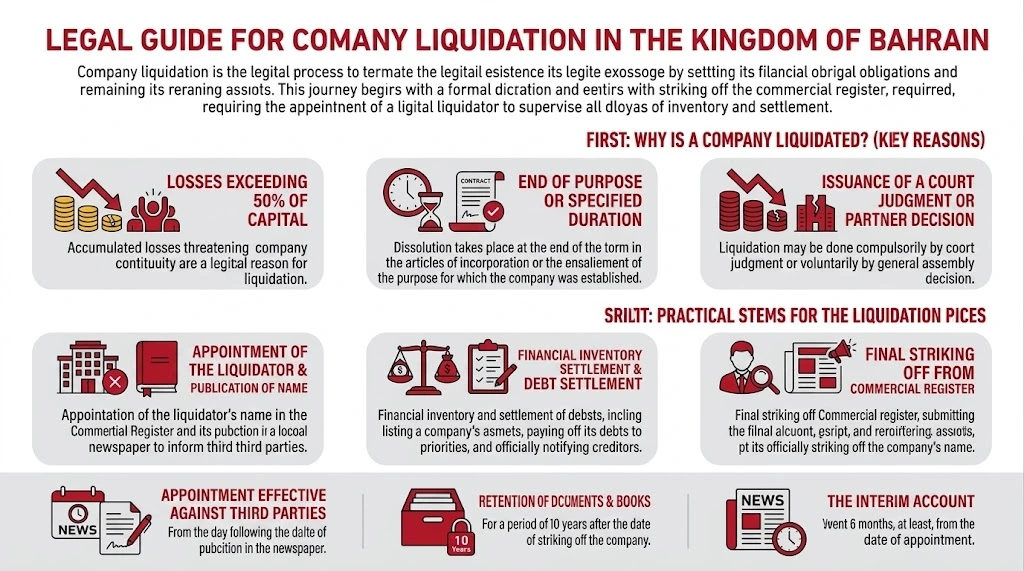
A company liquidation in Bahrain moves through several legal stages. Each stage helps bring the company’s business activities to an end while settling its rights and liabilities before final closure.
The main steps include:
- Issuing the decision to liquidate the company: Begin the process with a formal decision made by the partners or the General Assembly, depending on the type of company. The decision confirms the intention to end the business and start the legal liquidation process.
- Appointing the company liquidator: Appoint a liquidator to manage the process. The liquidator’s responsibilities include identifying the company’s assets, reviewing its financial liabilities, following up on amounts owed to the company by third parties, and taking the necessary steps to close its business properly.
- Preparing a list of the company’s assets and liabilities: Prepare a statement showing the company’s financial position, including its assets, debts, liabilities and existing contracts. This provides a clear basis for reaching a proper legal settlement before the company is terminated.
- Settling the company’s debts and liabilities: Pay outstanding debts and settle the company’s obligations before submitting the final application to strike the company off the Commercial Registration.The company must also settle the financial rights of all parties connected to it during liquidation, including its employees. For this reason, the rights of employees when a company is liquidated in Bahrain must be handled in line with the applicable legal procedures.
- Completing the Commercial Registration strike-off procedures: Complete the company closure and strike-off procedures after the liquidation work has been finalised and all liabilities have been settled, following the procedures approved in Bahrain.
Main Reasons That Lead to Company Liquidation
A decision to liquidate a company is not made without reason. It is usually based on legal or practical circumstances that make continuing the business impossible or no longer worthwhile.
These reasons may arise from the company’s constitutional documents or from financial, commercial or legal circumstances.
- The term stated in the Memorandum of Association expires without being extended.
- The purpose for which the company was established has been achieved or becomes impossible to achieve.
- Losses accumulate to the point that they exceed half of the nominal share capital, placing the company’s continuity at risk.
- The company becomes unable to meet its financial obligations and remains in continuing financial difficulty.
- All shares or ownership interests are transferred to one person, causing the company to lose its collective ownership structure.
- The partners or General Assembly issue a decision to dissolve the company.
- A court issues a judgment ordering the company’s dissolution and liquidation.
- The company merges into another company, requiring its dissolution and the settlement of its assets.
Practical Steps in the Liquidation Process
Once the dissolution decision has been made, the company begins the actual liquidation process through a series of organised legal and financial steps.
These steps aim to close the company’s business fairly while protecting the interests of everyone involved.
- Issue a decision by the General Assembly or the partners to dissolve the company and appoint the liquidator.
- Have the liquidator prepare an inventory of all company assets and liabilities, together with a detailed statement and opening balance sheet.
- After three months from the date of appointment, have the liquidator submit an interim account to the partners or General Assembly explaining the progress of the liquidation.
- Once the liquidation is complete, have the liquidator submit the final accounts for approval by the partners or the General Assembly.
- Register the completion of the liquidation in the Commercial Registration and permanently strike the company’s name off the register.
- Keep all official documents and accounting books at a designated location for ten years so they can be referred to if necessary.
Appoint a liquidator to manage the liquidation process. Their role includes identifying company assets, reviewing financial liabilities, following up on the company’s rights against third parties, and taking the necessary steps to close its operations.
Procedures differ depending on the legal form of the company. For example, the procedures for liquidating a Single Person Company in Bahrain may differ from those applying to other company types in terms of the documents and steps required.
Company Liquidation Report
During the liquidation process, the liquidator is required to prepare periodic reports showing how the process is progressing. These reports are submitted to the partners or the General Assembly.
One of these reports is the interim report. It should be prepared at least once every six months and must contain accurate financial and legal information.
Based on the company’s Memorandum of Association and Articles of Association, which give the partners the right to remove one of the partners, and following one partner’s wish to withdraw together with the agreement of the remaining partners, the parties agreed to end that individual’s status as a partner.
- The partner’s contribution was made entirely in cash, with no contribution in kind.
- The partner received the annual profits due for the previous financial year.
- The partner’s financial position was reviewed, the company’s profits up to the date of withdrawal were determined, and the partner received the share due under the Articles of Association.
- The partner is considered to have permanently left the company, and the company is released from any later liability arising from that partner’s actions.
- The report is published or filed with the Commercial Registration in accordance with the required procedures.
Because Company Liquidation in Bahrain involves several formal steps, working with a lawyer experienced in company liquidation can help with reviewing documents, following up with the relevant authorities, and making sure the process is completed in line with the legal requirements.
After the liquidation decision has been issued and the liquidator appointed, complete the required procedures for announcing the liquidation and notifying the relevant parties. The company liquidation announcement form is one of the important documents used to formally confirm that the liquidation process has begun.
Why Is Consulting a Lawyer Important When Liquidating a Company?
Company liquidation involves far more than financial and administrative work. It is a detailed legal process that requires a clear understanding of the applicable rules and careful application of the relevant provisions of corporate law.
Even a small error can expose the partners or the liquidator to legal liability. It may also lead to disputes with creditors or former partners.
This is where a corporate lawyer can play an important role.
A lawyer can:
- Review the Memorandum of Association and Articles of Association carefully from a legal perspective.
- Help ensure that all formal and substantive procedures are followed in the correct legal order.
- Prepare or review General Assembly minutes and liquidation resolutions.
- Supervise the preparation of inventory reports, financial statements and final liquidation reports.
- Represent the company before the relevant authorities, including the Commercial Registration, courts and tax authorities.
- Help resolve disputes that may arise during liquidation, whether through settlement or court proceedings.
Consulting a lawyer from the beginning can help protect the legal soundness of the process. It can also reduce unnecessary costs and potential risks while helping the liquidation move forward without avoidable delays.
Would you like to start the liquidation process? Contact our office through the WhatsApp button at the bottom of the screen to arrange an initial legal consultation.
Frequently Asked Questions About Company Liquidation in Bahrain
The following questions explain some of the most common points about how Company Liquidation in Bahrain works:
What Happens After a Company Is Liquidated?
After the company is liquidated, its assets are distributed to creditors, and any remaining funds or capital are distributed among the partners or shareholders, as applicable, before the company permanently ceases its operations.
What Happens to Shareholders When a Company Is Liquidated?
When a company is liquidated, shareholders are entitled to receive their share of any remaining assets or capital after the company’s debts and liabilities have been settled.
How Is a Company Liquidated?
A company is liquidated by first adopting a formal liquidation decision and appointing a liquidator. The company’s assets and liabilities are then identified and assessed, its outstanding debts are settled, and its Commercial Registration is ultimately cancelled.
At the end of this article, we have explained in detail how Company Liquidation in Bahrain works and reviewed the main reasons that may lead to liquidation.
We have also covered the steps required to carry out the liquidation, along with the company liquidation report and the timing for submitting it. We hope this guide has provided useful and practical information.
You may also find the following article helpful if you would like to learn more about liquidation procedures: Procedures for Liquidating a Limited Liability Company in Bahrain.

A Bahraini lawyer and the founder of a legal consultancy firm established in February 2019. He holds a Higher Degree in Sharia and Law from Al-Azhar University. He has extensive experience in court representation and providing legal advice in criminal, personal status, civil, and commercial matters. He is known for delivering clear, practical, and effective legal advice aimed at protecting his clients’ rights and interests, and has achieved tangible results in notable cases, including commercial litigation and inheritance matters
