
If you own a Single Person Company to carry out your business activities, but certain circumstances have brought the company to the liquidation stage, you may now be looking for clear and accurate legal information to help you complete the process properly.
If that is the case, this article will guide you through the key details and procedures for Single Person Company Liquidation in Bahrain.
To organize your liquidation file properly and in line with the law, let our legal team handle the entire process on your behalf, from settling LMRA and tax obligations to obtaining the final decision to strike the commercial registration off the register.
Appoint a lawyer to liquidate your company
Or continue reading the guide below to explore the deregistration process step by step.
Table of Content
Legal Basis for Single Person Company Liquidation in Bahrain
The procedures for Single Person Company Liquidation in Bahrain are governed by the Commercial Companies Law issued under Legislative Decree No. (21) of 2001, taking into account the latest amendments published in the Bahrain Laws Database, including the amendment introduced by Legislative Decree No. (38) of 2025 concerning certain provisions of the Commercial Companies Law. The law recognizes that, as an exception to the general principle that a company is formed by several partners, a company may be established by one person. It also recognizes the “Single Person Company” as one of the legal forms of commercial companies in Bahrain.
This means that Single Person Company Liquidation in Bahrain is not simply an administrative step to cancel a commercial registration. It is a regulated legal process designed to bring the company’s activities to an end, identify and collect its assets, settle its debts, address the rights of creditors and government authorities, and finally strike the company off the Commercial Register once the liquidation is complete.
The Difference Between Dissolution, Liquidation, and Deregistration
Before starting the liquidation process, it is important to distinguish between three different stages that many business owners tend to confuse:
| Term | What It Means | Legal Effect |
|---|---|---|
| Dissolution of the Company | A decision or court judgment is issued to terminate the company’s business activities. | The company moves into the liquidation stage. |
| Liquidation | The company’s assets and debts are identified and its outstanding rights and obligations are settled. | The company’s legal personality continues only to the extent required to complete the liquidation. |
| Deregistration | The company’s registration is removed from the Commercial Register after the liquidation process has been completed. | The company’s registration formally comes to an end. |
Single Person Company Liquidation Procedures Step by Step
A Single Person Company is normally liquidated through a number of connected stages. It is better to complete and organize these stages before submitting the final deregistration request, as an outstanding tax liability, an active work permit, or an unpaid social insurance obligation could delay the process.
1. Issue the Company Dissolution Decision and Appoint the Liquidator
Start the process by issuing a decision from the owner of the company’s capital to dissolve the company and appoint a liquidator. If the liquidation is ordered by the court, the process begins under the relevant judicial judgment. The decision should state the liquidator’s name, the scope of the liquidator’s authority, the remuneration payable, and the liquidation period where possible.
Under the Commercial Companies Law, one or more liquidators may be appointed to carry out the liquidation. Their appointment and remuneration are determined by the partners or the extraordinary general assembly. Where a court orders the dissolution or invalidity of a company, the court determines the method of liquidation and appoints the liquidator and sets the liquidator’s remuneration.
2. Register the Liquidator’s Name and Give Effect to the Liquidation
After appointing the liquidator, register the liquidator’s name and the method of liquidation, or the judgment ordering the liquidation, in the Commercial Register. The appointment must also be published in a local daily newspaper. The appointment of the liquidator and the method of liquidation cannot be relied upon against third parties until the day following the date of publication.
This step is especially important because it informs creditors and anyone dealing with the company that the company is now “under liquidation.” From that stage onward, transactions involving the company should be handled through the liquidator and remain within the limits of the liquidation process.
3. Prepare an Inventory of Assets and Liabilities
One of the liquidator’s first duties is to prepare a complete inventory of the company’s assets, rights, debts, and other liabilities. This includes bank accounts, commercial contracts, equipment, inventory, receivables, loans, tax liabilities, employee entitlements, and outstanding amounts owed to suppliers. The law provides that, immediately after appointment and in coordination with the board of directors or company managers, the liquidator must identify the company’s rights, assets, and liabilities and prepare a detailed statement and signed balance sheet.
4. Notify Creditors and Settle Their Claims
The liquidator must notify the company’s creditors that the liquidation process has started and invite them to submit their claims. If some creditors are unknown or their addresses cannot be identified, publication in a local daily newspaper becomes an important method of giving notice.
Pay the company’s debts according to the applicable legal priorities, while taking into account the rights of preferential creditors and any debts or claims that remain under dispute.
5. Settle Outstanding Obligations with Government Authorities in Bahrain
Before obtaining the final deregistration decision for Single Person Company Liquidation in Bahrain, the liquidator should make sure that all government files connected with the company’s activities have been properly closed. Leaving an obligation unresolved may delay deregistration or expose the owner to claims at a later stage.
The following are among the main authorities that should be checked before completing the liquidation file:
| Authority | What Should Be Checked Before Deregistration |
| Labour Market Regulatory Authority (LMRA) | Cancel or settle work permits connected with foreign employees and review any outstanding fees or active employment-related matters. |
| General Organization for Social Insurance (GOSI) | Pay any outstanding social insurance contributions for employees and close the employer’s file where required. |
| National Bureau for Revenue (NBR) | Submit any outstanding tax returns, pay VAT liabilities where applicable, and apply to cancel VAT registration once the relevant conditions are met. |
Bahraini legislation confirms that procedures relating to work permits include their issuance, renewal, and cancellation. It also regulates employers’ obligations concerning social insurance contributions. VAT registration and deregistration, meanwhile, are governed by the Value Added Tax Law issued under Legislative Decree No. (48) of 2018.
Documents Required for Single Person Company Liquidation
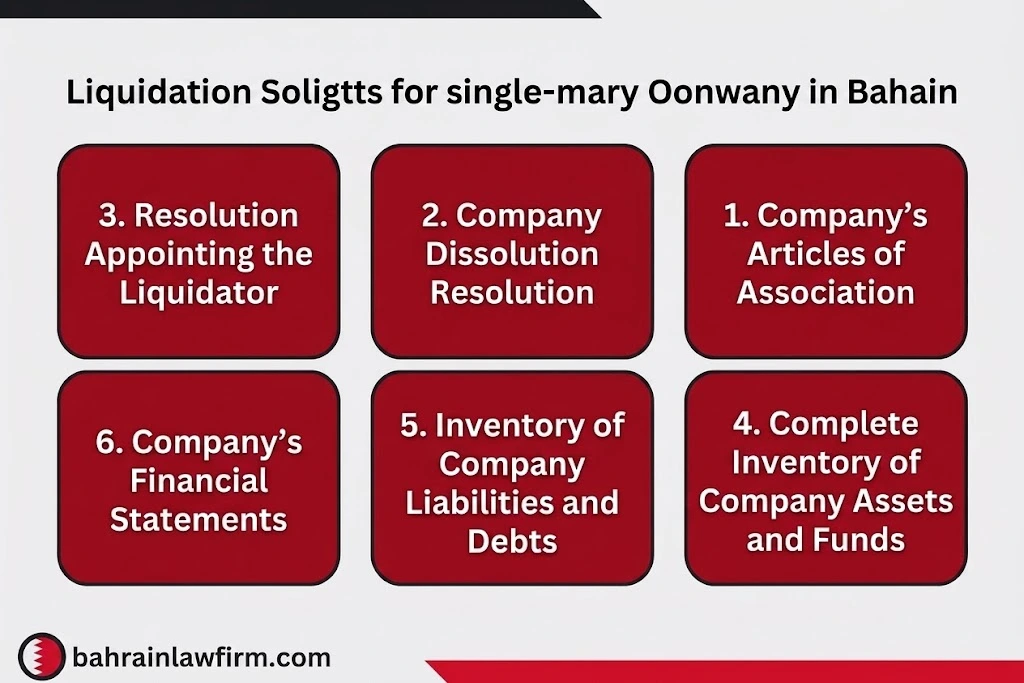
A number of documents must be prepared and submitted when carrying out Single Person Company Liquidation in Bahrain, including:
- The company’s Memorandum of Association.
- The decision to dissolve and liquidate the company, or the court judgment in the case of judicial liquidation.
- The decision appointing the court-appointed or voluntary liquidator.
- A full inventory of the company’s assets, property, and funds.
- The company’s Articles of Association.
- A complete statement of the company’s liabilities and debts.
- The company’s financial statements for the most recent financial year.
You may seek legal support and obtain detailed advice from a corporate lawyer in Bahrain regarding the liquidation procedures and every legal step involved in dissolving and liquidating the company from the beginning of the process.
Are you finding it difficult to close your company’s affairs and concerned about legal liability or mounting government penalties? Let a professional handle the liquidation process without allowing it to consume your time and effort.
How Long Does a Single Person Company Liquidation Take?
The time required to liquidate a Single Person Company varies according to the size of its liabilities, the number of employees, whether active work permits exist, whether the company is registered for VAT, and the status of its debts. In a voluntary liquidation with no employment or tax disputes, the process will often take around two to four months as a professional estimate. This period may include publishing the required notices, allowing time for creditors to submit claims, preparing the final accounts, obtaining no-objection letters, and closing the relevant government files.
If the company has disputed debts, employment claims, outstanding tax returns, or violations recorded against its commercial registration, the liquidation may take longer depending on the circumstances of the particular case.
Factors That May Delay the Liquidation
Consider the following practical issues before starting the Single Person Company liquidation process:
- Employees have not yet received their wages or end-of-service benefits.
- Work permits or residence permits linked to the company remain active.
- VAT returns have not been submitted or tax amounts remain unpaid.
- Lease agreements or supply contracts have not been formally terminated or settled in writing.
- The company does not have an up-to-date balance sheet or clear accounting records.
- Court proceedings or creditor claims are still pending.
Powers of the Liquidator and the Limits of Liability
The liquidator has broad powers to the extent required to complete the liquidation, but does not continue running the company in the same way the manager did before dissolution. The liquidator’s main role is to wind down the existing business, collect amounts owed to the company, pay its debts, sell assets where necessary, and represent the company before third parties and the courts.
Keep in mind that the liquidator may not start new business activities unless they are necessary to complete transactions that had already begun. During the liquidation period, the company retains its legal personality only to the extent required for the liquidation, and the words “Under Liquidation” are added to its name.
What Happens After the Liquidation Is Completed?
After paying the company’s debts and settling its outstanding obligations, the liquidator prepares and submits a final account of the liquidation work. The liquidation ends once the final account has been approved. The liquidator then registers the completion of the liquidation in the Commercial Register and publishes it in a local daily newspaper. The completion of the liquidation cannot be relied upon against third parties until the date of publication. The liquidator may then request that the company’s registration be struck off the Commercial Register.
It is also important to keep the company’s books and records for ten years from the date on which the company is struck off the Commercial Register. These documents should be kept at the place determined by the company owner or the competent authority, in accordance with Article (344) of the Commercial Companies Law.
FAQ About Single Person Company Liquidation in Bahrain
Here are some of the common questions related to this topic:
What Are the Legal Requirements for Single Person Company Liquidation in Bahrain?
One of the legal grounds for Single Person Company Liquidation in Bahrain is the death of the person who owns the company’s capital. The company may also be dissolved if the legal entity that owns its capital ceases to exist.
What Are the Advantages of a Single Person Company in Bahrain?
The main advantages of a Single Person Company include:
1. One person can carry out commercial activities and business operations independently.
2. The company can enter into contracts and legal transactions in its own name.
3. It maintains a legal identity separate from its owner.
4. The owner’s personal assets remain separate from the company’s assets.
5. The company bears financial liability for its debts and operating expenses.
Can a Single Person Company Be Liquidated Without Going to Court?
Yes. A Single Person Company may be liquidated voluntarily if the owner issues a decision to dissolve the company and appoints a liquidator, provided there are no disputes requiring court intervention.
However, if there are legal grounds for judicial dissolution or a dispute concerning the liquidation process, the company may be liquidated pursuant to a court judgment.
Does the Company Continue to Exist During Liquidation?
Yes. The company retains its legal personality only to the extent necessary to complete the liquidation process. During this period, the words “Under Liquidation” must be added to the company’s name.
Can the Owner Withdraw Company Funds Before Paying Its Debts?
As a general legal rule, the company’s debts and liabilities should be settled first. Any remaining surplus may then be distributed after the final liquidation accounts have been approved.
Therefore, the owner should not withdraw company funds before outstanding liabilities have been properly settled.
Is Cancelling the Commercial Registration Enough to End All Liabilities?
No. Cancelling the Commercial Registration does not replace the need to settle employment, social insurance, tax, and work permit obligations.
The company must therefore close or settle its files with the relevant government authorities before the final cancellation of its Commercial Registration.
Must a Liquidation Notice Be Published in a Newspaper?
Yes. Bahrain’s company law requires the liquidator’s name and the method of liquidation, or the judgment ordering the liquidation, to be registered in the Commercial Register and published in a local daily newspaper.
These procedures cannot be relied upon against third parties until the day following publication.
What Happens If a Claim Arises After the Liquidation Has Been Completed?
This depends on the nature of the claim, why it arose after the liquidation, and whether the required notification and publication procedures were properly completed.
This brings us to the end of our guide on the procedures for Single Person Company Liquidation in Bahrain. We have explained how a Single Person Company is liquidated, the documents required for the liquidation process, and the main legal requirements that apply under Bahrain’s Commercial Companies Law. Working with a lawyer experienced in company liquidation can also help ensure that every step is handled in accordance with the law and reduce the risk of legal issues arising during the process.

A Bahraini lawyer and the founder of a legal consultancy firm established in February 2019. He holds a Higher Degree in Sharia and Law from Al-Azhar University. He has extensive experience in court representation and providing legal advice in criminal, personal status, civil, and commercial matters. He is known for delivering clear, practical, and effective legal advice aimed at protecting his clients’ rights and interests, and has achieved tangible results in notable cases, including commercial litigation and inheritance matters
