

Appeal is an important legal route in the Bahraini court system. It lets individuals challenge judgments issued by the courts of first instance. Its purpose is to give the case a second look and make sure justice is done.
However, the appeal admissibility requirements in Bahrain call for specific conditions and procedures that must be followed so the court process runs smoothly. For civil and commercial cases, the official text is Decree-Law No. (12) of 1971 Promulgating the Civil and Commercial Procedures Law (unofficial English translation).
Worried you might lose your right to appeal over a small procedural gap or a missed deadline? Don’t let the first-instance judgment be the end of the story.
Get your judgment reviewed and your appeal accepted nowor keep reading to learn the deadlines and formal steps followed in Bahraini courts
Table of Content
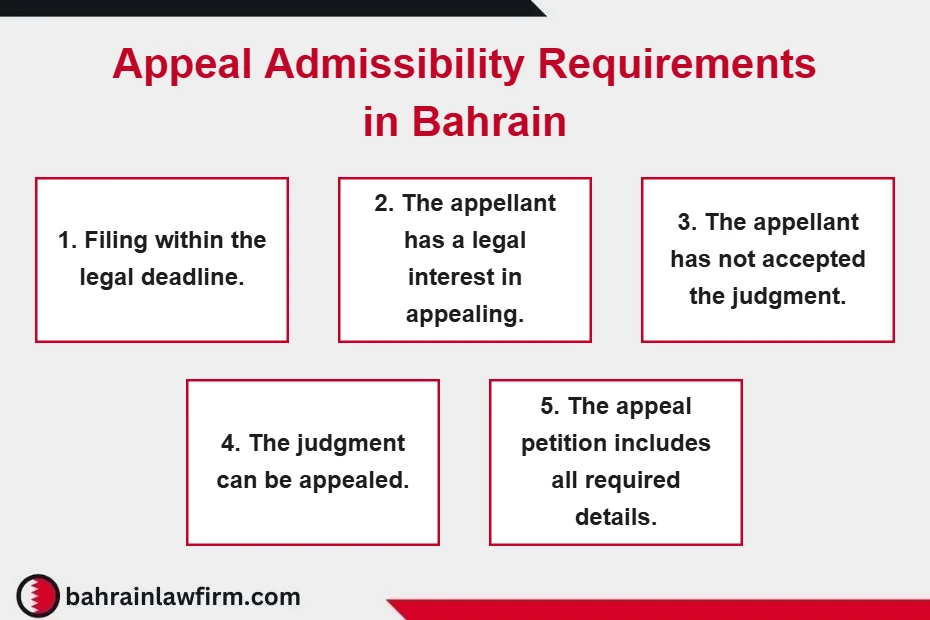
Appeal Admissibility Requirements in Bahrain
To be accepted in form, an appeal must meet the following conditions:
1. Filing within the legal deadline
The deadline depends on the type of case, as summarized below:
- Civil cases: You must file the appeal within 45 days of the date the judgment is issued, unless the law provides otherwise. For a party who failed to attend all the hearings set for the case, the period runs from the date the judgment is pronounced, and where the proceedings were interrupted and the judgment was issued without joining the person who stands in place of a party who died or lost legal capacity, it runs from the date the judgment is served.
- Criminal cases: The appeal must be filed within 15 days of the date of the contradictory judgment, or of the date of the judgment on the objection (opposition).
- Labour cases: The appeal is filed within 10 days of the date of the contradictory judgment, or of the date of notification for judgments treated as contradictory.
- Urgent judgments (Sharia and civil): The appeal must be filed within 10 days of the date of the contradictory judgment, or of the date of notification if the judgment is treated as contradictory.
- Sharia judgments: The appeal is filed within 30 days of the date of the contradictory judgment, or of the date of notification if the judgment is treated as contradictory.
2. The appellant must have an interest in the appeal
The appellant must have a direct legal interest in changing or cancelling the judgment under appeal. An appeal is not accepted from someone with no direct connection to the case.
3. The appellant must not have accepted the judgment
The appellant must not have accepted the judgment, expressly or by implication, because acceptance bars an appeal. Carrying out the judgment voluntarily and without reservation can also be treated as acceptance. Legal standing of the parties: Both the appellant and the respondent must have legal standing in the case.
4. The judgment must be open to appeal
The judgment issued by the court of first instance must be appealable. Some judgments cannot be appealed under the law.
5. The appeal petition must include the required details
The appeal petition must include the following:
- The names and full details of the appellant and the respondent.
- The number and date of the judgment under appeal.
- The grounds of appeal and the specific requests.
- The signature of the appellant or their lawyer, with proof of authority to act.
The Lawyer’s Role in Appeal Procedures
A lawyer plays a key role in the appeal process and handles the following tasks:
- Legal advice: explaining the chances of success based on the facts and the evidence available.
- Preparing the appeal petition: drafting it carefully, with the legal and factual grounds for the challenge.
- Representing the appellant in court: defending the appellant’s rights and presenting the arguments needed to support the case.
- Following up the procedures: making sure deadlines and legal requirements are met so the appeal is not rejected in form.
To benefit from our legal experience in filing appeals and protecting your rights, contact our office to appoint the best lawyer in Bahrain.
Frequently Asked Questions
Users often ask questions like these about the appeal admissibility requirements in Bahrain:
What is the deadline for filing an appeal in civil cases?
In civil cases, the appeal must be filed within 45 days of the date of the contradictory judgment, or of the date the judgment is served if the party did not attend.
Can all judgments issued by the courts of first instance be appealed?
No. Some judgments are final and cannot be challenged, as the law provides.
In this article on the appeal admissibility requirements in Bahrain, we saw that an appeal is an important way to make sure justice is done and judgments are reviewed. But having an appeal accepted in form means following specific conditions and procedures.
These include filing within the legal deadlines, having a legal interest and standing, and including all the required details in the appeal petition. A lawyer also plays a key role in guiding the appellant through the process, so the appeal meets the conditions and can deliver the results you want.
Do not hesitate to ask for our legal services using the WhatsApp button. For more information, also read: How to Appeal After the Deadline in Bahrain.
How to Object to a Court of Appeal Judgment in Bahrain. Form of a Claim to Annul an Appeal Judgment in Bahrain.

A Bahraini lawyer and the founder of a legal consultancy firm established in February 2019. He holds a Higher Degree in Sharia and Law from Al-Azhar University. He has extensive experience in court representation and providing legal advice in criminal, personal status, civil, and commercial matters. He is known for delivering clear, practical, and effective legal advice aimed at protecting his clients’ rights and interests, and has achieved tangible results in notable cases, including commercial litigation and inheritance matters
