

A man reviews an old misdemeanour file. More than three years have passed since the incident, so he assumes the case is over.
Then he learns that the prosecution took a formal investigation step during that time. The law started a new period at that step, so counting the years was not enough.
That is how the criminal statute of limitations in Bahrain works in practice. It depends on the type of offence, the date it happened, and every step taken afterwards.
The Criminal Procedure Code also makes you check the last interrupting step, and look for a special law or a final judgment. So never rely on the date of the complaint or on memory. Read the whole case file and tie each step to its date and legal effect.
Is an old criminal case coming back to haunt you? Do not leave your freedom to a wrong count of limitation years.
Table of Content
What Is the Criminal Statute of Limitations in Bahrain?
Limitation means the state’s right to continue a criminal case ends once the period set by law has run, as long as no valid step interrupts it. The law calls this result “extinction of the criminal case by lapse of time.”
Articles 17 to 21 of the Criminal Procedure Code cover the subject. Article 17 lists the grounds for ending a case, and Article 18 sets the general periods. Articles 19 and 20 deal with suspension and interruption, and Article 21 covers cases with several accused.
Limitation does not prove that the act never happened, and it does not make the act lawful. It only stops the prosecution from going on once its conditions are met. So the judge rules on the plea after reviewing the case papers, not by counting years alone.
Extinction of a Case or Lapse of a Case: Which Term Is Right?
Bahraini law uses the phrase “extinction of the criminal case.” That is the more precise wording for requests and memoranda. In daily speech people say the case “lapses,” and they usually mean the same result.
Both differ from the lapse of a sentence. A case is extinguished before a final judgment settles it. A sentence lapses only after a judgment has imposed a penalty and the period for carrying it out has passed.
This difference helps you pick the right request. A lawyer may ask for extinction of the case if there is no final judgment. If the judgment is final and enforcement has begun, the question becomes the lapse of the sentence.
Grounds for Ending a Criminal Case
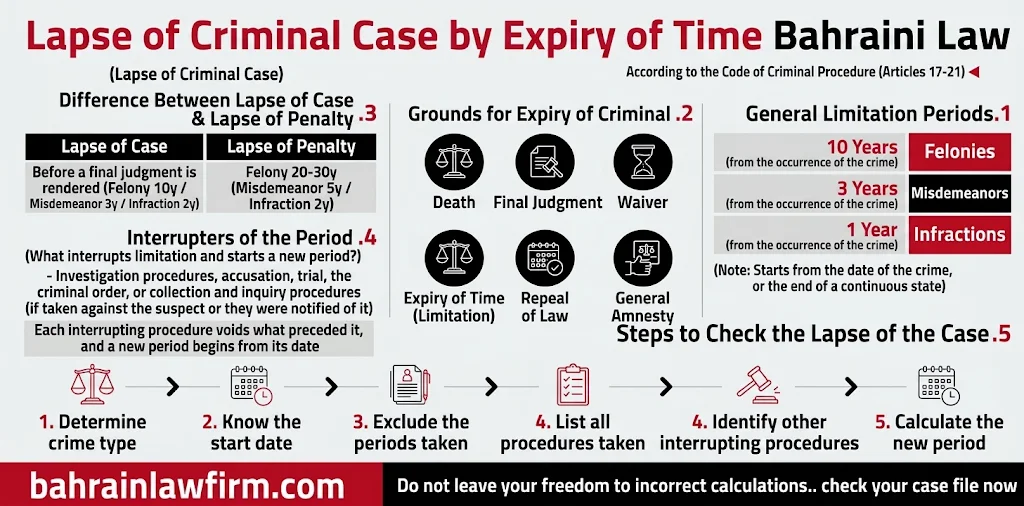
Article 17 lists several grounds, and not every one of them is limitation. They are:
- the death of the accused;
- a final judgment in the case;
- a waiver by the person who has that right, where the law allows it;
- a general amnesty;
- the repeal of the law that punishes the act;
- the passing of the legal period.
Limitation is only one of these. The death of the accused ends the case for a separate, personal reason, and it does not mean the period has run. If the accused dies during the trial, the court can still order confiscation under Article 64 of the Penal Code.
Criminal Statute of Limitations in Bahrain: General Periods
Article 18 sets the general periods by the type of offence. Take the type from the legal text, not from the name the parties use or the title of the complaint.
| Type of offence | General period | General starting point |
|---|---|---|
| Felony | 10 years | The day the crime was committed |
| Misdemeanour | 3 years | The day the crime was committed |
| Contravention | 1 year | The day the crime was committed |
These periods apply unless a special law sets another period or excludes the offence from limitation.
When Does the Criminal Statute of Limitations in Bahrain Start?
As a general rule, count from the day the crime was committed. The period does not necessarily start on the day of the complaint, the day the file was opened, or the day the victim learned of the act.
A continuing crime is different. It begins with one act, but the unlawful state goes on by the offender’s will. To find the start, you need the date the continuation ended, according to the nature of the crime and the text that punishes it.
Also separate a continuing crime from a one-time crime with lasting effects. The harm may go on after the act without making the crime continuing. This is a legal classification that depends on the facts of each case.
Article 18 also has a special rule for some felonies by public employees or people assigned a public service. For the felonies in Chapter Two of Part Two of the Special Section of the Penal Code, the period starts only when the person’s capacity or assignment ends, unless the investigation began before that.
Why Counting Years Is Not Enough
The criminal statute of limitations in Bahrain is not settled by a sum that ignores the case file. A new period can start after a questioning, a referral, a trial hearing, or an inquiry step that meets the legal conditions.
Before you give an opinion, review these points:
- the date the crime was committed, or the date a continuing state ended;
- the final legal description of the act;
- all inquiry, investigation and prosecution steps;
- the dates of hearings, judgments and notices;
- the steps taken against the other accused;
- whether a special law governs the offence;
- whether a final judgment moves the question to the lapse of the sentence.
One step in the file can change the whole result. So a serious plea needs the facts in time order, and it cannot rest on the date of the complaint alone.
No Suspension, but Interruption of the Period
Under the criminal statute of limitations in Bahrain, the law does not allow suspension of the period for any reason. Article 19 says that nothing suspends the running of the period that ends the criminal case.
Suspension would normally freeze the clock and let the rest run once the cause ends. That system does not apply here.
The law does recognise interruption. It wipes out the time that has passed and starts a new period from the date of the interrupting step.
The accused’s travel, or the fact that he cannot be reached, does not by itself suspend the period under the general rule. But the authorities may take legal steps while he is away, and those steps may interrupt it. So look for the step itself, and do not stop at asking where the accused is.
Steps That Interrupt the Criminal Statute of Limitations in Bahrain
Article 20 lists the interrupting steps. They are:
- investigation steps;
- prosecution (accusation) steps;
- trial steps;
- a penal order;
- inquiry steps, if they were taken against the accused or officially notified to him.
A report in the file does not interrupt the period just by being there. The step must be one of the types the law names, and inquiry steps must meet the condition that links them to the accused.
The effect also reaches other accused. If an interrupting step is taken against one accused in the same crime, the period may be interrupted for the rest, even if no step was taken against them personally. This comes from Article 21.
What Happens After an Interruption?
A new period runs from the day of the interruption. If several interrupting steps are taken, the period runs from the date of the last one.
Take an example. A misdemeanour is committed on 1 February 2020, and the prosecution questions the accused on 10 January 2022.
The count does not continue from 2020. A new three-year period starts from 10 January 2022.
Now suppose the court starts hearing the case on 15 September 2023. If that step is interrupting under the law, a new period starts from it. So a case can stay alive for many years after the original incident.
How to Raise the Plea of Limitation
Conditions of the Plea
A plea under the criminal statute of limitations in Bahrain rests on proven facts and clear dates. Before relying on it, a lawyer checks:
- whether the offence is a felony, a misdemeanour or a contravention;
- the date it was committed, or the date a continuing state ended;
- the legal period that applies;
- whether a special text departs from the general period;
- whether the offence is excluded from limitation;
- the date and nature of the last interrupting step;
- the steps taken against the other accused;
- whether there is a final judgment or one that can still be challenged.
This plea goes to whether the case itself survives. So present it clearly. Prove that the period has run, and explain why a given step does not interrupt it if the prosecution or the court relies on that step.
Documents You Will Need
Depending on the case, the file may include:
- the complaint and the inquiry report;
- the records of questioning or interrogation of the accused;
- summons, arrest and bring-in orders;
- Public Prosecution decisions and the referral order;
- notices to attend and proof of delivery;
- minutes of the trial hearings;
- a copy of the judgment and its level;
- papers of any opposition, appeal or cassation;
- the sentence enforcement file, if there is a final judgment.
The Public Prosecution lists e-services on the national portal, including a “Statement about the case status” and a “Statute of limitations and punishment expiry certificate.” The applicant must be a party to a registered case, or a lawyer holding a power of attorney, and must log in with the e-Key. These are described on the Public Prosecution e-services page.
A certificate does not replace reading the file when the date or effect of a step is disputed.
Preparing the Memorandum
Identify the penal provision and the type of offence. Then cite Article 18 and the right period, and show the dates in a simple table. Next to each date, state the step, who took it, and whether it interrupts the period.
Discuss the last possible step with care. If it is an inquiry report, check whether it was taken against the accused or officially notified to him.
If it is a notice, check that it was valid and properly delivered. With several accused, review what was done against each one.
The memorandum also changes with the offence. A defence in a drug felony needs a check of the special text and the exception in Article 18 before the general felony period is applied. A defence written for an ordinary misdemeanour cannot simply be copied across.
Offences Excluded from the Criminal Statute of Limitations in Bahrain
Article 18 excludes some felonies from lapse of time. They include the felonies in Part One of the Special Section of the Penal Code, and the drug felonies the Article refers to. So do not assume that every felony has a ten-year period without checking the exception.
Some special laws set their own rules. They may bar lapse for certain offences, set a different period, or change the starting date.
Always check the date of the act and the text in force at that time. An older law may refer to legislation that was replaced later, so you need the consolidated text and the official amendments. In criminal law, you also cannot read a text broadly or by analogy.
Limitation is also a different subject from the job consequences of a conviction or a suspended sentence. Those concern the judgment and the person’s job status, and they have nothing to do with counting the limitation period.
Limitation of the Case vs Lapse of the Sentence
| Point | Extinction of the case by lapse of time | Lapse of the sentence by lapse of time |
|---|---|---|
| Stage | Before a final judgment | After a judgment imposing a sentence |
| Felony | 10 years as a general rule | 20 years, or 30 years if the sentence is death |
| Misdemeanour | 3 years | 5 years |
| Contravention | 1 year | 2 years |
| Starting point | The day the crime was committed, as a general rule | The day the judgment becomes final. For a felony sentence passed in the accused’s absence, the day it was issued |
| What interrupts it | Investigation, accusation, trial, a penal order, and inquiry steps under the legal conditions | Arrest of a person sentenced to custody, and enforcement steps taken against him or that reach his knowledge by law. Committing a crime of the same or a similar type during the period also interrupts it |
| Main articles | Articles 17 to 21 | Articles 383 to 386 |
In-Absentia Judgments and the Criminal Statute of Limitations in Bahrain
First work out the nature and stage of the judgment. The label “in absentia” does not lead to one single result. The assessment depends on:
- the type of offence;
- the court that issued the judgment;
- whether the judgment can be opposed or appealed;
- the date the person was notified;
- how the notice was given, and whether it was valid;
- the date the judgment became final;
- arrest and enforcement steps;
- any challenge that stopped or changed the finality of the judgment.
Under Article 385, the period for the lapse of a sentence starts when the judgment becomes final. For a felony sentence passed in absentia, it starts on the day the judgment was issued. Under Article 386, the period is interrupted by the arrest of the person sentenced to custody, and by enforcement steps taken against him or that reach his knowledge by law.
Opposition brings the case back before the court that issued the in-absentia judgment, once the opposition is accepted in form. So the right of opposition, and the way the judgment was notified, help decide whether the case is still alive or the question has moved to the lapse of the sentence.
If the judgment was not notified to the accused in person, the start of the period to oppose it may differ. Read the notice paper itself. The words “notified” in the system are not enough.
Keep three dates apart: the date the judgment was issued, the date it was notified, and the date it became final. Mixing them up can lead to a wrong count or to a request that does not fit the legal stage.
Relying on memory to count your limitation period? One small mistake, or one missed interrupting step, can reopen your criminal file from zero. Do not gamble with your freedom.
How to Check the Criminal Statute of Limitations in Bahrain
Follow these seven steps in order:
- Identify the offence: review the charge and the penalty set by law.
- Find the period: apply the felony, misdemeanour or contravention period, or a special one.
- Find the start: prove the date of the offence, or the date a continuing state ended.
- Review the steps: check the inquiry, investigation, accusation and trial.
- Find the last interrupting step: record its date and why it does or does not interrupt the period.
- Work out the new period: it runs from the date of the last interrupting step, under Article 20.
- Check the judgment: decide whether the case is still alive or the question is now the lapse of the sentence.
What Does a Criminal Lawyer Do in Limitation Cases?
A criminal lawyer studies the case and decides whether a plea under the criminal statute of limitations in Bahrain is available. The work usually covers:
- reviewing whether the offence is a felony, a misdemeanour or a contravention;
- checking the date of the offence, or the end of a continuing state;
- examining the inquiry reports, investigation records, referral orders and hearing notices;
- identifying the last legal step that interrupted the period;
- checking for a special text or an exception that bars limitation;
- separating the limitation of the case from the lapse of the sentence;
- putting the facts and steps in a clear time order;
- drafting the memorandum and presenting the legal basis for the plea to the investigating body or the court;
- reviewing in-absentia judgments, opposition, appeals and enforcement where they affect the case.
When Attorney Abdulrahman Khalifa takes a case, the support includes studying the criminal file and its documents, and analysing the steps of the police, the Public Prosecution and the court. It also includes assessing how those steps affect the period, preparing the pleas and memoranda, representing the client before the investigating bodies and courts, and explaining the options in plain language.
No lawyer can promise a specific result. The court decides on the facts, the documents and the law in force. For a wider view of the subject, see our guide to criminal and penal cases in Bahrain.
Frequently Asked Questions about Criminal Statute of Limitations in Bahrain
What is the criminal statute of limitations?
It is the end of the criminal case after the period set by law has run without a step that interrupts it, unless the offence falls under an exception or a special law.
How long is the limitation period for a felony?
The general period is ten years from the day the crime was committed. Some felonies never lapse by time, and special laws regulate others.
How long is the limitation period for a misdemeanour?
The general period is three years. A new period starts if a step that interrupts it is taken during that time.
How long is the limitation period for a contravention?
The general period is one year from the day of the offence, unless the law provides otherwise.
When does the limitation period start?
As a general rule, from the day the crime was committed. For a continuing crime it may start when the continuing state ends, or on a special date set by law.
Which steps interrupt the limitation period?
Investigation, accusation and trial steps, and a penal order. Inquiry steps also interrupt it if they were taken against the accused or officially notified to him.
How is the plea of limitation proved?
From the case file, the records of the steps and the notices, with a table that shows the date of the offence, the last interrupting step, and the completion of the period after it.
What is the difference between limitation of the case and lapse of the sentence?
The first concerns the case before a final judgment. The second concerns the enforcement of a sentence that has already been issued, within the periods and conditions set by law.
Does an in-absentia judgment lapse by time?
It depends on the type of offence, the level of the judgment, how it was notified, whether opposition is possible, whether it is final, and the enforcement steps.
Is the death of the accused a case of limitation?
No. The death of the accused is a separate ground for ending the case under Article 17. It does not require any period to pass.
Build a one-page timeline. It helps the accused, the lawyer and the court understand the case quickly, and it lowers the risk of missing an old step in the file.
The criminal statute of limitations in Bahrain takes more than counting years. Start with the legal description of the offence, fix the date it happened, and then review every step taken by the police, the Prosecution or the court. One valid step can start a new period, and a special text can block the general periods.
Also keep the extinction of the case apart from the lapse of the sentence, especially when there is an in-absentia judgment. Each has its own start date, its own periods and its own interrupting steps.
To have your file reviewed and get a legal assessment based on dates and documents, contact our office through the WhatsApp button at the bottom of the screen.
Official References
- Criminal Procedure Code, Decree-Law No. 46 of 2002 (Articles 17 to 21 and 383 to 386): official text and unofficial English translation, Legislation and Legal Opinion Commission
- Public Prosecution e-services (statement about the case status, statute of limitations and punishment expiry certificate): Bahrain national portal

A Bahraini lawyer and the founder of a legal consultancy firm established in February 2019. He holds a Higher Degree in Sharia and Law from Al-Azhar University. He has extensive experience in court representation and providing legal advice in criminal, personal status, civil, and commercial matters. He is known for delivering clear, practical, and effective legal advice aimed at protecting his clients’ rights and interests, and has achieved tangible results in notable cases, including commercial litigation and inheritance matters
