

Criminal evidence shows what happened in a crime. It can link a person to an event, or clear him of it.
Evidence takes many forms: a fingerprint, a DNA sample, camera footage, a message, a witness statement, a confession or an expert report. The types of criminal evidence in Bahrain do not all carry the same weight, and that weight changes from case to case.
A fingerprint, a lab result or a confession does not settle a case on its own. The court looks at where the evidence came from, how it connects to the event, what it proves and whether it fits the rest of the file.
The Bahraini Criminal Procedure Law governs many investigation and proof steps. The judge then weighs the evidence by the conviction he forms from what is presented in court, as explained below.
Do you feel the evidence against you has gaps, or that it was collected in an unlawful way? Do not give up on your defence.
Table of Content
What Does Criminal Evidence Mean?
Criminal evidence is any element that helps prove a fact linked to the crime, or disprove it. It may show how the event happened, connect a person to a place, identify the source of a sample, or reveal contact between people.
It can also work the other way, by supporting the accused’s defence or showing that he had no link to the act.
It helps to separate the evidence itself from the means of proving it. A blood sample is biological evidence, but its result needs a technical examination. A phone is a physical object, while the messages and files inside it are digital evidence.
What Are the Types of Criminal Evidence in Bahrain?
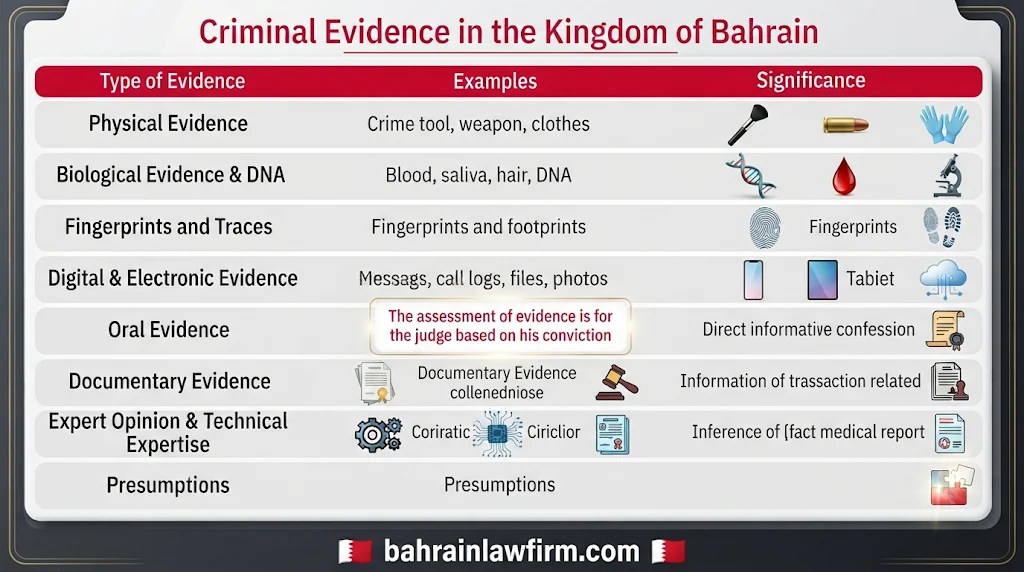
In general, the evidence in a criminal case falls into physical, biological, digital, oral, documentary and technical evidence, together with fingerprints and presumptions. Here are the main types of criminal evidence in Bahrain at a glance.
| Type of evidence | Examples | What it may show |
|---|---|---|
| Physical evidence | A weapon, a tool, clothing | A link to the crime or its location |
| Biological evidence | Blood, saliva, hair, DNA | The source of a sample and its link to a person |
| Fingerprints and traces | Fingerprints, footprints | The presence of a person or object at a place |
| Digital evidence | Messages, phones, files, photos | Activity or contact linked to the event |
| Oral evidence | Testimony, confession | Direct information about what happened |
| Documentary evidence | Contracts, records, correspondence | Information or transactions that matter to the case |
| Technical evidence | Medical and technical reports | An explanation of matters that need expertise |
| Presumptions | A set of linked facts | Inferring one fact from other facts |
Physical Evidence
Physical evidence means tangible items linked to the crime that can be seized and examined. It may be a weapon, a tool, a piece of clothing or something found at the scene.
Its strength does not come from the mere presence of the item. A tool may matter a lot if it is tied to the act, but say little if no link to the crime or the accused appears.
The value grows when it is clear where the item was found, what condition it was in and where it came from. It grows further when the item can be examined without serious doubt about its integrity.
Biological Evidence and DNA
Biological evidence includes blood, saliva, hair, tissue and other samples that can be examined. DNA is among the best-known examples.
Analysis helps compare samples and show how far a sample links to a given person. But it cannot answer every question in the case.
The test may identify the owner of the sample, yet other questions remain. Why was it found in that place? When did it get there, and how does it relate to the act under investigation?
So DNA should not be treated as conclusive in every case. The result must be read together with the other facts.
Fingerprints and Traces
A fingerprint can link a person to a surface or a place, if it is clear enough to examine and compare. Traces also include footprints and some marks left by tools or objects.
The meaning of a print depends on where it was found. It may carry more weight in a place the person had no usual reason to enter. It may carry less on something he handles normally.
So the question should not be “Is the fingerprint strong?” It should be: what does this print prove within the circumstances of the case?
Digital and Electronic Evidence
Digital evidence includes messages, photos, recordings, files, phone data, accounts and electronic records. It matters most in cybercrime cases in Bahrain, but it also appears in many traditional cases.
A message may show contact between two people. A recording may fix the time of an event, and device data may help explain a sequence of events.
The strength of digital evidence rests on three main points:
- identifying the source of the data;
- checking that the content has not been changed;
- proving its link to the person and the event.
A screenshot is not always enough to settle these points. That is especially true when there is a dispute about who owns an account, what the original conversation said, or whether the content was edited.
What About Camera Footage?
Video recordings help show what happened in a certain place. They may identify a person, a time or part of the events, but a camera does not always show the full picture.
A recording may start after the event began, show only one angle, or show a person at the scene without proving what he did. So the footage is read together with the other evidence, not alone.
Oral Evidence
Among the types of criminal evidence in Bahrain, oral evidence comes from people. It appears mainly in witness testimony and the accused’s confession, and it differs from physical evidence because it depends on what a person noticed, remembers or admits.
Witness Testimony
A witness reports what he saw, heard or noticed about the event. The court looks at the content of the statements, the conditions in which he saw the incident, and how far his account agrees with the other elements.
Small differences between two witnesses do not destroy testimony as a whole. But the effect grows if the difference touches the identity of the offender, the origin of the event or an essential point in it.
The Accused’s Confession
A confession is the accused’s admission that he committed the act he is charged with. It is an important means of proof, but it cannot be understood apart from the conditions in which it was made.
The assessment looks at whether the will was free, what the confession says, and how far it fits the facts and the other evidence. Under Article 253 of the Criminal Procedure Law, a statement proven to have been made by an accused or a witness under compulsion or threat is void and cannot be relied on.
A confession can also lose weight when its details clearly clash with solid physical or technical evidence.
Documentary Evidence
Documentary evidence includes contracts, invoices, records, receipts, correspondence and other papers linked to the event. It matters most in crimes that involve transactions, money or written documents.
You need to establish the source of a document and what it really proves. A technical examination may be needed when there is a dispute about a signature, handwriting, an alteration or who the paper belongs to.
So the presence of a document in the case file does not automatically give its content any force.
Expert Opinion and Technical Evidence
Technical evidence is one of the types of criminal evidence in Bahrain that depends on specialist knowledge. The investigation authority or the court turns to experts when a matter needs it, and this may cover:
- forensic medicine;
- examination of injuries;
- DNA analysis;
- fingerprint examination;
- weapons examination;
- analysis of materials;
- document examination;
- analysis of devices and digital data.
The expert explains the technical result within his field. He does not decide guilt or innocence, and the court remains the one that understands the report and weighs its value alongside the other evidence.
The Criminal Procedure Law sets some rules for experts during the investigation. When a doctor or another expert is needed, the Public Prosecution member issues an order appointing him and defining his task (Article 128). The expert may carry out the task without the parties being present.
The expert submits his report in writing within a time the member sets (Article 130).
The parties may use a consulting expert (Article 131). They may also challenge an expert for strong reasons, and the Public Prosecution must decide the request within three days of its submission (Article 132).
Presumptions and Indirect Evidence
Presumptions appear when no direct evidence shows the whole crime. Contact between two people may be proven, a camera may show one of them near the place, a document may show a financial link, and another element may complete the picture.
Each fact may look limited on its own, but together they may mean more. So the court looks at how well the presumptions connect and agree, not only at how many there are.
How Do the Types of Criminal Evidence in Bahrain Differ from Means of Proof?
The type of evidence describes the nature of the item in the case. We say physical, biological or digital evidence.
A means of proof is the way the truth reaches the court, such as testimony, confession, expert opinion and presumptions. A DNA sample is biological evidence, but its meaning before the court appears through the examination and the expert’s opinion.
Understanding this difference helps avoid confusing the item that is examined with the result the expert gives about it.
How Strong Are the Types of Criminal Evidence in Bahrain?
No fixed ranking makes one type of evidence always stronger than another. A clear recording may be the key item in one case, while a fingerprint or a biological sample matters more in another.
The strength of evidence usually depends on several factors:
- how clear its source is;
- its direct link to the event;
- the soundness of the technical examination;
- its agreement with other independent evidence;
- the absence of another reasonable explanation for it.
The general rule of criminal proof is in Article 253 of the Criminal Procedure Law. The judge decides the case according to the conviction he formed with full freedom, but he may not base his judgment on any evidence that was not presented before him at the hearing.
That is why “strong evidence” does not mean the same thing in every case.
Facing a criminal charge and worried about the evidence against you? Do not let a single item decide your fate.
Can Evidence Work in the Accused’s Favour?
Yes. Any of the types of criminal evidence in Bahrain can help the accused, not only prove the charge. A recording may show that the accused was not at the place, a DNA result may rule out his link to a sample, or digital data may show that activity attributed to him came from another source.
So check each item from both sides: what does it prove, and what does it rule out?
What Happens When Evidence Conflicts?
Comparison matters more when each item tells a different story. This applies to all types of criminal evidence in Bahrain.
A witness may say the accused was at a certain place, while data or recordings contradict that. A statement may also clash with a technical report about the time of the event or the nature of an injury.
Not every difference is a damaging contradiction. The court usually looks at the nature of the difference and how close it is to the core of the event. It matters most when it touches the identity of the offender, how the crime happened, or an essential element of the charge.
How to Handle Evidence in an Existing Case
Start by keeping the original evidence as far as you can. Do not edit a file, a chat or a recording to “tidy it up” before presenting it, and keep the source the data came from, because the original is often more useful than a separate copy or image.
Then gather the facts around the evidence: when did you get it, from where, and how does it relate to the event? If you are a victim who needs to submit documents or recordings, a criminal lawyer in Bahrain can help you organise what relates to the event and raise your requests in the right setting.
The value of a single item cannot be judged from a short description. It has to be read together with the rest of the case papers.
Frequently Asked Questions about Types of Criminal Evidence in Bahrain
What are the types of criminal evidence?
They include physical, biological, digital, oral, documentary and technical evidence, together with fingerprints and presumptions. The value of each type depends on the circumstances of the case and its link to the event.
Is a fingerprint conclusive evidence?
No. Its value depends on where it was found, whether it can be examined, why its owner was at that place, and how well it agrees with the other evidence.
Is DNA enough for a conviction on its own?
There is no rule that makes a DNA result enough on its own in every case. The test may identify the owner of a sample, while the explanation for its presence and its link to the crime is a separate question.
Are WhatsApp messages criminal evidence?
Messages from apps can count as digital evidence if they relate to the event and their source, integrity and link to the person concerned can be checked.
Is a confession the strongest evidence in a criminal case?
There is no fixed ranking. The court looks at the circumstances of the confession, what it says and how far it agrees with the other evidence. Under Article 253 of the Criminal Procedure Law, a statement proven to have been made under compulsion or threat is void and cannot be relied on.
Is an expert report binding on the court?
The expert gives a technical opinion on a specialised matter. The court stays responsible for weighing the report together with the other elements of the case.
What is the difference between evidence and a presumption?
Evidence gives information about a fact linked to the case, while a presumption helps infer a fact from another proven fact or a group of facts.
Does more evidence mean a stronger case?
Not necessarily. Several items of limited value may count for less than one clear item that fits the facts. So the quality and meaning of the evidence matter more than the number of items.
The types of criminal evidence in Bahrain range from physical, biological and digital evidence to statements, documents, expert opinion and presumptions.
The value of each item depends on what it actually proves, not only on its name. A fingerprint may be highly important in some circumstances and weak in others, and the same is true of DNA, recordings, testimony and confessions.
So look at the source of the evidence, its link to the crime, the soundness of its examination and how far it agrees with the other elements. The court remains the one that weighs the evidence presented before it under the law.
To have the evidence in your case reviewed, use the WhatsApp button at the bottom of the screen or contact our office. For related reading, see our cybercrime lawyer page.
Official References
- Criminal Procedure Law, Decree-Law No. 46 of 2002 (Articles 128 to 132 and 253): official text (Arabic) and unofficial English translation, Legislation and Legal Opinion Commission

A Bahraini lawyer and the founder of a legal consultancy firm established in February 2019. He holds a Higher Degree in Sharia and Law from Al-Azhar University. He has extensive experience in court representation and providing legal advice in criminal, personal status, civil, and commercial matters. He is known for delivering clear, practical, and effective legal advice aimed at protecting his clients’ rights and interests, and has achieved tangible results in notable cases, including commercial litigation and inheritance matters
