

A worker gets hurt while doing his job. He stops working, starts treatment, and soon faces more questions than answers: who pays for the treatment?
Does his income continue? And when does the injury become a disability that justifies a compensation claim?
Understanding workers compensation in Bahrain starts with working out which system covers the worker, because the Social Insurance Law and the Labour Law do not treat every case the same way. The law itself speaks of compensation for work injuries and occupational diseases, but “workers compensation” is the phrase most people use when they ask what an injured employee can claim.
After an accident, record what happened and the treatment, report it to the right authority, and keep the medical reports and wage records. If the effects of the injury continue, wait until the condition settles so the final disability rate can be set.
Then you may be entitled to an allowance for the time off work, a lump-sum compensation, or an injury pension, depending on the injured person’s situation and the legal text that applies to the file.
Do you need to know which system applies to your injury, and which documents to prepare before you claim? Start by reviewing the basic facts instead of relying on a general estimate.
The short version: there is no single fixed amount for workers compensation in Bahrain. Entitlement is set after checking whether the accident is linked to work, which insurance system covers the injured worker, the insured wage, and how long the disability lasts.
If the injury becomes permanent, the final disability rate comes next. So start with documentation and the legal track before you calculate anything.
Table of Content
When does an injury count as a work injury in Bahrain?
The Social Insurance Law treats an injury as a work injury when it happens while doing the job or because of it. An occupational disease listed in the schedule attached to the law is included too.
A physical injury alone is not enough, so the real link to work and the circumstances of the accident must be examined and proven with evidence.
The definition also covers some accidents on the way to or from work, provided the worker did not stop, linger or leave the normal route. Travel carried out on the employer’s instructions or on an assignment is covered as well, according to the definition of a work injury in Article (4) of the Social Insurance Law issued by Decree-Law No. (24) of 1976 (unofficial English translation).
| Case | Initial assessment |
|---|---|
| Accident while carrying out work | May count as a work injury if it is shown to be linked to work. |
| Accident during an assignment given to the worker | May fall under work injuries, depending on the circumstances of the assignment. |
| Accident on the usual route to or from work | May be covered if the route conditions set by law are met. |
| Occupational disease | Checked against the occupational diseases schedule and the conditions of the law. |
| Injury not related to work | Not treated automatically as a work injury. |
Which law sets the rights of an injured worker?
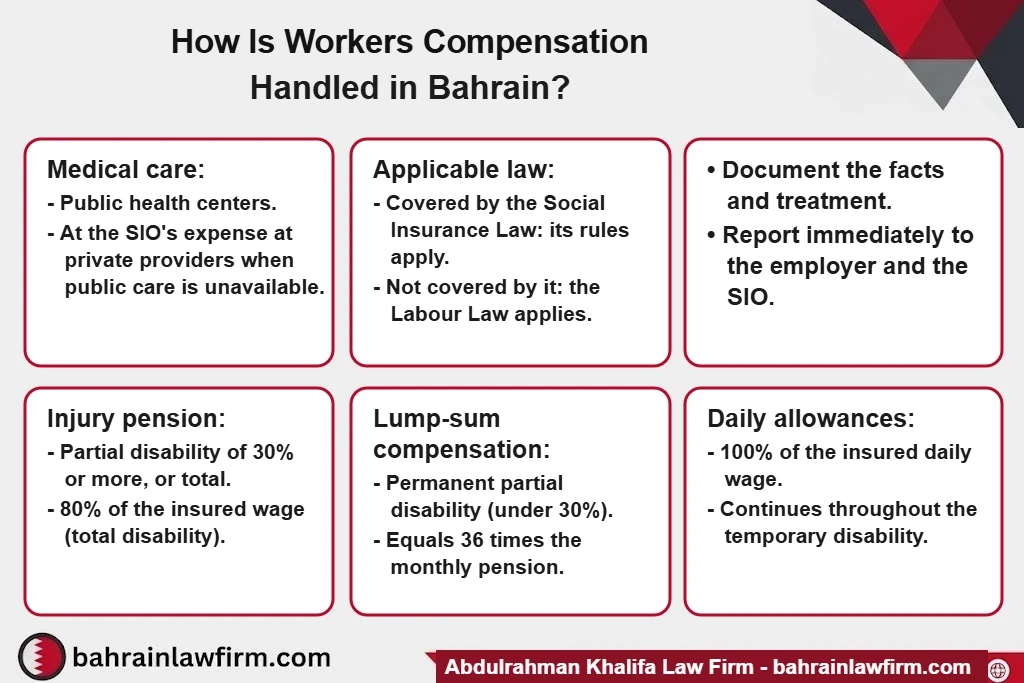
Start by identifying the system before looking for any figure for workers compensation in Bahrain. Article (85) of the Private Sector Labour Law No. (36) of 2012 (unofficial English translation) says the chapter on compensation for work injuries and occupational diseases applies to workers who are not covered by the Social Insurance Law.
It is part of the wider framework that governs workers’ rights under Bahraini law. This distinction stops you from applying the rules of one track to a case governed by another. Here is a quick guide:
| Worker’s status | Where the review starts |
|---|---|
| Covered by the Social Insurance Law | Social Insurance Law No. (24) of 1976 and its amendments. |
| Not covered by the Social Insurance Law | The work injuries chapter of Labour Law No. (36) of 2012, under Article (85). |
Note also that non-Bahraini workers in the private sector who are covered by the work injury insurance branch have also been subject, since 1 March 2024, to the end-of-service gratuity system issued under Prime Minister’s Decision No. (109) of 2023.
That system is separate from injury compensation, since it only regulates the end-of-service gratuity, and its details are in the guide to end-of-service benefits in Bahrain.
What rights can arise after a work injury?
Treat medical care, income during time off, and the right that arises if a permanent disability settles as three separate things. A worker may go through more than one stage, and the matter does not normally begin with one final lump sum. Entitlement changes with the treatment, the length of time off and the final medical outcome.
The Social Insurance Law requires medical care for the injured person under its provisions. Article (51) explains that care is first provided through public health centers at the insurance grade, and if that is not possible, the Social Insurance Organization (SIO) provides it at its own expense with the private providers it designates.
The employer bears the wage for the day of the injury, then the SIO pays the daily allowances for the whole period of inability to work, until recovery or until the condition settles with a permanent disability or death, whichever comes first, under Article (52).
In short, workers compensation in Bahrain may include medical care, a temporary disability allowance, an assessment of the disability rate, a lump-sum compensation in some cases, or an injury pension when its conditions are met.
How is workers compensation in Bahrain calculated?
There is no single figure for all injured workers. Under the insurance track, workers compensation in Bahrain depends on the insured wage and the length of the disability, and then on the disability rate if the injury becomes permanent. The law distinguishes between partial disability below 30%, disability of 30% or more, and total permanent disability.
Article (53) of the Social Insurance Law says the daily allowance equals 100% of the injured person’s daily wage on which contributions were paid, for the whole period of disability caused by the injury. The daily wage is the monthly wage on which contributions were paid, divided by 30.
If the disability becomes permanent and is below 30% of total permanent disability, Article (55) sets a lump-sum compensation equal to 36 times the monthly pension estimated for the partial disability according to the rate.
If the rate reaches or exceeds 30% without reaching total permanent disability, Article (56) sets a monthly pension equal to the disability rate applied to the total permanent disability pension. If the injury causes total permanent disability or death, Article (57) sets a monthly pension equal to 80% of the insured wage.
Apply these rates to the injured person’s actual data and the text in force on the date of the accident, and do not rely on a general example detached from the file.
| Medical outcome | General effect under the Social Insurance Law |
|---|---|
| Temporary disability that prevents work | Daily allowance under Articles 52 and 53 when the conditions are met. |
| Permanent partial disability below 30% | Lump-sum compensation under Article 55. |
| Permanent partial disability of 30% or more, short of total disability | Proportional monthly pension under Article 56. |
| Total permanent disability or death from the injury | Pension under Article 57. |
What should you do right after the injury?
Start with treatment, then record the incident without delay. If the injury forces the worker to stay away from work for treatment, the Social Insurance Law requires the employer to notify the competent police station and the SIO within 24 hours under Article (63). The injured person may also make the report once his health allows it.
Depending on its nature, the dispute may head toward a labour rights claim in Bahrain if the claim falls within this track.
- Get medical care. Follow the treatment provider set by the system that applies to you.
- Tell your employer right away. Article (64) requires the injured person to notify the employer or his representative even if the injury does not stop him from continuing to work.
- Document where and when it happened. Keep whatever shows how the accident occurred, without altering any evidence.
- Collect the medical reports. Keep test results, leave notes, reports and appointments related to the treatment.
- Check the report details. Make sure the description of the incident matches what actually happened.
- Follow the disability assessment. Do not treat the rate in an initial report as final while the condition is still under treatment.
Which documents support a claim for workers compensation in Bahrain?
Gather documents according to the nature of the incident, because a file for an accident inside the workplace differs from one for an accident that happened while the worker was traveling for an outside assignment.
Consistent documents help show the link between the injury and work, the date work stopped and the treatment, and reduce the need to explain contradictions that could have been avoided from the start.
- The injury report, or proof that the accident was recorded.
- Medical reports and certificates of leave or temporary disability.
- Test results and medical images related to the injury.
- Proof of the insured wage, when it is needed for the calculation.
- Correspondence about assigning the worker to the task, if the injury happened away from the workplace.
- Witness details or the investigation record, if there is one.
- Something showing the route taken, if the accident happened on the way to or from work.
Article (63) states that the investigation of the report covers the injured person’s details, occupation and wage, a description of the accident, its causes and circumstances, and the witnesses’ statements. So gathering the papers that prove these facts helps more than keeping a pile of documents unrelated to the accident.
How does the disability rate affect entitlement?
Wait until the medical condition settles before treating the disability rate as final. An injured worker may start with a temporary disability, then recover fully, or later settle with a permanent disability.
At that point the way workers compensation in Bahrain is determined changes with the rate and the medical outcome. The medical assessment matters because moving from a permanent disability below 30% to one of 30% or more changes, under the Social Insurance Law, the form of entitlement from a lump sum to a proportional monthly pension.
So review the medical report and the competent authority’s decision before building any financial expectation.
When can workers compensation in Bahrain be affected?
The right is not lost just because the worker is blamed. Article (54) lists specific cases in which the insured person is not entitled to the daily allowance or permanent disability compensation, including deliberately injuring oneself or manipulating the injury, refusing required medical instructions, and some forms of gross and deliberate misconduct.
Among these the law mentions an act committed under the influence of alcohol or drugs, and a clear breach of safety instructions posted in a visible place. But it puts limits on applying these cases and requires that they be proven by the investigation carried out under Article (63). So a dispute needs the incident, the investigation and the medical outcome read together.
What if there is a dispute over the injury?
Pin down the point of disagreement first. The dispute may be over the link between the accident and work, the route to or from work, the medical report, the disability rate, or the wage used in the calculation. The right step depends on the type of dispute and the body that issued the decision.
Review the report, the investigation, the medical reports, the contribution record and the correspondence, then identify the law that applies to the injured worker. If the worker is not covered by the Social Insurance Law, do not carry the rates or formulas for workers compensation in Bahrain from that law over to a case governed by the private sector Labour Law.
Practical mistakes that can weaken an injury file
Avoid delay and contradiction before you look for complicated legal wording. The file starts from direct facts: where the accident happened, when it happened, what the worker was doing, when the employer was told, and when treatment began. Any major difference between these facts may need explaining later.
- Delaying the report for no clear reason: It can make the incident harder to document, especially where a legal reporting deadline applies in some cases.
- Changing how the accident is described: It can raise questions if the story differs between the report, the medical record and the correspondence.
- Losing the medical reports: It makes it harder to trace the treatment, the disability period and how the condition developed.
- Relying on an initial rate: It can produce a financial expectation that does not match the final assessment.
- Using a law that does not apply: It can lead to a calculation or procedure that does not belong to the worker’s case.
A practical guide before you claim or object
Review the file in order instead of jumping straight to the calculation or the objection. Start with when and where the injury happened, then the reporting date, then the report and the investigation, followed by the medical reports, the insured wage and the final disability rate.
This sequence helps you find the point that could actually change the entitlement.
| What do you check? | Why does it matter? |
|---|---|
| Time and place of the injury | They help prove the link to work. |
| When the employer was notified | It relates to the procedure and the documentation. |
| The report and the investigation | They show the account of the accident and the basic details. |
| Medical reports | They show the treatment, the disability period and how the condition developed. |
| The insured wage | It enters into calculating some insurance entitlements. |
| The final disability rate | It can change the form of compensation or pension. |
| The applicable law | It stops you using rules that do not belong to the case. |
When should you review the file with a work injury lawyer?
Legal review becomes more important with a work injury lawyer when the matter is no longer just following treatment or filing an injury report, and the dispute can change the entitlement itself. That shows up when there is a permanent disability, a death caused by the injury, an objection to the disability rate, a dispute over whether the accident is linked to work, or a disagreement over the wage the calculation was based on.
A lawyer usually starts by reviewing the report, the medical reports, the wage data and the decision being challenged, then identifies the applicable law and the point that needs actual action. This shows whether the file needs a claim, an objection, or a move to litigation in the labour courts in Bahrain, instead of taking a step that does not address the root of the problem.
The office of lawyer Abdulrahman Khalifa can review your documents and identify the right legal track for workers compensation in Bahrain, based on each case’s facts and without assuming any result in advance. The final entitlement still depends on the evidence, the legal texts and the decision issued by the competent authority.
If the dispute concerns the disability rate, a refusal of entitlement, or the link between the accident and work, prepare the report, the medical reports and the wage data before asking for legal review.
Workers compensation in Bahrain: FAQs
Is an accident on the way to work a work injury?
An accident may be treated as a work injury if it happens while going to or returning from work, under the conditions of the Social Insurance Law. The route must be taken without stopping, lingering or deviating from the normal route. So the journey and its actual circumstances must be examined before applying the rule to a specific case.
Who pays the worker while he is off because of the injury?
Under Article (52) of the Social Insurance Law, the employer bears the wage for the day of the injury, then the Social Insurance Organization pays the daily allowances for the whole period of inability to work, until recovery, until the condition settles with a permanent disability, or death, whichever comes first, as long as the conditions of the law apply to the injured person.
Does every injured worker get a lump-sum compensation?
No. Workers compensation in Bahrain depends on the medical outcome and the law that applies. Under the Social Insurance Law, a permanent partial disability below 30% leads to a lump-sum compensation under Article (55), while a disability of 30% or more may lead to a proportional monthly pension under Article (56).
What happens if the injury causes total permanent disability?
Article (57) of the Social Insurance Law, where it applies, sets a monthly pension for total permanent disability or death resulting from a work injury. The entitlement is calculated from the insured wage, the text in force and the injured person's actual insurance data, so it is not enough to rely on a general published rate.
Is the right lost because of the worker's fault?
Not every mistake removes the right automatically. Article (54) lists specific cases, such as deliberately causing the injury and some forms of gross and deliberate misconduct, and it sets conditions for proving them along with specific effects and exceptions. So the outcome of the investigation and the medical circumstances must be read before deciding how the worker's conduct affects the entitlement.
Do I need a lawyer after a work injury?
Not every injury needs a legal dispute. A file review helps when there is a disagreement over whether the accident is linked to work, the disability rate, the wage or a refusal of entitlement, or when there is a permanent disability or death. A lawyer sets the track after reviewing the documents and the decision in dispute, without guaranteeing any specific result.
Start by determining whether the injury is linked to work, then identify the law the worker falls under, and record the accident and treatment without delay. After that, review the wage, the disability period and the final medical assessment before calculating workers compensation in Bahrain. These steps show whether the case is heading toward a temporary allowance, a lump sum or a pension, and what the file needs next.
In every case, do not skip speaking to a qualified labour case lawyer from the office of lawyer Abdulrahman Khalifa in Bahrain. Just tap the WhatsApp button at the bottom of the screen.

A Bahraini lawyer and the founder of a legal consultancy firm established in February 2019. He holds a Higher Degree in Sharia and Law from Al-Azhar University. He has extensive experience in court representation and providing legal advice in criminal, personal status, civil, and commercial matters. He is known for delivering clear, practical, and effective legal advice aimed at protecting his clients’ rights and interests, and has achieved tangible results in notable cases, including commercial litigation and inheritance matters
