
Think of every form you fill in: a clinic, a bank, an online shop. Each one asks for your name, your phone number or your ID. Who decides what they can do with it?
That is the question the personal data protection law in Bahrain answers. This guide covers who it applies to, the rules for using data, the rights people have, and the penalties for getting it wrong.
Worried that your company may be breaking the personal data protection law in Bahrain, or that your own data was misused? Our lawyers can review your practices and policies, and explain your obligations clearly and fast.
Table of Content
What Is the Personal Data Protection Law in Bahrain?
Bahrain’s rules come from Law No. (30) of 2018, which issued the Personal Data Protection Law and set up the Personal Data Protection Authority. It took effect from the first of the month following one year after its publication in the Official Gazette. An unofficial English translation is available as a Word file.
A few terms come up again and again.
Personal data is any information about a person who is, or can be, identified.
Sensitive data reveals things like ethnic origin, political views, religious beliefs, union membership, criminal record, or health and sex life.
The data controller decides why and how data is processed, and the data subject is the person it is about.
Why Does the Personal Data Protection Law in Bahrain Matter?
Because it turns privacy into clear legal rights and duties. In short, the law does four things:
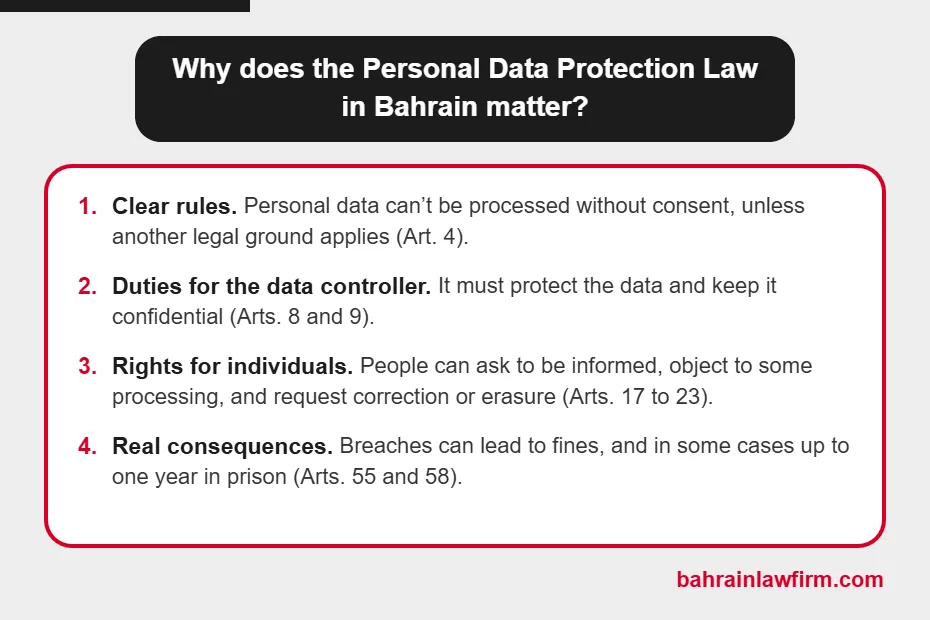
- It sets clear rules. Personal data can’t be processed without consent, unless another legal ground applies.
- It puts duties on the data controller. The controller must keep the data secure and confidential.
- It gives rights to individuals. People can ask to be informed, object to some processing, and ask for corrections or deletion.
- It has real consequences. A breach can lead to fines, and in some cases prison.
Who Must Follow the Law?
The law covers processing done fully or partly by automated means, and non-automated processing of data kept in a filing system. It applies to individuals and companies that live or have a place of business in Bahrain. It also applies to anyone else who processes data using means located in Bahrain, unless the data is only passing through.
Size doesn’t matter. A small shop and a large bank both fall under the law if they process personal data. A foreign entity must appoint an authorised representative in Bahrain and tell the Authority.
There are two main exceptions: an individual processing data only for personal or family affairs, and public security processing by bodies such as the Ministry of Interior and the National Security Service.
When Can Personal Data Be Processed?
The starting point is consent. Article 4 prohibits processing without the data subject’s consent, unless it is necessary for one of these reasons:
- Performing a contract with the data subject, or steps taken at their request before a contract.
- Complying with a legal obligation, or with orders from a competent court or the Public Prosecution.
- Protecting the vital interests of the data subject.
- The legitimate interests of the controller or a third party, as long as they don’t conflict with the person’s fundamental rights.
Consent has conditions too (Article 24). It must come from a person with full legal capacity. It must be written, explicit, specific and freely given after the person is told the purpose, and it can be withdrawn at any time.
Data must also not be kept in an identifiable form once its purpose is achieved.
Sensitive data gets stricter treatment. Processing it without consent is prohibited except in the cases listed in Article 5. Operations such as biometric identification, genetic data and surveillance by visual recording also need the Authority’s prior written authorisation (Article 15).
What Must Companies Do to Protect Personal Data?
Protection does not stop at keeping hackers out. The main duties are:
- Keep it secure. Use suitable technical and organisational measures against loss, destruction, unauthorised access or disclosure, and record them (Article 8).
- Keep it confidential. Don’t disclose data without consent or a judicial order. Staff can’t use it for their own benefit, even after the job ends (Article 9).
- Notify the Authority. Prior notice is required for automated processing, with exceptions such as an employer processing staff data as far as necessary (Article 14).
- Control transfers abroad. Data may leave Bahrain only to countries the Authority lists as adequate, or with its authorisation, unless an exception applies, such as consent or a contract (Articles 12 and 13).
The law also lets a controller appoint a Data Protection Guardian accredited by the Authority (Article 10). If one is appointed, the controller does not have to give the prior notice in Article 14.
What Rights Do Individuals Have?
People are not just the subject of the data. The law gives them the right to be informed about the processing and to ask to be notified (Articles 17 and 18). They can object to direct marketing, to processing that causes them damage, and to decisions based only on automated processing (Articles 20 to 22).
They can also ask to have data rectified, blocked or erased. The controller must reply free of charge within ten working days (Article 23). A person who suffers damage can claim compensation (Article 57).
What Is the Penalty for Breaking the Law?
There are two kinds of consequences: administrative and criminal. This table sets them out:
| Type | What the law says | Article |
|---|---|---|
| Administrative: daily penalty | Up to BD 1,000 a day for a first violation, and BD 2,000 a day for a repeat within 3 years | Art. 55 |
| Administrative: penalty | Up to BD 20,000, based on how serious the violation is and the damage caused | Art. 55 |
| Criminal | Up to 1 year in prison and/or a fine of BD 1,000 to 20,000 for listed violations | Art. 58 |
| Company liability | Fines double, where the crime is committed in the company’s name or for its benefit through a board member or official | Art. 59 |
The criminal list includes processing sensitive data against Article 5, transferring data abroad against Articles 12 and 13, and processing without notifying the Authority or without its prior authorisation.
Making a Complaint
Anyone with a legitimate interest can lodge a written complaint with the Authority if they think the law was breached (Article 25). The Authority can order the violator to stop and remove the effects of the violation before imposing a penalty.
How Can a Lawyer Help?
A civil lawyer in Bahrain can review your privacy policy, consent forms and contracts with processors. We can also prepare notification and authorisation requests, and reply to complaints or orders from the Authority.
If your data was leaked or misused online, you may also need a cybercrime lawyer. And if your company is closing, see our guide to the company liquidation report in Bahrain.
To ask about your own case, tap the WhatsApp button at the bottom of the screen or contact us.
Frequently Asked Questions about Personal Data Protection Law in Bahrain
Does the personal data protection law in Bahrain apply to small businesses?
Yes. It applies to any person with a place of business in Bahrain that processes personal data, whatever its size (Article 2). The main exceptions are processing for purely personal or family affairs, and public security processing by the security bodies named in the law.
What is the penalty for leaking customer data?
The law has no single offence called a leak. The penalty depends on the breach. For example, processing sensitive data against the law, transferring data abroad against it, or processing without notifying or being authorised by the Authority can lead to up to one year in prison and/or a fine of BD 1,000 to 20,000 (Article 58). The Authority can also impose daily and administrative penalties (Article 55), and the person harmed can claim compensation (Article 57).
Can an employer transfer employee data outside Bahrain?
Sometimes. Transfers outside Bahrain are prohibited unless the destination is on the Authority's list of countries with adequate protection, or the Authority authorises the transfer case by case (Article 12). Exceptions include the data subject's consent and transfers necessary to perform a contract (Article 13). Check the exact conditions before you transfer.
Do I need a Data Protection Guardian?
The law lets a controller appoint a Data Protection Guardian accredited by the Authority (Article 10). If one is appointed, the controller does not have to give prior notice under Article 14, and the Guardian keeps the register of processing. Check the Authority's current resolutions for any extra requirements.
What can I do if a company misuses my data?
You can ask the controller to rectify, block or erase your data. It must reply free of charge within ten working days (Article 23). You can also lodge a written complaint with the Personal Data Protection Authority (Article 25), and claim compensation for damage (Article 57).
The personal data protection law in Bahrain is more than a legal framework. It protects individuals and builds trust in the digital world.
Following it is not only a legal duty. It also protects a company’s reputation and credibility. For a specialist opinion on how it applies to your business, speak to a lawyer in Bahrain.
Official References
- Law No. (30) of 2018 issuing the Personal Data Protection Law, Articles 1 to 25, 55, 57, 58 and 59: Legislation and Legal Opinion Commission (Arabic) and an unofficial English translation

A Bahraini lawyer and the founder of a legal consultancy firm established in February 2019. He holds a Higher Degree in Sharia and Law from Al-Azhar University. He has extensive experience in court representation and providing legal advice in criminal, personal status, civil, and commercial matters. He is known for delivering clear, practical, and effective legal advice aimed at protecting his clients’ rights and interests, and has achieved tangible results in notable cases, including commercial litigation and inheritance matters
