

Appealing a judgment of the court of first instance is the main way to have a case reviewed again. But an appeal is accepted only if certain grounds and conditions are met.
This guide explains how to appeal a first instance judgment in Bahrain, the grounds you can rely on and the procedure to follow. Our team at Bahrain Law Firm explains each step in simple terms.
Was a first instance judgment issued against you and you fear the appeal deadline will pass? Do not let legal gaps cost you your right. Our lawyers can review the judgment and prepare the strongest grounds of appeal.
Table of Content
Grounds to Appeal a First Instance Judgment in Bahrain
An appeal brings the dispute again before the court of appeal. It returns the case to the state it was in before the judgment, but only for the part that was appealed (Article 223).
The Civil and Commercial Procedure Law does not limit the grounds of appeal to specific cases. It only requires the statement of appeal to include its grounds (Article 217). The grounds that appellants usually rely on are these:
- A mistake in applying or interpreting the law.
- A mistake in assessing the facts or the evidence in the case.
- A nullity in the judgment or in the procedures that affected the judgment.
- A ruling on something the parties did not ask for, or on more than they asked for.
Some matters are not grounds of appeal. Fraud by the opponent, forged papers or false testimony found after the judgment, decisive documents the opponent had kept back, and two contradictory judgments from the same court are grounds for a request for reconsideration (Article 229). The period for that request is the same as the appeal period (45 days, counted under Article 216), except in cases of fraud, forgery or a withheld document, where it runs from the day the fact came to light (Article 230).
A professional appeal lawyer in Bahrain can help you draft the grounds of appeal precisely.
Procedures for a First Instance Appeal
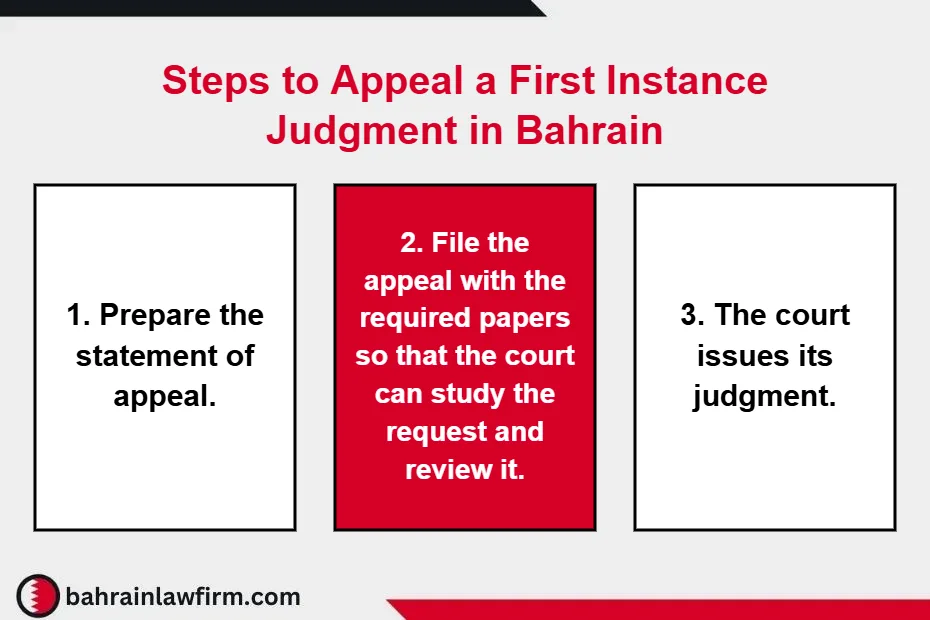
To file the appeal, follow these steps in order.
- Prepare the statement of appeal. It must include the names and full details of the appellant and the respondent, the judgment appealed with its date and the grounds of appeal (Article 217), and the appellant’s requests.
- File it with the court. Submit it to the case registration section of the court that will hear the appeal, and pay the full fee when you file, or the appeal is inadmissible in form. Attach copies for each respondent, copies of the supporting documents and an explanatory memo on the grounds (Articles 217 and 218).
- Follow the usual rules. The rules that apply before the court of first instance apply to the appeal too, unless the law says otherwise (Article 222).
- Wait for the merits review. If the appeal is accepted in form, the court reviews the merits on the evidence and defences given to it, including new ones, and those given before the court of first instance (Article 224).
- Receive the judgment. The court either rejects the appeal and upholds the judgment, or accepts it, amends or cancels the judgment and issues a substitute judgment (Article 228).
Speak to a lawyer from our office before you file, so that the statement and the documents are complete.
Frequently Asked Questions About First Instance Appeals
Here are short answers to common questions.
Can a first instance judgment be appealed?
Yes. Judgments issued on the merits of the case at first instance can be appealed unless the law says otherwise (Article 213 of the Civil and Commercial Procedure Law). The appeal must be filed within 45 days from the date of the judgment, unless the law says otherwise (Article 216), and the formal conditions must be met.
Can I appeal a judgment of the court of first instance?
Yes. Either party, the plaintiff or the defendant, may appeal if he lost the case or did not win all his claims, because the appellant must have an existing interest recognised by law (Article 5). A party who won all his claims has no interest in appealing.
What are the most common reasons for rejecting an appeal of a first instance judgment?
An appeal may be declared inadmissible or rejected when the deadline has passed, which forfeits the right and which the court applies on its own (Article 216). The same happens when the appellant has no existing interest recognised by law (Article 5), when the appellant accepted the judgment or missed the deadline (Article 227), or when the full fee was not paid with the statement of appeal (Article 217).
In conclusion, to appeal a first instance judgment in Bahrain you need valid grounds, a complete statement and a filing made in time. We covered the main grounds and the steps to follow in the court of appeal.
You may also want to read about the appeal period in Bahrain, how to appeal a judgment in Bahrain, the civil appeal petition in Bahrain and how to appeal an enforcement judge decision.

A Bahraini lawyer and the founder of a legal consultancy firm established in February 2019. He holds a Higher Degree in Sharia and Law from Al-Azhar University. He has extensive experience in court representation and providing legal advice in criminal, personal status, civil, and commercial matters. He is known for delivering clear, practical, and effective legal advice aimed at protecting his clients’ rights and interests, and has achieved tangible results in notable cases, including commercial litigation and inheritance matters
