

A woman wins a maintenance judgment and assumes the money will arrive by itself, so she waits too long to open an enforcement file and complete the missing papers. In another file, a request to declare the heirs stalls because one heir’s name is written differently in two official documents.
These delays do not always mean the legal right is weak. They often come from a wrong procedure, a missing document or a missed deadline, so family cases depend on ordering the facts, choosing the right authority and following the right path from consultation to enforcement.
A Sharia court lawyer in Bahrain helps you understand your position before you take a step that is hard to undo, and builds a legal plan that fits your family and your practical goal.
Struggling with the complications of family cases or with collecting your rights in Bahrain? Do not let procedures and documents add to your burden.
Table of Content
Who Is a Sharia Court Lawyer in Bahrain?
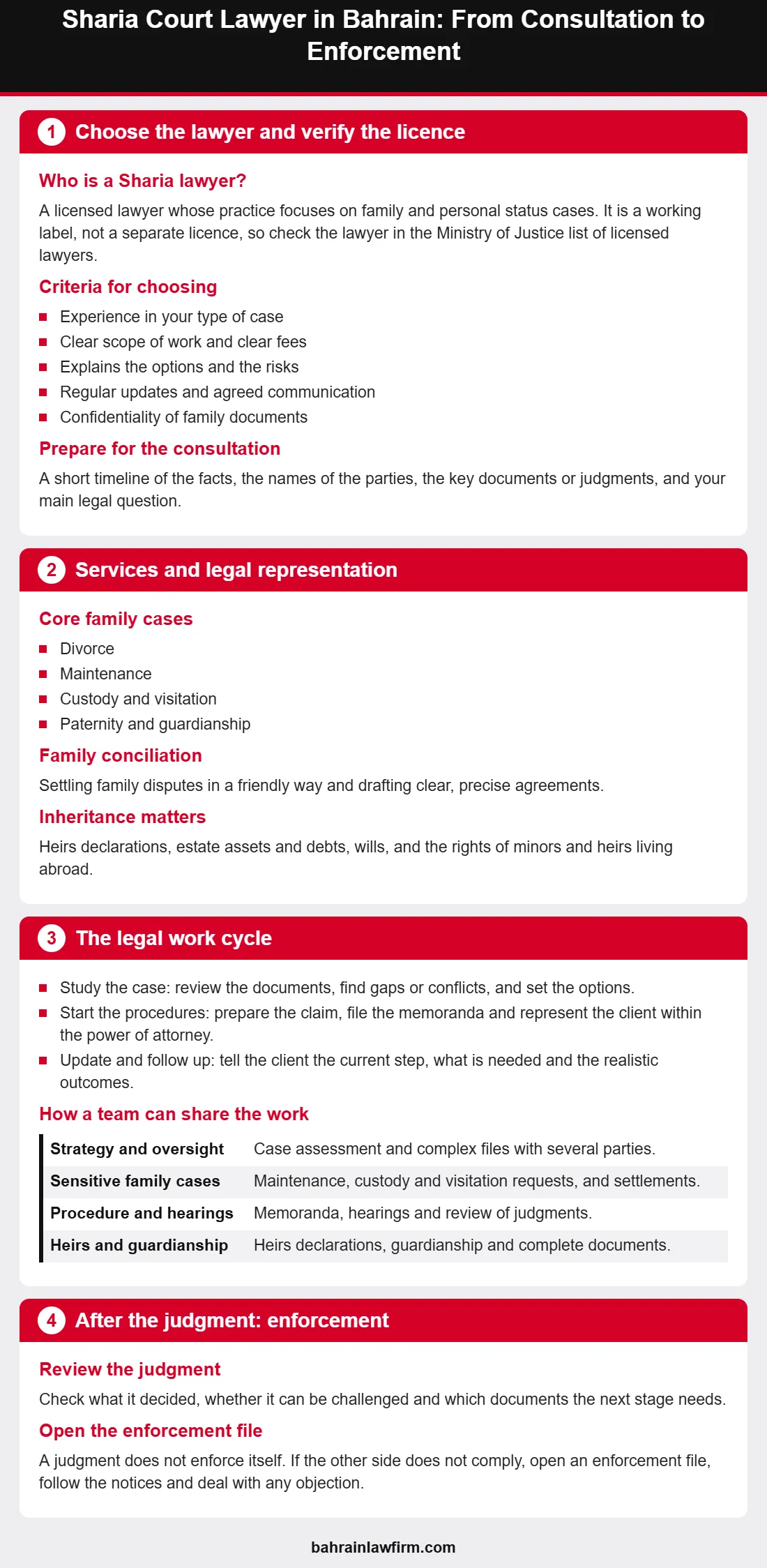
In Bahrain, “Sharia lawyer” is a common professional description for a licensed lawyer whose experience focuses on family and personal status cases before the competent bodies and the Sharia courts.
The term does not replace a professional licence, and it does not appear as a separate licence category in the official lawyers guide. What matters first is that the service provider is a licensed lawyer, and experience in Sharia and family cases comes second. The Ministry of Justice allows the public to view lists of licensed lawyers and their details.
It also helps to separate the professional description from the marketing one. Words such as “the best” or “the strongest” are not enough to judge a Sharia court lawyer in Bahrain, while the client can check several clear criteria:
- Experience in the type of case.
- A clear scope of work.
- Ability to explain the options and the risks.
- Regular updates to the client.
- Confidentiality of family information.
- Transparent fees.
A lawyer does not promise a specific result, because the final decision belongs to the court according to the facts, the evidence and the law. The lawyer studies the file, prepares requests and memoranda, represents the client and explains the procedures and options. A divorce lawyer, by comparison, focuses on divorce claims only.
When Do You Need a Specialist Lawyer?
A consultation is important before filing a claim, when you receive a court notice, or when no clear family agreement can be reached. The need grows when the case involves a child’s rights, continuing financial obligations or documents issued outside Bahrain.
You may need legal help when:
- You want to file a claim for maintenance, custody or visitation.
- You must reply to a claim or a memorandum filed by the other side.
- You need to declare the heirs or you face a dispute over an estate.
- The other party does not comply with a judgment.
- A minor, guardianship or an appointed guardian is involved.
- A party or an heir lives outside Bahrain.
- Names or data differ between documents.
- An earlier judgment or agreement affects the new request.
- A hearing date or a procedural deadline is close.
A consultation with a Sharia court lawyer in Bahrain does not necessarily mean starting a dispute. The best solution may be to complete a document, correct data, draft an agreement or try a family settlement before going to court.
Which Cases Does a Personal Status Lawyer Handle?
The table below introduces the scope of court and case services for orientation only. It does not go into the conditions or steps of each claim, because every subject has its own rules and facts.
| Case | Type of legal help |
|---|---|
| Divorce | Assessing the suitable path and its effects, and preparing the claim or the agreement. |
| Maintenance | Claiming or adjusting maintenance, defending the claim and following the judgment. |
| Custody | Studying a custody request or a transfer of custody, and handling changed circumstances. |
| Visitation | Organising visits, stays and hand-overs, and solving compliance problems. |
| Proof of paternity | Defining the request and the evidence needed for the facts of the case. |
| Wills | Reviewing and drafting a will and explaining its legal effect. |
| Inheritance | Handling the heirs’ rights, the assets, the debts and the disputes linked to the estate. |
| Heirs declaration | Preparing the request to prove the heirs and reviewing the data and documents. |
| Guardianship | Following requests about a minor or about a person who needs legal representation. |
| Family conciliation | Negotiating and drafting a clear settlement that can be applied. |
| Enforcement of judgments | Preparing the enforcement file and following the procedures after the judgment. |
Procedures differ by case type and stage. A maintenance claim differs from a request to declare heirs, and enforcing a custody judgment differs from filing a new claim. So a general template is not enough: each request must be tied to its facts, its documents and the result the client wants, and the first step is to ask a Sharia court lawyer in Bahrain.
How Does Work With the Lawyer Proceed?
In every case, whether Sharia, civil or even criminal, the lawyer starts after the legal consultation with these steps.
1. Studying the Case
The service starts with a focused consultation in which the lawyer listens to the facts in time order, reviews the available documents and decides which issues need proof or completion. The study usually includes:
- Identifying the parties and the capacity of each one.
- Ordering the facts and the key dates.
- Reviewing judgments, contracts, certificates and messages.
- Finding missing documents or conflicting data.
- Defining the legal position and the practical options.
- Explaining the risks and the next step.
- Agreeing on the scope of the service and the fees.
Bahrain Law Firm follows a “consultation first, then a plan” approach. After meeting a Sharia court lawyer in Bahrain, the client knows what is required, what the likely path is and whether the case needs negotiation, a claim or enforcement.
2. Starting the Procedures
When the client agrees on representation, the scope of work is set in writing. It may include:
- Preparing the request or the statement of claim.
- Organising the evidence and the attachments.
- Filing memoranda and replies.
- Following notices and hearings.
- Replying to the other side’s documents.
- Representing the client within the power of attorney.
- Studying settlement options while the case is running.
3. Keeping the Client Informed
A good client experience rests on clear answers to four questions:
- What is the current procedure?
- What is required from the client?
- What is the next date or step?
- What are the realistic outcomes?
The client should also agree on the communication method, the timing of updates and whether the fees cover one stage or extend to appeal and enforcement.
4. After the Decision
Not every file ends when the judgment is issued. The lawyer explains what rights and duties the decision created, whether it can be challenged, which documents the next stage needs, and whether the other side complied voluntarily or an enforcement file must be opened.
The Legal Framework for Sharia Cases in Bahrain
The Family Law (Law 19 of 2017) is the main statute that a Sharia court lawyer in Bahrain relies on for marriage, separation, maintenance, lineage, custody and other family matters it regulates. It applies to disputes within the jurisdiction of the Sharia courts, for those who follow Sunni or Jaafari jurisprudence.
Filing and running a claim before the Sharia courts is governed by the Law of Procedure before the Sharia Courts (Decree-Law 26 of 1986) and its amendments. For example, a lawyer needs a special authorisation to admit a claim, waive it or settle it (Article 29).
This page does not explain the articles of the family law or the court procedure in detail, because specialised guides cover them. What matters is that a possible right is not enough on its own: the request must reach the competent body in the right form, with the right documents and within the right deadlines.
Always check the latest official texts when you assess a case, because general articles cannot reflect every difference in facts, documents or request type.
Family Conciliation in Bahrain
Family conciliation aims to settle family and marital disputes in Sharia cases where settlement is allowed, before the dispute turns into a full court case or according to the path set for the request.
There are exceptions, especially for some urgent or enforcement requests and for matters that cannot be settled. The national portal describes the service in the same way.
The aim of a settlement is not to pressure anyone into giving up rights. It is to test whether a clear solution can save time and cost and keep a workable relationship between the parents when obligations toward the children continue.
The Lawyer’s Role During a Settlement
In a settlement, a Sharia court lawyer in Bahrain helps the client decide what can be negotiated, what must be documented precisely and which clauses may cause a new dispute if they are phrased in general terms. In agreements on maintenance, visitation or children, the parties should specify:
- The value of the obligation and how it is paid.
- The dates of visitation or visits.
- The place of hand-over and receipt.
- The duties linked to education or medical care.
- The date the agreement starts.
- How a breach of the agreement will be handled.
The more specific the agreement, the lower the chance of a later dispute over how to interpret or enforce it. The parties can also ask the court to record a settlement in the hearing minutes (Article 46 of the procedure law), and the minutes carry the force of an official document.
Declaring the Heirs
An heirs declaration is a procedure that proves who has the status of heir after the death of the deceased. Its issue alone does not mean that all estate assets have been inventoried, divided or transferred to the heirs. Dividing an estate may require identifying the assets, debts and obligations, and then separate procedures depending on whether there is an agreement or a dispute.
For example, a document may name the wife and the children as heirs, while a bank account, a property and debts on the estate still need separate handling. So proving the status of heir must be distinguished from managing and dividing the estate.
Documents Usually Required
Requirements differ by case, but a file for declaring heirs that a Sharia court lawyer in Bahrain prepares usually starts with:
- The ID card or passport of the applicant and of the heirs.
- The death certificate of the deceased.
- Documents that prove kinship.
- A power of attorney if the request is filed through an agent.
- Earlier judgments or documents that affect the request.
- Foreign documents on death, marriage or birth.
Foreign documents may need translation, legalisation or completion depending on their type and the receiving body. This is a first list and not a final one, because more requirements may appear after the heirs’ details and the location of the assets are reviewed.
When Is a Lawyer Essential for an Estate File?
The need for a lawyer in Bahrain grows when:
- Some heirs live outside Bahrain.
- A minor is among the heirs.
- Names or birth dates differ between documents.
- Some kinship documents are missing.
- Assets or properties are in more than one country.
- Ownership of an asset is disputed.
- A will is contested.
- Debts have not been settled.
- One of the heirs refuses to cooperate.
In these cases, an early assessment by a Sharia court lawyer in Bahrain helps decide what can be done in Bahrain and what may need a separate procedure in another country.
Who Is the Best Lawyer for Your Case?
The best Sharia court lawyer in Bahrain cannot be named from an advertisement or a general ranking, because the right lawyer changes with the type, the stage and the facts of the case. A custody dispute may need skill in handling evidence and the child’s interests.
An inheritance file needs careful review of the documents and the parties to the estate, while a case after judgment needs a lawyer who can follow the enforcement steps. At Bahrain Law Firm, accredited lawyers can divide a family file between them, and the roles below are examples of how the work can be shared.
| Role | How it can contribute to Sharia cases |
|---|---|
| Strategy and oversight | Assessing the case, choosing the legal path and supervising files with several parties or overlapping settlement, litigation and enforcement stages. |
| Personal status claims | Organising facts and documents, preparing requests and memoranda, and following hearings on maintenance, custody and visitation. |
| Procedure and enforcement | Reviewing judgments and documents, preparing legal replies and coordinating the claim stage with the enforcement stage. |
| Sensitive family matters | Listening to the client’s details, reviewing maintenance, custody and visitation requests, and drafting settlements that set the rights of the parties and the children clearly. |
| Heirs and guardianship | Preparing case files, reviewing data and attachments, and helping with heirs declarations, guardianship and other requests that need several documents. |
Enforcement of Sharia Judgments
A judgment establishes a right or an obligation, while enforcement aims to put what the judgment decided into effect. A judgment on maintenance, visitation or another matter may be issued, and the right holder may still need enforcement steps if the other side does not comply voluntarily.
So the client should know from the start whether the lawyer’s scope of work ends with the judgment or also covers the enforcement stage.
Enforcement Steps
The general steps are:
- Reviewing the judgment and identifying the part that must be enforced.
- Preparing the enforcement title, the data and the documents.
- Opening the enforcement file with the competent body.
- Filing the requests that suit the nature of the obligation.
- Following notices and completions.
- Dealing with any objection or dispute during enforcement.
Government enforcement services allow a new enforcement request to be opened, linked requests to be filed, and the amounts and procedures to be followed. They do not replace a specialised guide to enforcing judgments, because the procedure differs by judgment type and file stage.
Worried that a wrong step or a missing document may cost you your family or financial rights? Do not leave your future and your children’s future to chance. Talk to a Sharia lawyer now, or take your time with the full guide below to organise your thoughts.
How to Choose the Right Lawyer for a Family Case
Several details deserve attention when you choose a lawyer.
1. Check the Licence
Ask for the full professional name and the office details, and check that whoever gives the consultation or handles the case is a licensed lawyer. Advertising or high ratings are not enough to prove professional status. You can refer to the list of licensed lawyers published by the Ministry of Justice.
2. Practical Experience
Ask about experience in your exact type of case, because a custody claim differs from an estate dispute, and filing a claim differs from enforcement. During the consultation, notice whether the lawyer:
- Asks for the facts and the documents before giving an opinion.
- Distinguishes between the available options.
- Explains the risks clearly.
- Avoids promising a guaranteed result.
- Offers a plan that is easy to understand and to carry out.
3. Clear Fees and Scope of Work
The agreement with a Sharia court lawyer in Bahrain should state what the fees cover: the consultation, preparing the claim, the hearings, an appeal or enforcement. It should also state the costs, the expenses and the services that are not included, so the client is not surprised by costs outside the original agreement.
At Bahrain Law Firm the consultation fee is BHD 30 according to the firm’s website. Representation fees are set after studying the case and its stage, and instalments may be agreed depending on the scope of work.
4. Communication and Confidentiality
Family cases contain private information, so ask about:
- How documents are sent and stored.
- The person responsible for communication.
- The timing of case updates.
- How the results of hearings are reported.
- The approved channels for sending sensitive information.
Agreeing on these points from the start reduces anxiety and helps the client follow the case without repeated calls or conflicting information.
What to Prepare Before the Consultation
Prepare one message or one file for your Sharia court lawyer in Bahrain that contains:
- A summary of the facts in time order.
- The names of the parties and the capacity of each one.
- The most important dates.
- Photos of the documents, judgments and minutes.
- The main legal question.
- The result you want to reach.
- Any hearing, deadline or appointment that is close.
Name the files clearly, for example “marriage contract“, “maintenance judgment” and “death certificate”. Do not leave out a document because it does not support your position, because the lawyer needs to see the strengths and the weaknesses to give a realistic assessment.
Frequently Asked Questions
What is a Sharia court lawyer in Bahrain?
It is a common description for a licensed lawyer whose experience focuses on family and personal status cases, such as divorce, maintenance, custody, inheritance and the enforcement of judgments.
Is there a separate licence called Sharia lawyer?
The term describes a field of work. It does not replace checking the lawyer's professional status, licence and experience in your type of case.
How do I check a lawyer's licence?
Ask for the full professional name and the office details, then check them in the list of licensed lawyers published by the Ministry of Justice before you pay fees or hand over original documents.
When do I need a lawyer's consultation?
Before filing a claim, when you receive a court notice, when a family dispute arises, when a judgment must be enforced, or when a minor, or documents and parties outside Bahrain, are involved.
What is the role of the family conciliation office?
It tries to reach a settlement in family and marital disputes where settlement is allowed, subject to exceptions linked to the nature of each request.
What should I send before the legal consultation?
Send a dated summary of the facts, the names of the parties, the key dates, the available documents, your legal question and any hearing or deadline that is close.
How is a Sharia judgment enforced?
By reviewing the judgment, preparing the enforcement title, opening an enforcement file, filing the suitable requests and following the procedures until the obligation is applied.
Choosing a Sharia court lawyer in Bahrain does not depend on advertising phrases. It depends on the licence, experience in your type of case, a clear plan and clear fees, good communication and confidentiality.
Correct handling starts by understanding the facts and preparing the documents, then deciding whether a settlement, a claim or enforcement is the best path. The earlier the consultation comes, before a hasty step is taken, the clearer your chances of avoiding gaps and delay.
To learn more, see our guide to the Personal Status Court in Bahrain.
Do not hesitate to request an urgent legal consultation through the WhatsApp button at the bottom of the screen, or contact us here. The official texts are available on the Legislation and Legal Opinion Commission website: Family Law (Law 19 of 2017) and Law of Procedure before the Sharia Courts (Decree-Law 26 of 1986).

A Bahraini lawyer and the founder of a legal consultancy firm established in February 2019. He holds a Higher Degree in Sharia and Law from Al-Azhar University. He has extensive experience in court representation and providing legal advice in criminal, personal status, civil, and commercial matters. He is known for delivering clear, practical, and effective legal advice aimed at protecting his clients’ rights and interests, and has achieved tangible results in notable cases, including commercial litigation and inheritance matters
