
An arbitration agreement in Bahrain can be as short as one line in a contract. Yet that line decides who will hear your dispute, under which rules and in which place.
Consider a real contract file, with the parties’ details withheld. A commercial contract sent disputes to “arbitration before the competent body”, with no institution, rules or seat named. When a money dispute arose, the first fight was not about the amount but about whether a valid and enforceable agreement existed at all.
This case shows why so many disputes start with the clause itself. Loose wording can raise doubts about the scope, the institution, the number of arbitrators, the governing law, or even whether the parties truly agreed to arbitrate.
This guide explains what an arbitration agreement in Bahrain means, when it is valid, how to draft it, when it fails and what happens when a case reaches the Bahraini courts. It also lists the most common practical mistakes to avoid.
Need your arbitration clause reviewed before signing, or after a dispute has started?
Table of Content
What Is an Arbitration Agreement in Bahrain?
Article 7 of the UNCITRAL Model Law defines an arbitration agreement as an agreement by the parties to submit to arbitration all or certain disputes that have arisen or may arise between them in respect of a defined legal relationship, whether contractual or not. Bahrain applies this Model Law through the Arbitration Law (Law No. 9 of 2015), which annexes its text.
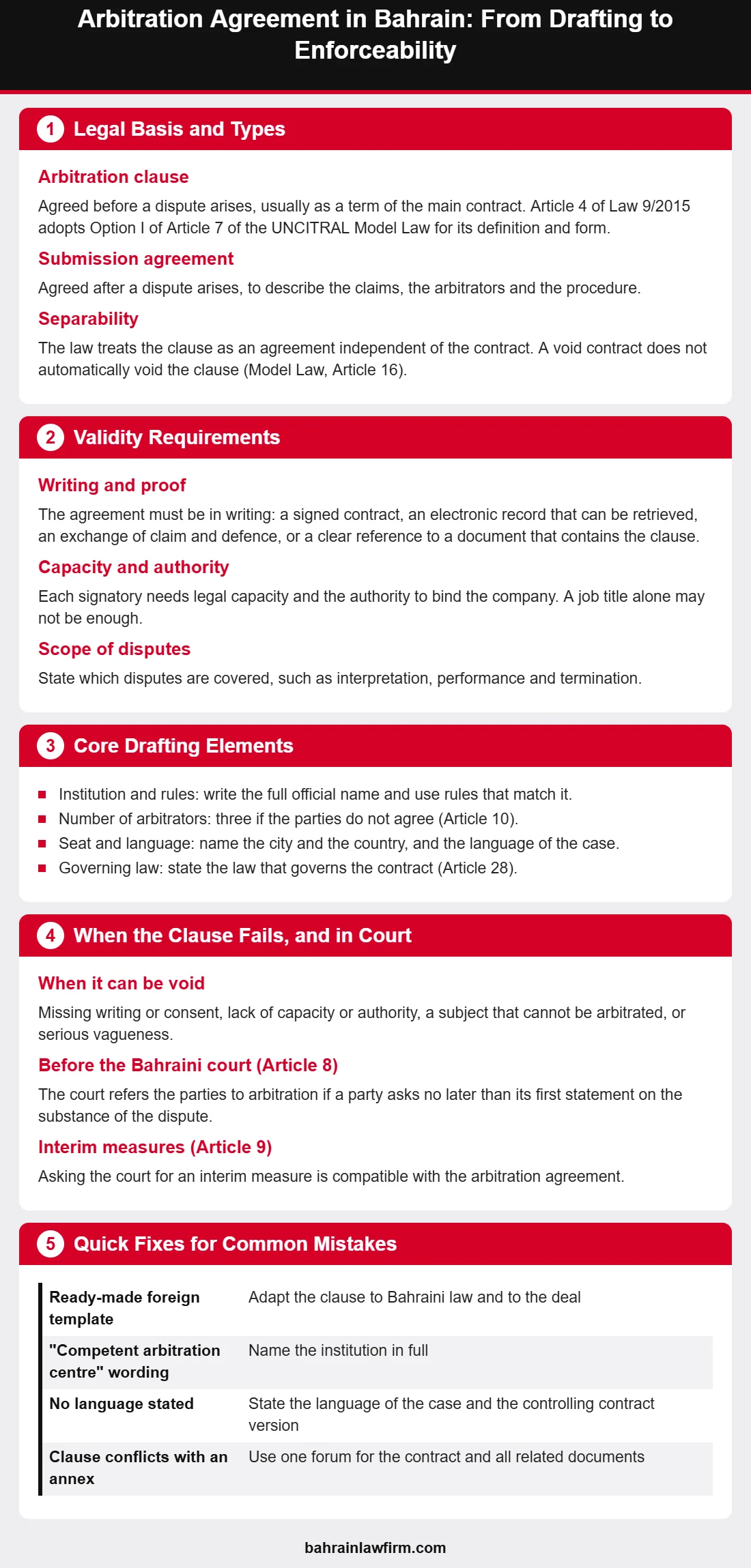
An arbitration agreement can take two forms: a clause inside the main contract, or a separate agreement. Article 4 of Law 9/2015 adopts Option I of Article 7 for the definition and the form of the agreement.
In this sense, an arbitration clause is an agreement made before any dispute. It sets how a possible future dispute over the interpretation, performance, termination or breach of the contract will be decided.
Arbitration Clause vs Submission Agreement
An arbitration clause differs from a submission agreement mainly in timing and in how precisely the dispute is described.
| Point of comparison | Arbitration clause | Submission agreement |
|---|---|---|
| When it is agreed | Before a dispute arises | After a dispute arises |
| Where it appears | Usually inside the main contract | Usually in a separate document |
| Dispute covered | A possible future dispute | An existing, defined dispute |
| Level of detail | Can be short | Usually more detailed |
| Main practical risk | Vague or missing details | Disagreement on how to refer the existing dispute |
For example, a supply contract may say that any dispute arising from it goes to arbitration. That is an arbitration clause.
If a dispute then happens and the parties sign a new document naming the claims, the arbitrators and the procedure, that document is a submission agreement.
How an Arbitration Clause Affects Dispute Resolution
A valid arbitration clause moves the power to decide the dispute from the ordinary courts to the arbitral tribunal. It does not remove the courts completely.
Under Article 3 of Law 9/2015, the High Civil Court performs the court functions named in Article 6 of the Model Law. The courts can support arbitration in cases set by law, mainly by:
- Appointing an arbitrator when the parties cannot agree on one.
- Granting some interim or protective measures.
- Hearing an application to set aside an award.
- Dealing with the recognition and enforcement of an award.
This guide does not cover enforcement of arbitration awards in Bahrain in detail, because enforcement has its own conditions, procedures and defences. It is enough to say that careful drafting and a clean procedure affect how easily the winning party can use the award later.
Validity Requirements for an Arbitration Clause
Written Form
The law requires an arbitration agreement in Bahrain to be in writing. Under Option I of Article 7, an agreement is in writing if its content is recorded in any form, even if the agreement or the contract was made orally or by conduct.
So the writing does not have to be a traditional paper signed by hand. It is enough that the content can be kept and retrieved. Writing can be shown in several ways:
- A signed contract that contains the arbitration clause.
- Emails exchanged between the parties that show their agreement.
- An electronic communication that keeps the content of the agreement and allows later reference.
- An exchange of statements of claim and defence in which one party alleges the agreement and the other does not deny it.
- A clear reference in the contract to another document that contains the clause, if the reference makes that clause part of the contract.
These rules stop arbitration from being forced on someone who never agreed to it. So keep the final signed contract, its annexes, the correspondence about negotiation and signing, and any other document that shows acceptance.
Capacity and Signing Authority
Each party must have the legal capacity to enter an arbitration agreement in Bahrain. A company representative must also have the authority to approve this type of agreement.
Sometimes a job title such as manager or employee is not enough. The signatory may have limited powers, or the company’s documents may require approval from the board or the partners.
Before relying on a signature, check the documents that prove the signatory’s role and limits:
- The commercial registration.
- The articles of association.
- Resolutions of the board or the partners.
- Powers of attorney and authorisation letters.
- Any limits placed on the signatory’s powers.
Scope of Disputes
An arbitration agreement in Bahrain must relate to a defined legal relationship. It is wise to state which types of disputes it covers, so the parties do not start a new fight over the tribunal’s authority.
A clause can cover a range of disputes linked to the contract, such as disputes about:
- The formation of the contract.
- The interpretation of its terms.
- Its performance or breach.
- Its termination or cancellation.
- A claim that it is void.
The parties can also limit arbitration to certain subjects and leave the rest to the courts. The phrase “any dispute arising out of or relating to this contract” is usually wider than “disputes arising from the performance of the contract”.
The second phrase may raise doubt about disputes over validity, cancellation or talks held before signing. Match the scope to the relationship, and do not stretch the clause to contracts or persons the parties clearly did not intend to include.
Arbitration by Reference
A contract can contain an arbitration agreement in Bahrain by referring to another document, such as general terms, a framework agreement or standard contracting rules. Under Option I of Article 7, the reference must be clear and must make the clause part of the contract.
A vague mention of “the usual terms” or “the known rules” is therefore not enough without naming the document. To make the reference clear and easy to prove:
- Name the referred document precisely.
- State its version number and date.
- Attach it to the contract or record that it was delivered to the other party.
- State that it forms an integral part of the contract.
- Avoid a general reference if the document exists in different versions.
For example, the contract can say: “The Supplier’s General Terms, January 2026 edition, form an integral part of this contract.” This wording reduces the risk of a party denying knowledge of the document or arguing about which version applies.
Separability: The Clause Is Independent of the Contract
Separability means the law treats the arbitration clause as a separate agreement from the other terms of the contract, even when it sits in the same document. Under Article 16 of the Model Law, the tribunal can rule on its own jurisdiction, including objections to the existence or validity of the arbitration agreement.
A decision that the main contract is void does not, by itself, make the arbitration clause void. In practice this means:
- The clause does not fall just because a party says the contract is void.
- The tribunal may examine whether the contract is valid, cancelled or terminated.
- The tribunal keeps its jurisdiction as long as the defect does not affect the arbitration agreement itself.
- The clause can still fail if a signature was forged, consent was missing or the representative had no authority to accept it.
The principle has a clear purpose. If a bare claim that the contract is void could remove the clause, any party could block arbitration just by calling the contract void.
Separability lets the tribunal examine claims of invalidity, cancellation or termination and decide them on the evidence and the applicable law. Understanding this point is key when you draft or challenge an arbitration agreement in Bahrain, because it separates defects in the main obligations from defects in the arbitration agreement itself.
How to Draft an Arbitration Clause in a Contract
When you draft an arbitration agreement in Bahrain, define the scope of the clause in balanced language. It can cover every dispute that arises out of the contract or relates to its formation, validity, interpretation, performance, breach or termination.
In linked contracts, such as a construction contract, a guarantee and a maintenance agreement, decide whether the clause covers disputes under all the documents or under one contract only.
Choose the Institution or the Rules
Decide whether the arbitration is institutional or ad hoc. In institutional arbitration, an arbitration centre administers the case under published rules, while in ad hoc arbitration the parties and the tribunal manage the case more freely.
When you choose the institution or the rules, keep these points in mind:
- Write the full official name of the institution.
- State which arbitration rules will apply.
- Do not mix the name of one institution with the rules of another.
- Check that the rules suit the type of dispute.
If you want the wider picture of arbitration, its advantages and its stages, read our guide to arbitration in Bahrain. This article stays focused on the clause itself: its validity, wording, scope and legal effects.
Number of Arbitrators
State the number of arbitrators clearly. You can choose a sole arbitrator or a panel of three, depending on the value and the complexity of the dispute.
These practical points can help you choose:
- A sole arbitrator usually reduces cost and procedure.
- A panel of three offers a wider range of expertise.
- Under Article 10 of the Model Law, the number is three if the parties do not agree on it.
- An even number can cause trouble when the arbitrators disagree.
Seat of Arbitration
State the seat by naming the city and the country, for example Manama, Kingdom of Bahrain. Do not confuse the legal seat with the place where hearings are held.
The seat matters for several reasons:
- It links the arbitration to a specific legal system.
- It helps identify the court that performs the supporting and supervisory functions.
- It is different from the physical place where hearings take place.
Under Article 20 of the Model Law, the parties are free to agree on the place of arbitration. Unless they agree otherwise, the tribunal may meet at any place it considers suitable to consult, to hear witnesses, experts or the parties, or to inspect goods and documents.
Language of Arbitration
Choose the language for written statements, correspondence, hearings and the award. This choice matters more when contracts are written in more than one language.
Under Article 22 of the Model Law, the parties are free to agree on the language, and the tribunal may order that documents be translated into it. The clause should cover these language points:
- The language of statements and correspondence.
- The language of hearings and witness evidence.
- The language of the award.
- The controlling version of the contract if the Arabic and foreign-language texts differ.
A clause that differs between the Arabic and English versions can lead to a dispute over which text reflects the parties’ intention.
Applicable Law
Distinguish between the laws that may touch an arbitration:
- The law that governs the substance of the contract.
- The procedural law linked to the seat of arbitration.
- The law that governs the arbitration agreement itself.
State the substantive law in express words, for example that the contract is governed by the laws of the Kingdom of Bahrain. Do not assume that choosing a seat automatically decides the law that governs all contract rights and duties.
Under Article 28 of the Model Law, the tribunal decides the dispute under the rules of law the parties choose, and a choice of a country’s law means its substantive law, not its conflict-of-laws rules, unless the parties agree otherwise. Failing a choice, the tribunal applies the law determined by the conflict-of-laws rules it considers applicable. In all cases it decides in accordance with the contract terms and takes into account the trade usages that apply.
Common Mistakes That Turn an Arbitration Clause Into a Dispute
Practical problems often appear before the claim itself is discussed. These mistakes turn an arbitration agreement in Bahrain, which should settle disputes, into a dispute of its own:
- Using ready-made templates: copying a clause from a foreign contract without adapting it to Bahraini law and the deal.
- Not naming the institution: using wording such as “the competent arbitration centre” without naming a specific body.
- Not stating the seat: leaving the procedural law and the supervising court open to argument.
- Different contract versions: a clause in the English version that is missing or different in the Arabic version.
- Unclear scope: not knowing whether it covers invalidity, termination and liability before the contract.
- Conflict with annexes: giving the courts exclusive jurisdiction in an annex and arbitration in the main contract.
- Mixing mediation and arbitration: not saying when negotiation or mediation ends and arbitration begins.
- Ignoring signing authority: relying on a signature from someone who lacks enough authority.
- Combining conflicting rules: choosing one institution but referring to the rules of another.
- Ignoring linked contracts: not saying whether the clause covers guarantees, change orders and related agreements.
Also avoid a wrong name for the institution, a reference to rules that are no longer in force, or giving the court and the tribunal conflicting authority over the same dispute. If the clause will sit in a commercial contract, see arbitration clauses in commercial contracts in Bahrain for the points that apply to that type of contract, instead of copying one standard text into every deal.
When Is an Arbitration Agreement Void or Unenforceable?
Missing Writing or Consent
A clause may be void if the written form required by law is missing, or if a party’s consent is not proven. This includes a clause added after the contract was signed without the other party’s approval, or hidden in a document that was never referred to or accepted.
A printed clause is not enough if the party it is said to bind did not accept it or was not bound by the contract.
Lack of Capacity or Authority
The clause is affected if it was signed by someone without the needed capacity or authority. This can happen in several cases:
- An employee signs a contract outside the limits of their authorisation.
- The company’s documents require an extra approval that was never given.
- A power of attorney or authorisation expired before the contract was signed.
- The signatory went beyond the limits in the authorisation decision.
Check the authority at the time of signing, not after a dispute starts.
Vague Wording
Not every small gap leads to nullity, but serious vagueness can make an arbitration agreement in Bahrain impossible to perform. It appears in forms such as:
- Referring to an arbitration body that does not exist.
- Naming two different centres without saying which one has authority.
- Making arbitration optional for one party and mandatory for the other without clear rules.
- A conflict between the clause and another term or annex of the contract.
Under Article 8 of the Model Law, the court refers the parties to arbitration when a party relies on the agreement, unless it finds that the agreement is null and void, inoperative or incapable of being performed.
Disputes That Cannot Be Arbitrated
Not every dispute can go to arbitration just because the parties agree. Article 1(5) of the Model Law says that it does not affect any other law of the State under which certain disputes may not be submitted to arbitration, or may be submitted only under provisions other than those of the Law.
Check whether the subject can be arbitrated before you add the clause, especially in relationships that touch:
- Public order.
- The rights of third parties.
- Matters the parties are not free to settle.
- Subjects the law bars from arbitration.
What Happens When a Case Is Filed in Court?
Raise the Clause Early
Article 8 of the Model Law says a court that receives a case on a matter covered by an arbitration agreement must refer the parties to arbitration if a party asks for it no later than its first statement on the substance of the dispute. The exception is when the agreement is null and void, inoperative or incapable of being performed.
So raise the clause before you discuss the merits of the claim. A party that argues the merits and does not rely on arbitration in time may lose the right to object to the court hearing the dispute.
Take these basic steps:
- Review the contract and its annexes as soon as you receive the notice of the claim.
- Decide whether the clause covers the claim that was filed.
- Raise the objection before you discuss the merits.
- Avoid filing a full defence on the merits before you raise the clause.
Do not postpone checking the arbitration agreement in Bahrain until after your substantive reply.
Does the Clause Stop a Party From Filing?
In practice, an arbitration agreement in Bahrain does not physically stop a party from registering a case in court. But the court refers the parties to arbitration if the other party asks in time and the agreement applies to the dispute.
Interim and Protective Measures
A party may ask the court for an interim or protective measure without giving up the arbitration agreement. Such measures may aim to:
- Preserve important evidence.
- Protect property that is the subject of the dispute.
- Stop the disposal of a particular asset.
- Avoid harm that is hard to repair.
Article 9 of the Model Law allows a party to request such a measure from a court before or during the arbitration. Article 17 gives the tribunal the power to grant interim measures within the limits of the law.
Does the Clause Change by Type of Contract?
Arbitration is widely used in supply, construction, agency, investment and technology-service contracts, especially when the relationship is international or needs special technical expertise. In these contracts, an arbitration agreement in Bahrain should state the institution, the seat, the language and the governing law, and link to every related annex and change order.
Commercial Contracts
Commercial contracts need wording that takes several factors into account:
- The value of the deal.
- The number of parties.
- The language of the documents.
- Related contracts and guarantees.
The popularity of arbitration in commerce does not mean that one clause fits every company or activity.
Civil Contracts
Article 1 of Law 9/2015 applies the Model Law whatever the nature of the legal relationship, so it is not limited to commercial matters. The scope of the Law and whether the subject can be arbitrated still need checking in each case.
In civil contracts, make consent and capacity very clear, especially when one party is an individual who does not run a specialised business.
Company Contracts
Company contracts need an arbitration agreement in Bahrain that fits with the articles of association, the shareholders’ agreement and the investment and financing contracts. When you draft the clause, note these points:
- Name the parties that the agreement covers.
- Align the clause across all related documents.
- Set how disputes with several parties will be handled.
- Avoid different clauses in documents that govern the same relationship.
Conflicting clauses may cause parallel proceedings or a dispute over which body has jurisdiction.
When Do You Need an Arbitration Lawyer?
Get advice from a lawyer in Bahrain when some factors make the contract or the dispute more complex:
- A high contract value.
- Parties from different countries.
- A deal that links several contracts or guarantees.
- A dispute over signing authority or the scope of the agreement.
- A case filed in court despite an arbitration clause.
Legal review is also useful before the first memorandum is filed in court, because a delay in raising the objection may affect your right to rely on arbitration. Early review also helps you draft an arbitration agreement in Bahrain that fits the deal, instead of fixing gaps after a dispute begins.
Frequently Asked Questions
What is an arbitration clause?
It is an agreement made before a dispute arises. The parties agree to refer all or certain disputes about a defined legal relationship to arbitration instead of the ordinary courts.
What is the difference between an arbitration clause and a submission agreement?
An arbitration clause is agreed before a dispute arises and usually sits inside the contract. A submission agreement is made after a dispute arises and usually describes the dispute and the procedure in more detail.
When is an arbitration clause void?
It may be void if the writing or the consent is missing, if capacity or authority is lacking, if the subject cannot be arbitrated, or if serious vagueness makes the clause impossible to perform.
Does an arbitration clause stop a party from filing a case in court?
It does not physically stop a party from filing a case. But the court refers the parties to arbitration if a party asks no later than its first statement on the substance of the dispute and the clause is valid and can be performed.
Is the clause void if the contract is void?
Not automatically, because the arbitration clause is independent of the contract. It can still fall if the defect affects the clause itself, such as missing consent, a forged signature or no authority to sign.
Must an arbitration clause be in writing?
Yes. Writing can be a signed document, an electronic record that can be retrieved, an exchange of statements of claim and defence in which one party alleges the agreement and the other does not deny it, or a clear reference to a document that contains the clause.
Can the arbitration clause be amended after the contract is signed?
Yes, if the parties agree to the change and meet the requirements of writing, consent and signing authority. It is wise to state that the amendment replaces the earlier text and to give its effective date and the contracts it covers.
Who chooses the arbitrator?
The agreement of the parties sets how arbitrators are chosen. Each party may pick one arbitrator and the two may choose the chair, or the named institution may appoint under its rules. If the appointment fails, the competent court can be asked to help, as the law provides.
The validity of an arbitration agreement in Bahrain does not depend on a general phrase that mentions arbitration. It depends on valid written consent, enough signing authority, a clear scope and a workable mechanism. The institution or rules, the number of arbitrators, the seat, the language and the governing law should also be set, and every version of the contract and its annexes should be reviewed.
The arbitration clause stays independent of the main contract, so a void or cancelled contract does not automatically end it. When a case is filed in court, rely on the clause no later than your first statement on the substance of the dispute.
To have your arbitration clause reviewed or to assess its effect in an existing dispute, use the WhatsApp button at the bottom of the screen to reach a specialist commercial lawyer. For more information, see our page on commercial arbitration cases.

A Bahraini lawyer and the founder of a legal consultancy firm established in February 2019. He holds a Higher Degree in Sharia and Law from Al-Azhar University. He has extensive experience in court representation and providing legal advice in criminal, personal status, civil, and commercial matters. He is known for delivering clear, practical, and effective legal advice aimed at protecting his clients’ rights and interests, and has achieved tangible results in notable cases, including commercial litigation and inheritance matters
