

Imagine that two companies go to arbitration over a supply contract, and the tribunal rules in favor of one of them. The winner thinks the dispute is over, but the other side does not pay, and the next fight is about enforcement.
This is why the enforcement of arbitration awards in Bahrain matters. An award is only useful if you can turn it into a payment, and Bahraini law sets a clear path for this.
Do you hold an arbitration award that the other party refuses to pay? Every week of delay can cost you time, money and assets.
Table of Content
Enforcement of Arbitration Awards in Bahrain: The Legal Framework
The Arbitration Law (Law 9 of 2015) applies the UNCITRAL Model Law to arbitrations that the parties agree to place under it. Article 35 of the Model Law says that an award is binding, whatever the country in which it was made, and that it is enforced on a written request to the competent court.
The Enforcement Law (Decree-Law 22 of 2021) then turns the award into an enforcement instrument. Under its Article 2, an arbitrator’s award can be enforced only after the competent court orders its enforcement.
If you want the general picture of how a dispute reaches an award, read our guide to arbitration in Bahrain.
Procedure to Enforce an Arbitration Award in Bahrain
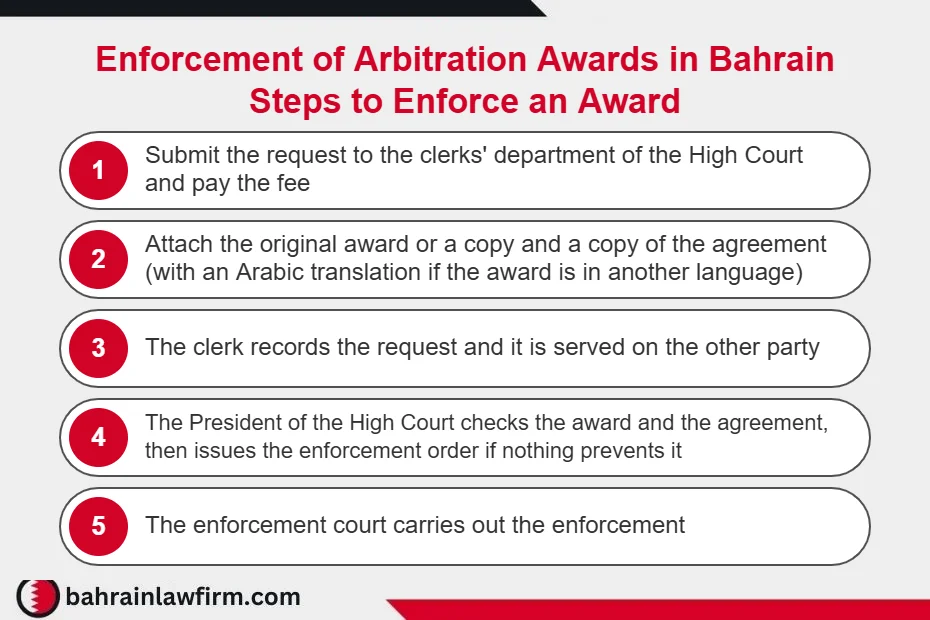
Article 3 of the Enforcement Law sets the steps for the enforcement of arbitration awards in Bahrain, from the request to the order.
- File the request: submit it to the clerks’ department of the High Court after paying the fee. The fee follows the Judicial Fees Law, as the Arbitration Law says in its Article 5.
- Attach the documents: the original award or a copy, and a copy of the arbitration agreement. If the award is not in Arabic, attach an Arabic translation.
- Record and serve: the court clerk writes a record of the request, and a copy is served on the party against whom enforcement is sought.
- Obtain the order: the President of the High Court reviews the award and the agreement and checks that nothing prevents enforcement. He then issues the enforcement order.
- Start enforcement: after the order, the enforcement court proceeds under the Enforcement Law, according to the type of assets or rights that you want to enforce against.
Recognition and Enforcement of Foreign Awards
Article 35 of the Model Law treats an award as binding whatever the country where it was made. Bahrain’s courts also apply the international conventions that are in force in the Kingdom, and the Arbitration Law says so in its Article 1.
Before you file a request, have a commercial lawyer in Bahrain check the award, the arbitration agreement, the place where the award was made and any court case linked to it. A foreign award that has been set aside in its home country faces a serious obstacle.
Grounds for Refusing Enforcement of an Arbitration Award
Article 36 of the Model Law lists the grounds on which a court may refuse recognition or enforcement. The other party must prove the first group of grounds.
- A party to the arbitration agreement lacked capacity, or the agreement is not valid. Our article on arbitration clauses in commercial contracts explains how to draft a valid clause.
- The party was not properly told of the appointment of the arbitrator or of the proceedings, or could not present its case.
- The award deals with a dispute that the agreement does not cover. If the parts can be separated, the court may enforce the part that is covered.
- The tribunal or its procedure did not follow the agreement of the parties or the law of the place of arbitration.
- The award is not yet binding, or a court of the country where it was made has set it aside or suspended it.
The court may also refuse on its own motion if the subject of the dispute cannot be settled by arbitration under Bahraini law, or if enforcement conflicts with public policy.
If a request to set aside the award is pending in the home country, the court may adjourn its decision and may order the other party to give suitable security (Article 36). Challenging the award itself is a separate path with a short time limit, which we explain in our guide on how to challenge an arbitration award in Bahrain.
Frequently Asked Questions About Award Enforcement
These are short answers to the questions we hear most from clients.
Which authority handles the enforcement of an arbitration award in Bahrain?
The request is submitted to the clerks' department of the High Court, and the President of the High Court issues the enforcement order after reviewing the award and the arbitration agreement. After the order, enforcement continues under the Enforcement Law in Civil and Commercial Matters.
How long does the enforcement of an arbitration award take?
There is no single period for all requests. The time depends on the completeness of the documents, the position of the other party, any dispute about recognition or enforcement, and the type of enforcement that is requested.
Can foreign arbitration awards be enforced in Bahrain?
Yes. Article 35 of the Model Law treats an award as binding whatever the country where it was made, and the Arbitration Law is applied together with the international conventions in force in Bahrain. The grounds for refusal in Article 36 still apply.
In which cases can enforcement of an arbitration award be refused?
Enforcement can be refused if the arbitration agreement is invalid, if a party was not properly notified or could not present its case, if the tribunal went beyond the agreement, if the procedure was unlawful, if the award is not binding or was set aside in its home country, or if it conflicts with public policy.
Can the enforcement order be challenged?
The law separates the two paths. A request to set aside the award is an independent path with a time limit of three months, while the grounds of Article 36 are raised against the request for recognition or enforcement. The right step depends on the stage of the dispute.
In conclusion, the enforcement of arbitration awards in Bahrain turns on a full file, the right request to the High Court and a check of the grounds for refusal. For help with your award, see our commercial arbitration cases page and contact us through the WhatsApp button.

A Bahraini lawyer and the founder of a legal consultancy firm established in February 2019. He holds a Higher Degree in Sharia and Law from Al-Azhar University. He has extensive experience in court representation and providing legal advice in criminal, personal status, civil, and commercial matters. He is known for delivering clear, practical, and effective legal advice aimed at protecting his clients’ rights and interests, and has achieved tangible results in notable cases, including commercial litigation and inheritance matters
