

In a commercial case in Bahrain, an arbitration tribunal ruled in favor of a local company against a foreign partner. The partner was not satisfied and asked how the award can be attacked.
This raises a common question about how to challenge an arbitration award in Bahrain and what the law allows. The answer is narrower than most people expect.
Did an arbitration tribunal rule against you? The time limit to challenge the award is short, and it does not wait for you.
Table of Content
Challenge an Arbitration Award in Bahrain: The Only Path
An arbitration award is final and binding, but the law leaves one exception. Article 34 of the Model Law, which the Arbitration Law (Law 9 of 2015) applies, says that an award can be challenged before the courts only by a request to set it aside.
The court does not hear the dispute again on the merits. It checks only the grounds that the law lists.
Grounds for Setting Aside an Award
The party that asks to set the award aside must prove one of these grounds (Article 34(2)).
- Invalid agreement: a party to the arbitration agreement lacked capacity, or the agreement is not valid under the law that applies to it.
- Improper notice: the party was not properly told of the appointment of an arbitrator or of the proceedings, or could not present its case.
- Excess of scope: the award deals with a dispute that the agreement does not cover. If the parts can be separated, only the part outside the agreement is set aside.
- Wrong composition or procedure: the tribunal or the procedure did not follow the agreement of the parties or, if there is no agreement, the law.
The court may also set the award aside on its own finding that the subject of the dispute cannot be settled by arbitration under Bahraini law, or that the award conflicts with public policy.
Stay of the Proceedings and Security
When asked, the court may stay the set-aside proceedings for a period that it sets, so that the tribunal can resume the arbitration or take another step to remove the grounds (Article 34(4)).
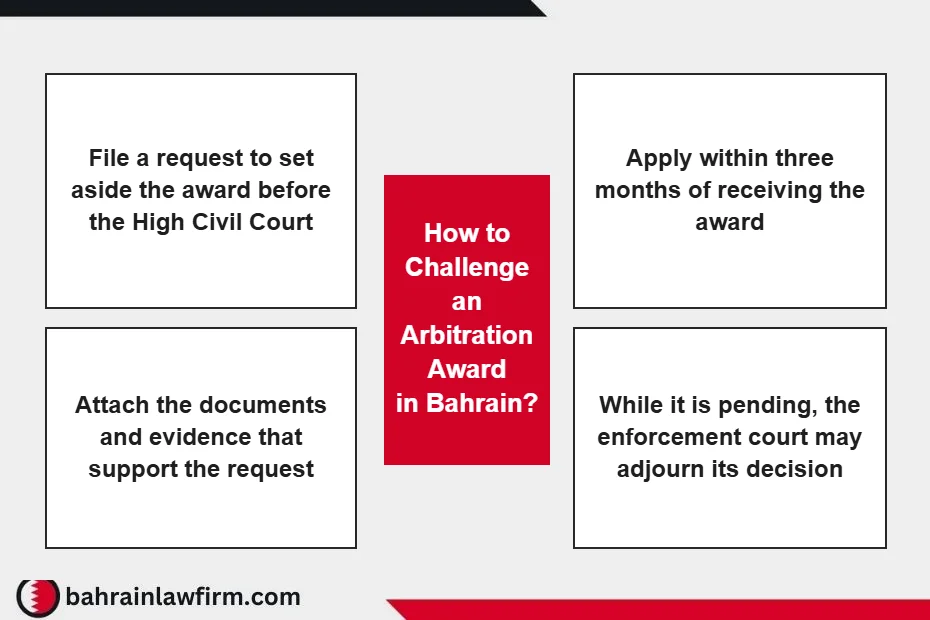
If a set-aside request is pending in the country where the award was made, the court that hears the request to enforce it may adjourn its decision. It may also order the other party to give suitable security (Article 36(2)).
Procedure of a Set-Aside Request
The steps to challenge an arbitration award in Bahrain depend on strict time limits, so each step should be planned from the day you receive the award.
- The time limit: the request cannot be made after three months from the day the party received the award. If a request for correction, interpretation or an additional award was made under Article 33, the three months run from the day the tribunal decided it. A request filed after the deadline cannot be accepted.
- The court: the High Civil Court performs the court functions of the Model Law (Article 3 of the Arbitration Law), and the fees follow the Judicial Fees Law (Article 5).
- The grounds: the request must state clearly which of the legal grounds applies and attach the evidence for it.
Objecting to Recognition or Enforcement
Setting aside is not the same as objecting to enforcement. If the other party asks the court to recognize or enforce the award, you may raise the grounds of Article 36 against that request, such as an invalid agreement or a conflict with public policy.
Our guide on the enforcement of arbitration awards in Bahrain explains these grounds and the steps of the request. For the general path of a dispute, read about arbitration in Bahrain.
How a Lawyer Helps in Challenging an Award
A lawyer reads the award and the arbitration agreement together, checks the dates and tells you whether a ground really exists. This matters because a weak request costs time and does not stop enforcement.
At Bahrain Law Firm, we prepare the request, collect the evidence and follow the case before the court. Contact us through the WhatsApp button on this page.
Frequently Asked Questions About Challenging Awards
These are short answers to the most common questions.
Can an arbitration award be challenged in Bahrain?
Yes, but only by a request to set the award aside before the competent court, on the grounds that the law lists. The court does not hear the dispute again on the merits.
What is the time limit to set aside an arbitration award?
The request cannot be made after three months from the day the party received the award. If a request for correction, interpretation or an additional award was made, the three months run from the day the tribunal decided it (Article 34(3) of the Model Law).
Which court hears a request to set aside an arbitration award in Bahrain?
The High Civil Court performs the court functions that the Model Law gives to the court, as Article 3 of the Arbitration Law says. The fees follow the Judicial Fees Law.
What are the grounds for setting aside an arbitration award?
They are an invalid arbitration agreement or a party without capacity, improper notice or no chance to present the case, an award beyond the scope of the agreement, and a tribunal or procedure that broke the agreement or the law. The court may also act if the subject cannot be settled by arbitration or if the award conflicts with public policy.
Does a set-aside request stop enforcement of the award?
The law does not say that filing the request stops enforcement by itself. Where a request is pending in the country where the award was made, the court that hears the enforcement request may adjourn its decision and order security, so the right step depends on your stage.
In conclusion, to challenge an arbitration award in Bahrain you must use the set-aside request, within three months and on a legal ground. Good planning from the first day protects your rights, so contact a lawyer before the deadline passes.

A Bahraini lawyer and the founder of a legal consultancy firm established in February 2019. He holds a Higher Degree in Sharia and Law from Al-Azhar University. He has extensive experience in court representation and providing legal advice in criminal, personal status, civil, and commercial matters. He is known for delivering clear, practical, and effective legal advice aimed at protecting his clients’ rights and interests, and has achieved tangible results in notable cases, including commercial litigation and inheritance matters
