

In many modern commercial disputes, arbitration is a practical route. A supply contract is delayed, or partners disagree about payment or quality, and arbitration lets them settle the dispute outside the courts with more privacy and more flexible procedures.
This guide explains where arbitration in Bahrain stands among the ways to settle disputes, and what a dispute goes through from the arbitration agreement to the award.
Are financial disputes slowing down your company? Look for a fast solution away from the traditional courts and keep your business private.
Table of Content
Arbitration in Bahrain: What It Means
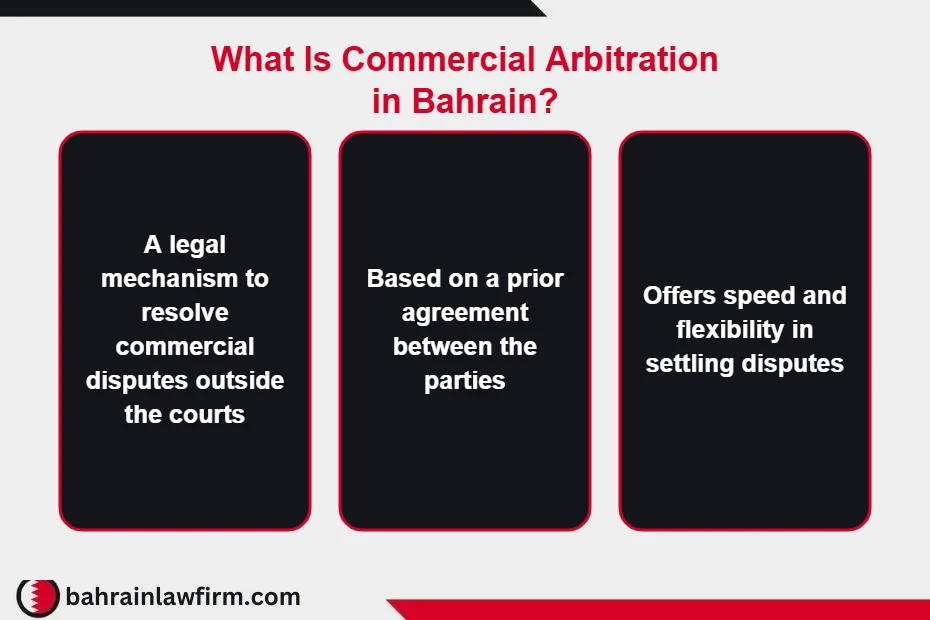
Commercial arbitration is a legal method to settle commercial disputes outside the traditional courts. The parties agree to appoint an arbitrator or a tribunal that decides the dispute by a binding award.
The starting point is not the wish of one party but a written agreement that sets the path. It is usually one of two forms.
- An arbitration clause in a commercial contract, such as a supply or a contracting contract.
- A separate submission agreement that the parties sign after the dispute arises.
The Arbitration Law, Law 9 of 2015
Law 9 of 2015 issued the Arbitration Law, which governs arbitration in Bahrain. Article 1 applies the UNCITRAL Model Law, which is attached to it, to any arbitration whose parties agree to place it under the law, whether it takes place in the Kingdom or abroad.
Article 8 repealed the chapter on arbitration in the Civil and Commercial Procedure Law and the 1994 law on international commercial arbitration. Cases with a foreign element are covered in our guide to international commercial arbitration in Bahrain.
The Written Agreement
The arbitration agreement must be in writing. Article 4 of the Arbitration Law adopts the first option of Article 7 of the Model Law, so an agreement is written if its content is recorded in any form, even if the contract itself was made orally or by conduct.
An electronic communication also meets the condition if its information can be used for later reference. For drafting and validity, see our article on arbitration clauses in commercial contracts.
Court, Fees and Number of Arbitrators
The High Civil Court performs the functions that the Model Law gives to the court (Article 3 of the Arbitration Law). The fees of the requests for recognition, enforcement and setting aside follow the Judicial Fees Law (Article 5).
The parties are free to decide the number of arbitrators. If they do not, the number is three (Article 10 of the Model Law).
Procedure of Commercial Arbitration
Arbitration passes through connected stages, from the agreement to the award and then to enforcement when needed. This section gives the general picture only.
1. The Arbitration Agreement
The agreement is the base of the whole case, because it shows that the parties want the dispute to be heard by arbitration and not by the courts. At this stage the parties check its scope, the rules or the institution they chose, the seat of arbitration and the number of arbitrators.
2. Appointing the Arbitrators
The parties usually choose the arbitrators under the clause or the rules they adopted. The best result comes from an arbitrator who understands the sector of the dispute and has no link or interest in it.
- Suitable experience helps the tribunal understand technical facts.
- Neutrality reduces the risk of procedural objections.
- A backup appointment method in the clause avoids delays.
3. The Proceedings
The tribunal organizes the exchange of documents and memoranda and hears witnesses or experts when the dispute needs it. Orderly evidence saves time and cost, and technical experts are often used in construction, supply and investment disputes.
4. The Award
The tribunal issues the award after the claims, defenses and evidence are complete. The award ends the dispute on the merits, but it is not enforced by itself, because recognition and enforcement have their own requirements. Read our guide on the enforcement of arbitration awards in Bahrain.
An award can be attacked only by a request to set it aside before the competent court (Article 34 of the Model Law), and such a request cannot be made after three months from the day the party received the award. Our guide on how to challenge an arbitration award in Bahrain explains the grounds.
Benefits of Commercial Arbitration
Commercial arbitration has several benefits for companies, but no process can promise a certain result.
- Speed: the procedures are often quicker than traditional litigation, but this depends on the dispute.
- Privacy: the process helps to protect commercial information and data.
- Flexibility: the parties have room to choose the arbitrators and the suitable procedures.
- Binding award: the award has a binding effect, and recognition and enforcement can be requested under the legal conditions.
The Role of a Law Firm in Commercial Arbitration Cases
At Bahrain Law Firm, we turn a dispute into an organized file: clear facts, ordered evidence, a procedural strategy and a risk review before each step. Clients usually need an action plan and not a general description of services.
- We review the arbitration agreement and its scope to choose the suitable procedural path.
- We prepare the case file, with documents, memoranda and technical expertise when needed.
- We follow the stage after the award, including the steps for recognition and enforcement.
To book a consultation on an arbitration dispute or to review the clause in your contract, see our commercial arbitration cases page and contact us through the WhatsApp button.
Frequently Asked Questions About Commercial Arbitration
Here are short answers to the most common questions.
What is the commercial arbitration law in Bahrain?
Arbitration is governed by Law 9 of 2015, which issued the Arbitration Law. Article 1 applies the UNCITRAL Model Law to any arbitration whose parties agree to place it under the law, whether it takes place in the Kingdom or abroad, and Article 8 repealed the older arbitration chapters.
What are the benefits of commercial arbitration compared with litigation?
Arbitration lets the parties choose the arbitrators and agree on the procedure, it often keeps the dispute private, and it ends with a binding award. Speed and cost differ from one dispute to another, and arbitration does not guarantee a result, so the choice depends on the contract and the nature of the dispute.
Must the arbitration agreement be in writing?
Yes. Article 4 of the Arbitration Law adopts the first option of Article 7 of the Model Law, so the agreement is written if its content is recorded in any form, even if the contract was made orally, and an electronic communication is enough if its information can be used later.
How many arbitrators are there in an arbitration?
The parties are free to decide the number and the way of appointing them. If they do not agree on the number, there are three arbitrators under Article 10 of the Model Law, and the High Civil Court performs the court functions if the appointment fails, so a clause should state a clear number and method.
Can an arbitration award be challenged in Bahrain?
An award can be attacked only by a request to set it aside before the competent court, and the request cannot be made after three months from the day the party received the award (Article 34 of the Model Law). This is different from objecting to the recognition or enforcement of the award.
In conclusion, arbitration in Bahrain is a developed legal framework that helps settle commercial disputes with fairness and efficiency. If you face a commercial dispute, ask a commercial lawyer in Bahrain to review your agreement before you start.

A Bahraini lawyer and the founder of a legal consultancy firm established in February 2019. He holds a Higher Degree in Sharia and Law from Al-Azhar University. He has extensive experience in court representation and providing legal advice in criminal, personal status, civil, and commercial matters. He is known for delivering clear, practical, and effective legal advice aimed at protecting his clients’ rights and interests, and has achieved tangible results in notable cases, including commercial litigation and inheritance matters
