
Many people search for Consequences of Not Paying Deferred Mahr to understand whether a husband’s failure to pay the deferred mahr leads to a legal penalty, or what legal options are available for the wife to claim her right.
The deferred mahr is considered a financial right belonging to the wife, established according to the marriage contract and the provisions regulating mahr under the Bahraini Family Law.
However, failure to pay the deferred mahr does not mean that a criminal penalty automatically applies due to non-payment.
Instead, the wife has the right to claim this financial entitlement before the competent court when it becomes due, while reviewing the marriage contract and the circumstances related to the case to determine the appropriate legal action.
Are you facing an issue due to failure to pay the deferred mahr and need to know the legal way to claim your right?
Contact a deferred mahr lawyer now You can continue reading first to learn about the legal rules and procedures related to deferred mahr.
Legal Notice: The information provided in this article offers a general explanation of the legal provisions related to deferred mahr in Bahrain. It does not constitute specific legal advice or replace reviewing the details of each case with a specialised lawyer.
Table of Content
What Is Deferred Mahr Under Bahraini Law?
Deferred mahr refers to the postponed part of the dowry that is not paid at the time of concluding the marriage contract. Instead, it becomes payable when the agreed condition between the spouses occurs or according to the applicable legal provisions regulating it. Understanding the Consequences of Not Paying Deferred Mahr requires first knowing that deferred mahr remains a financial right owed to the wife once it becomes due.
Mahr is considered one of the financial rights established for the wife under the marriage contract requirements. It includes the immediate mahr and the deferred mahr according to what was agreed upon when the marital relationship was established. Therefore, postponing part of the mahr does not mean waiving it or losing the right to it. It only means delaying the time of payment until the stage when it becomes due.
The Bahraini Family Law No. (19) of 2017 regulates provisions related to marriage, mahr, and their legal effects. It establishes the general framework for rights and obligations arising from the marital relationship, including the rules governing financial rights such as deferred mahr and the legal implications related to failure to fulfil these obligations.
| Comparison Aspect | Immediate Mahr | Deferred Mahr |
|---|---|---|
| Payment Time | Paid at marriage or at the agreed time | Postponed until the time of entitlement |
| Nature of the Right | Part of the mahr | Part of the mahr |
| Reason for Postponement | No postponement in principle | Agreement between spouses to postpone payment |
Is There a Penalty for Not Paying Deferred Mahr in Bahrain?
The Consequences of Not Paying Deferred Mahr do not involve a criminal penalty simply because the husband fails to make the payment. Instead, the matter is related to the wife’s right to claim this financial entitlement through legal procedures if the deferred mahr has become due and has not been paid.
A distinction must be made between refusing to fulfil a financial obligation and committing a crime punishable by law, as criminal penalties require a clear legal provision that establishes such punishment.
When a dispute arises regarding deferred mahr, the competent court reviews the documents and facts related to the case, including the marriage contract and any conditions stated in relation to the mahr.
Failure to pay deferred mahr in Bahrain does not automatically result in a criminal penalty. The wife may claim her financial right before the competent court once the deferred mahr becomes due, based on the marriage contract and the legal circumstances of each case.
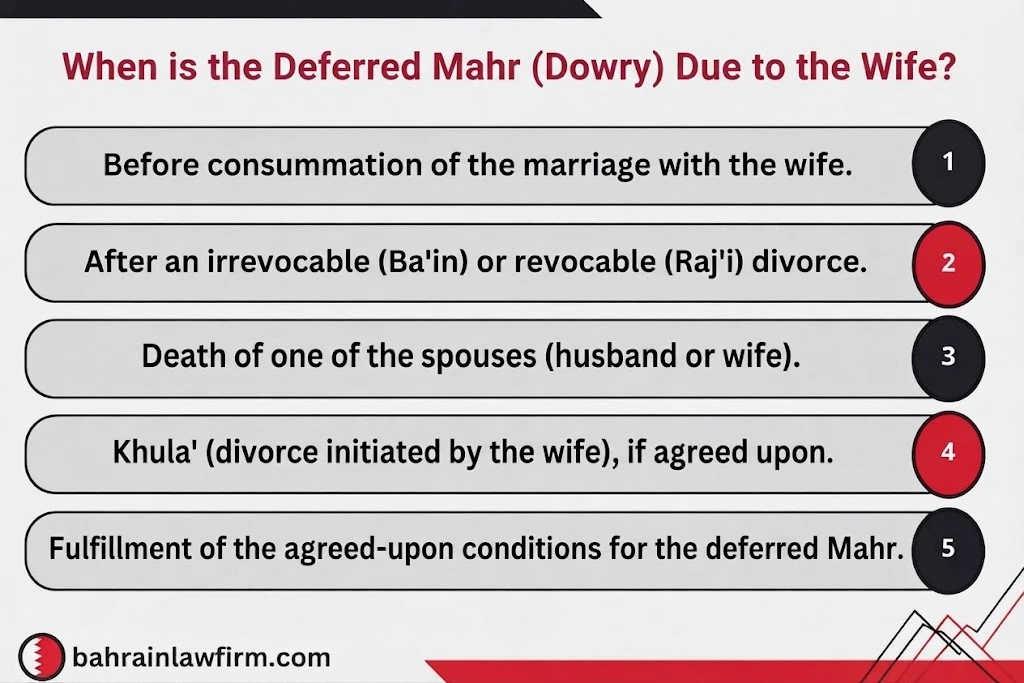
When Does Deferred Mahr Become Due to the Wife?
The reason for entitlement to deferred mahr is determined according to what is stated in the marriage contract and the circumstances surrounding the marital relationship. Therefore, not every case can be treated in the same way, as the time of entitlement may vary depending on the wording of the contract and the reason behind the claim.
The circumstances commonly associated with entitlement to deferred mahr include:
- Divorce occurring if the deferred mahr was agreed to become payable upon divorce.
- The husband’s death if entitlement is linked to this event.
- The occurrence of the condition agreed upon in the marriage contract.
Each case requires reviewing the details of the marriage contract and related documents before determining whether the deferred mahr can be claimed and identifying the appropriate legal procedure.
The failure to pay deferred mahr differs from losing the right to it. The husband’s refusal to pay the deferred mahr after it becomes due does not mean that the wife’s right automatically ends. Determining whether the right exists or has been lost depends on the facts, documents, and valid agreements governing the marital relationship.
Before filing a claim, it may be necessary to verify certain matters, such as whether there was a valid waiver of the right, financial agreements between the spouses, or the nature of the procedure through which the marital relationship ended.
| Situation | Possible Legal Effect |
|---|---|
| The husband refuses to pay the deferred mahr after it becomes due | The wife may claim her right through the appropriate legal procedures. |
| Existence of a valid waiver or agreement regarding the right | The content of the agreement and its legal effects must be reviewed. |
| A dispute regarding the amount of deferred mahr or its entitlement | The competent court decides the dispute based on the submitted documents. |
How Can the Wife Claim Deferred Mahr in Bahrain?
The claim for deferred mahr begins by reviewing the legal circumstances of the case and confirming the availability of documents proving the existence of the right, its amount, and the time when it became due. After that, the appropriate legal procedures are taken before the competent authority.
The details of the procedures vary depending on the circumstances of each claim, but the general steps usually include:
- Reviewing the marriage contract to determine the value of the deferred mahr and the conditions related to it.
- Preparing documents and records related to the marriage, divorce, or reason for entitlement.
- Submitting the claim before the competent court according to the approved procedures.
- Following up on the case and submitting the required documents or legal arguments until a decision is issued.
Seeking assistance from a lawyer specialised in personal status cases helps in understanding the appropriate legal process and avoiding procedural mistakes, especially when there is a dispute regarding entitlement to deferred mahr or the method of claiming it.
Is There a Penalty for Not Paying Deferred Mahr in Bahrain?
The Consequences of Not Paying Deferred Mahr do not involve a criminal penalty simply because the husband fails to make the payment. Instead, the matter is related to the wife’s right to claim this financial entitlement through legal procedures if the deferred mahr has become due and has not been paid.
A distinction must be made between refusing to fulfil a financial obligation and committing a crime punishable by law, as criminal penalties require a clear legal provision that establishes such punishment.
When a dispute arises regarding deferred mahr, the competent court reviews the documents and facts related to the case, including the marriage contract and any conditions stated in relation to the mahr.
Failure to pay deferred mahr in Bahrain does not automatically result in a criminal penalty. The wife may claim her financial right before the competent court once the deferred mahr becomes due, based on the marriage contract and the legal circumstances of each case.
When Does Deferred Mahr Become Due to the Wife?
The reason for entitlement to deferred mahr is determined according to what is stated in the marriage contract and the circumstances surrounding the marital relationship. Therefore, not every case can be treated in the same way, as the time of entitlement may vary depending on the wording of the contract and the reason behind the claim.
The circumstances commonly associated with entitlement to deferred mahr include:
- Divorce occurring if the deferred mahr was agreed to become payable upon divorce.
- The husband’s death if entitlement is linked to this event.
- The occurrence of the condition agreed upon in the marriage contract.
Each case requires reviewing the details of the marriage contract and related documents before determining whether the deferred mahr can be claimed and identifying the appropriate legal procedure.
Consequences of Not Paying Deferred Mahr vs. Loss of Wife’s Right
The failure to pay deferred mahr differs from losing the right to it. The husband’s refusal to pay the deferred mahr after it becomes due does not mean that the wife’s right automatically ends. Determining whether the right exists or has been lost depends on the facts, documents, and valid agreements governing the marital relationship.
Before filing a claim, it may be necessary to verify certain matters, such as whether there was a valid waiver of the right, financial agreements between the spouses, or the nature of the procedure through which the marital relationship ended.
| Situation | Possible Legal Effect |
|---|---|
| The husband refuses to pay the deferred mahr after it becomes due | The wife may claim her right through the appropriate legal procedures. |
| Existence of a valid waiver or agreement regarding the right | The content of the agreement and its legal effects must be reviewed. |
| A dispute regarding the amount of deferred mahr or its entitlement | The competent court decides the dispute based on the submitted documents. |
How Can the Wife Claim Deferred Mahr in Bahrain?
The claim for deferred mahr begins by reviewing the legal circumstances of the case and confirming the availability of documents proving the existence of the right, its amount, and the time when it became due.
Understanding the Consequences of Not Paying Deferred Mahr also helps the wife identify the available legal options and determine the appropriate procedure to claim her financial entitlement before the competent authority.
The details of the procedures vary depending on the circumstances of each claim, but the general steps usually include:
- Reviewing the marriage contract to determine the value of the deferred mahr and the conditions related to it.
- Preparing documents and records related to the marriage, divorce, or reason for entitlement.
- Submitting the claim before the competent court according to the approved procedures.
- Following up on the case and submitting the required documents or legal arguments until a decision is issued.
Seeking assistance from a lawyer specialised in personal status cases helps in understanding the appropriate legal process and avoiding procedural mistakes, especially when there is a dispute regarding entitlement to deferred mahr, the Consequences of Not Paying Deferred Mahr, or the method of claiming it.
What Documents Are Required to Claim Deferred Mahr?
The required documents depend on the nature and circumstances of each case. Therefore, there is no single list that applies to all situations. However, the wife usually needs documents proving the marital relationship and the financial right being claimed.
| Document | Purpose |
|---|---|
| Marriage contract | Proving the marriage details and the information related to the mahr. |
| Divorce documents, if available | Proving the situation that resulted in the claim for deferred mahr. |
| Any documents related to financial agreements | Clarifying any conditions or agreements that may affect the right. |
It is preferable to review the documents before starting the procedures to ensure they are complete and determine whether any additional steps are required.
Not Paying Deferred Mahr vs. Losing the Wife’s Right
The matter does not end once the right has been established, as legal procedures are available for enforcing issued judgments according to the applicable system. Enforcement procedures vary depending on the type of judgment, the competent authority, and the circumstances related to the person against whom the judgment was issued.
Dealing with the enforcement stage requires careful attention to deadlines and procedures because obtaining a court judgment represents one stage of the claim process, while enforcement is governed by separate legal procedures.
Do you have a dispute regarding deferred mahr or has the husband refused to fulfil the due financial right?
Request a legal review of your case
Continue reading to find answers to the most common questions about deferred mahr.
When Does the Wife Need a Lawyer to Claim Deferred Mahr?
Not all cases require the same level of legal assistance. Some claims may be clear based on the available documents, while other cases require specialised legal review due to the existence of a dispute or disagreement regarding entitlement.
The lawyer’s role becomes more important in circumstances such as:
- A dispute regarding the interpretation of what is stated in the marriage contract.
- The husband’s objection to the entitlement or amount of deferred mahr.
- The need to follow up on judicial and enforcement procedures.
- The presence of multiple issues connected to the case, such as divorce or other financial rights.
Early legal review helps identify available options based on the details of the case instead of relying on general information that may not reflect all circumstances.
Why Consult a Personal Status Lawyer for Deferred Mahr?
Cases involving Consequences of Not Paying Deferred Mahr require careful review of the marriage contract and the circumstances that led to the claim by a Sharia lawyer, because determining the right does not depend only on the existence of deferred mahr, but also on the time it becomes due and the nature of the legal relationship between the spouses.
A specialised lawyer can assist with:
- Reviewing the marriage contract and identifying information related to the mahr and deferred amount.
- Explaining the appropriate legal procedures according to the circumstances.
- Reviewing documents before submitting any legal claim.
- Following up on procedures before the competent authorities when required.
This gives the concerned party a clearer understanding of their legal position and the steps that can be taken before beginning official procedures.
FAQ About Consequences of Not Paying Deferred Mahr in Bahrain
The most common questions related to this topic include:
Is Failure to Pay Deferred Mahr Considered a Crime in Bahrain?
Failure to pay deferred mahr is not considered a crime by itself simply due to non-payment. Instead, it is a financial right that the wife may claim when it becomes due according to the provisions regulating mahr. The legal treatment varies depending on whether there is a dispute, refusal to comply, or other circumstances related to the case.
Can the Wife File a Claim for Deferred Mahr After Divorce?
The wife may claim deferred mahr after divorce if it has become due according to the marriage contract and the relevant legal provisions. The claim requires reviewing the details of the contract and documents related to the marriage and divorce to determine whether the deferred mahr is payable and what legal procedure should be followed.
Does the Wife’s Right to Deferred Mahr Expire Due to the Passage of Time?
The effect of the passage of time on claiming deferred mahr cannot be determined generally without reviewing the applicable legal rules and the circumstances of each case. Therefore, the facts and documents must be examined to determine whether there is any legal obstacle affecting the ability to claim this right.
How Can the Wife Prove Her Right to Deferred Mahr?
The right to deferred mahr is usually proven through the marriage contract and the information it contains regarding the mahr, in addition to the documents and facts related to the case. The court may need to review the documents submitted by both parties before deciding the dispute.
Does Claiming Deferred Mahr Differ in the Case of Khula Divorce?
The legal effects vary depending on the type of termination of the marital relationship and the agreements made between the parties. Therefore, the effect of khula divorce on deferred mahr cannot be determined without reviewing the details of the case, the terms of the agreement, or the judgment issued in the matter.
Understanding the Consequences of Not Paying Deferred Mahr requires distinguishing between failure to fulfil a financial obligation and the existence of a criminal offence. Non-payment does not automatically create a criminal penalty, but it may allow the wife to pursue her financial right through the legal procedures available in Bahrain when the deferred mahr becomes due.
The possibility of claiming deferred mahr depends on reviewing the marriage contract, the circumstances surrounding the end of the marital relationship, and the available documents. Therefore, obtaining a legal assessment helps determine the appropriate procedure based on the details of each case.
Legal Sources:
- Bahraini Family Law No. (19) of 2017 issued by the Kingdom of Bahrain.
- The official authority responsible for publishing legislation and laws in the Kingdom of Bahrain.
Disclaimer: The information provided in this article is intended to offer a general explanation of the legal provisions related to deferred mahr in Bahrain. It does not constitute specific legal advice and does not create an attorney-client relationship. Procedures and outcomes vary depending on the details of each case. Therefore, it is recommended to consult a specialised lawyer before taking any legal action.

A Bahraini lawyer and the founder of a legal consultancy firm established in February 2019. He holds a Higher Degree in Sharia and Law from Al-Azhar University. He has extensive experience in court representation and providing legal advice in criminal, personal status, civil, and commercial matters. He is known for delivering clear, practical, and effective legal advice aimed at protecting his clients’ rights and interests, and has achieved tangible results in notable cases, including commercial litigation and inheritance matters
