

Legal Review: This content was written and reviewed by the legal team at Abdulrahman Khalifa Law Firm.
Last Updated: August 31, 2026.
Category: Bahraini Corporate and Commercial Law.
General Partnership Formation in Bahrain can be a suitable option when two or more partners wish to carry on a business based on mutual trust, direct management, and the sharing of profits and losses.
However, this type of company requires particular legal attention because the partners’ liability is not limited to their capital contributions. It may extend to their personal assets whenever the company incurs obligations toward third parties.
For this reason, General Partnership Formation in Bahrain should not be viewed merely as an electronic Commercial Registration procedure. It is a legal and investment decision that should be preceded by a careful assessment of the nature of the business, the relationship between the partners, management powers, withdrawal arrangements, profit distribution, and the manner in which future debts and claims will be handled.
Are you preparing to launch a business partnership but concerned that you could become personally liable for the company’s debts? Protect your personal assets and your relationship with your partners through carefully planned legal arrangements.
Table of Content
What Is a General Partnership in Bahrain?
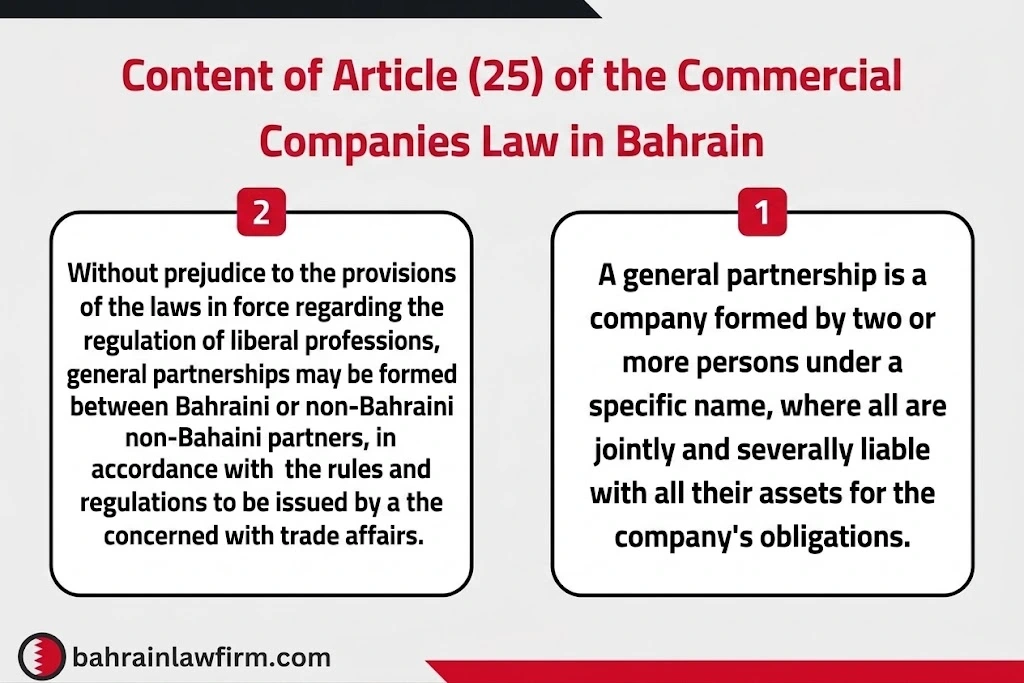
Under Article 25 of the Commercial Companies Law promulgated by Legislative Decree No. 21 of 2001, a general partnership is a company formed by two or more persons under a specific name. Its partners are jointly and severally liable, with all their assets, for the obligations of the company.
The law permits the formation of companies as general partnerships between Bahraini partners or even non-Bahraini partners, subject to the rules and conditions prescribed by a decision of the minister responsible for commerce.
The name of a general partnership may consist of the names of all partners, or the name of one or more of them followed by “& Partners” or wording of a similar meaning. The company may also use another name accepted by the ministry responsible for commerce, provided that the company name is followed by the designation “Bahraini General Partnership Company.”
Article 28 further provides that any person who is not a partner but knowingly agrees to have their name included in the company’s name may become jointly and severally liable for its obligations toward any third party who relied on that name in good faith.
Difference Between a General Partnership and a With Limited Liability Company
Investors should understand the distinction before choosing a legal structure. In a general partnership, liability is generally broader and more closely attached to the partners personally. In a With Limited Liability Company (W.L.L.), a partner’s liability is generally limited to their share in the capital, subject to certain legal exceptions relating to management, violations, and other obligations.
| Comparison | General Partnership | With Limited Liability Company (W.L.L.) |
|---|---|---|
| Number of Partners | Two or more persons | Subject to the statutory requirements applicable to the company |
| Liability | Joint and several and may extend to personal assets | Generally limited to the partner’s share, subject to exceptions |
| Personal Trust | A fundamental element | Important, but not to the same extent |
| Transfer of Interests | Generally restricted and subject to partners’ approval | Governed by the Memorandum of Association and applicable law |
| Suitable For | Closely held family or business partnerships | Small and medium-sized businesses and structured investments |
| Personal Risk Level | High | Relatively lower |
Requirements for General Partnership Formation in Bahrain
For General Partnership Formation in Bahrain to be completed properly, several legal and procedural requirements should be taken into account, including:
- Having at least two partners.
- Selecting an acceptable trade name suitable for a general partnership.
- Preparing a clear written Memorandum of Association.
- Precisely identifying the company’s business activity in accordance with permitted activities.
- Specifying the company’s principal place of business in Bahrain.
- Determining the capital and each partner’s contribution.
- Appointing the manager or managers and defining their signing powers.
- Regulating the distribution of profits and losses.
- Specifying the company’s duration if it is established for a fixed term.
The company must also be registered in the Commercial Register and any required approvals must be obtained from the relevant authorities.
Steps for General Partnership Formation in Bahrain
General Partnership Formation in Bahrain involves a series of procedures and requirements that must be properly completed:
1. Assess the Business Activity and Choose the Appropriate Legal Structure
Before beginning the registration process, the partners should determine whether a general partnership is genuinely the most suitable legal structure for the proposed business. It is not enough for the structure to be legally available; it should also be appropriate in light of the level of risk, the nature of the contracts, the number of partners, the management structure, and the sources of financing.
At this stage, a lawyer or legal adviser will typically consider important questions such as:
- Does the business involve a high level of risk or significant debt?
- Will the manager enter into long-term contracts?
- Are any partners not actively involved in management?
- Is there an intention to bring in new investors in the future?
- Would a general partnership or a With Limited Liability Company be more appropriate?
2. Reserve the Trade Name
Once the legal structure has been selected, an appropriate trade name should be chosen and submitted to the competent authority through the Commercial Registration portal. The name must not be misleading or contrary to applicable regulations, and it must not conflict with registered business names or protected trademarks.
3. Prepare the General Partnership Memorandum of Association
The Memorandum of Association is one of the most important documents in a general partnership. Weak or inadequate drafting can later result in disputes between partners or expose them to unexpected liabilities.
The Memorandum should clearly address:
- The company’s name.
- The company’s purpose and business activities.
- The address of its principal place of business and any branches.
- The partners’ details, nationalities, and places of residence.
- The capital and each partner’s contribution.
- The nature of each contribution, whether in cash, in kind, through work, or expertise, where legally and regulatorily permitted.
- The powers of the manager or managers.
- Limits on authority to sign contracts and incur banking obligations.
- The mechanism for distributing profits and losses.
- The decision-making process.
- Procedures for admitting a new partner or withdrawing an existing partner.
- Restrictions on competition and the exploitation of business opportunities.
- The company’s financial year.
- Grounds for dissolution and liquidation.
- The mechanism for resolving disputes between partners.
4. Notarize the Memorandum of Association
Once the Memorandum has been prepared, it must be notarized in the legally required manner. It is important to understand that notarization alone does not remedy poor drafting. Notarization establishes the existence and formal validity of the document, but it does not correct a missing, ambiguous, or unfair contractual provision.
5. Submit the Commercial Registration Application
The company’s registration application must be submitted through the competent channels together with the required documents and applicable fees. Depending on the nature of the business, certain activities may require additional approvals from regulatory authorities.
6. Publish a Summary of the Memorandum of Association
An important requirement for a general partnership is the publication of a summary of its Memorandum of Association in accordance with the applicable rules. The summary typically includes information such as the company name, business purpose, registered office, names of the partners, capital, managers, date of incorporation, and financial year.
7. Complete Subsequent Licences and Compliance Requirements
After obtaining the Commercial Registration, the company may need to complete additional steps, such as opening a bank account, leasing business premises, registering employees, obtaining business licences, and maintaining the required commercial and accounting books and records.
Contact a lawyer in Bahrain at Abdulrahman Khalifa Law Firm. You can book an online or in-person legal consultation by clicking the WhatsApp button at the bottom of the screen.
Liabilities of Partners in a General Partnership
| Type of Liability | What It Means | Practical Risk | How to Reduce the Risk |
| Liability for Company Debts | Partners are jointly and severally liable for the company’s obligations | A creditor may seek recovery against a partner’s personal assets | Clearly regulate borrowing and signing powers |
| Management Liability | The manager must act within the company’s purpose and the authority granted | Entering into contracts beyond the manager’s authority | Establish clear financial and procedural limits |
| Liability of a New Partner | Liability may extend to previous and subsequent debts in accordance with the law | Joining the company without reviewing its financial position | Conduct legal and financial due diligence before admission |
| Liability of a Withdrawing Partner | The partner may remain liable for previous obligations subject to applicable rules | Claims arising after withdrawal | Properly record and publish the withdrawal and document the settlement |
| Non-Competition Obligations | A partner may not compete with the company without approval | Loss of clients and business opportunities | Include a clear non-compete clause |
| Protection of Company Funds | Company funds must not be used for personal purposes | Repayment obligations and claims for compensation | Separate accounts and properly document expenses |
| Duty of Disclosure | Conflicts of interest and relevant interests should be disclosed | Invalid decisions or compensation claims | Adopt a clear conflict-of-interest policy |
| Books and Records | Company documents and transactions must be properly maintained | Difficulty defending the company in disputes | Maintain an organized accounting and document-retention system |
Key Legal Risks of General Partnership Formation in Bahrain
There are several legal risks that new founders may overlook. The most significant include:
1. Joint and Several Liability
The most significant risk associated with a general partnership is that a partner may be held liable for the company’s debts from their personal assets. Choosing partners carefully and clearly defining management powers are therefore not merely legal formalities; they are essential measures for protecting each partner’s financial position.
2. A Poorly Drafted Memorandum of Association
Short-form agreements and generic templates may not be sufficient. Partners may later discover that their Memorandum does not address critical situations such as the death or withdrawal of a partner, loss of capital, conflicts of interest, or restrictions preventing one partner from independently entering into significant obligations.
3. Excessively Broad Signing Powers
If a manager or partner is given broad authority without adequate controls, they may enter into contracts, obtain loans, or provide guarantees that expose both the company and the partners to substantial liability. Financial authority, transactions requiring collective approval, and the limits of unilateral action should therefore be clearly defined.
4. Admitting a New Partner Without Due Diligence
The admission of a new partner may have significant legal consequences, particularly in relation to debts and existing obligations. A clear admission agreement should be prepared, the company’s financial position should be reviewed, and the extent to which the new partner may assume previous liabilities should be determined while taking into account the legal effect toward third parties.
5. Mixing Company Funds With Partners’ Personal Funds
Using personal accounts for company transactions, paying private expenses from company funds, or failing to maintain proper accounting records can all create disputes and potential legal liability.
6. Competition Between Partners
A partner may establish a competing business or divert the company’s clients for personal benefit. It is therefore important to include provisions restricting competition and the misappropriation of business opportunities, together with appropriate remedies and compensation provisions.
7. Failure to Update Commercial Registration Details
Changes involving the manager, the withdrawal of a partner, the company’s activities, relocation of its registered office, or changes to partners’ interests should be dealt with legally and updated with the relevant authorities whenever required by law. Failure to update such information can create liabilities and complications in dealings with third parties.
Documents Required for General Partnership Formation in Bahrain
The required documents should not be treated merely as an administrative checklist. For General Partnership Formation in Bahrain, they form an integrated legal file establishing the partners’ identities, the nature of the business, management authority, and the company’s registered office. Incorrect information or missing documents may delay registration or contribute to future disputes between the partners.
Partners’ Documents
Partners’ documents generally include copies of identity cards or passports, address details, and official contact information. If one of the partners is a legal entity, documents relating to that corporate partner will also be required, such as its Commercial Registration, a resolution approving participation in the partnership, and details of its legal representative. These documents establish who the actual partner is, who bears the relevant obligations, and who has authority to sign or represent the partner. They are directly connected to partner liability in a general partnership because a partner is not merely a name appearing in an agreement; the partner may ultimately be personally liable for the company’s debts and obligations.
Memorandum of Association Documents
The Memorandum of Association is the principal document governing the formation of a general partnership. It should specify the company’s name, purpose, registered office, details of the partners, capital, each partner’s contribution, the distribution of profits and losses, the manager’s powers, the decision-making process, and the circumstances governing withdrawal, death, or liquidation.
A weak or overly brief Memorandum may give rise to significant disputes, particularly where it fails to define management powers, the process for a partner’s exit, or restrictions on dealing with company assets.
Management and Signing Authority Documents
The company must identify its manager or managers and the persons authorized to sign on its behalf, together with the limits of their authority. The Memorandum or an internal agreement should preferably specify whether a manager may borrow funds, enter into long-term contracts, open bank accounts, or provide guarantees in the company’s name.
The less clearly management powers are defined, the greater the likelihood of disputes between partners and the greater the risk that third parties may pursue the company and its partners in connection with actions taken by the manager.
Registered Office and Business Activity Documents
These documents generally include evidence of the company’s address or business premises, details of the commercial activity to be registered, and any additional approvals or licences required where the activity is regulated or subject to specific conditions.
Accurately defining the company’s activities is particularly important because conducting business outside the scope of the applicable licence may expose the company to violations, claims, or procedural delays.
Special Approval Documents
For certain activities, obtaining a Commercial Registration alone may not be sufficient. Additional approvals from competent authorities may be required depending on the nature of the business, including for financial, healthcare, educational, professional, or other regulated activities.
How Can a Corporate Lawyer in Bahrain Help You?
When you consult a corporate lawyer, the legal service should go beyond simply completing a registration form. Proper legal assistance usually involves several stages, including:
- Understanding the business activity, number of partners, capital, risks, and expansion plans.
- Recommending the most appropriate legal structure, whether a general partnership or another form of company.
- Drafting a tailored Memorandum of Association rather than relying on a generic template.
- Reviewing the documents and preparing the registration file.
- Following up on registration, licences, and regulatory approvals.
- Preparing an internal partners’ agreement where the project requires additional arrangements that do not all need to appear in the Memorandum of Association.
- Providing ongoing advice regarding management, contracts, employment, taxation, disputes, or liquidation.
Frequently Asked Questions
Common questions regarding General Partnership Formation in Bahrain include:
What Taxes and Fees Are Payable for General Partnership Formation in Bahrain?
The taxes and fees payable for General Partnership Formation in Bahrain vary depending on the scale of the business activity and the applicable licensing and registration requirements.
Can a Non-Bahraini Establish a General Partnership in Bahrain?
Yes. A non-Bahraini may establish a general partnership in Bahrain, subject to the applicable legal and regulatory requirements.
What Are the Legal Requirements for General Partnership Formation in Bahrain?
The main legal requirements for General Partnership Formation in Bahrain include:
Preparing the contracts and documents required for incorporation.
Having the partners adopt the company's constitutional arrangements in a formally executed and notarized instrument.
Completing the company's official registration.
Publishing the partnership agreement as required by law.
What Documents Are Required for General Partnership Formation in Bahrain?
The documents generally required for General Partnership Formation in Bahrain include:
Copies of the partners' identification cards and, for foreign partners, copies of their passports.
A title deed or lease agreement for the company's premises, together with any required security clearance where a foreign partner is involved.
A certificate confirming the availability and approval of the company's trade name.
Can a General Partnership Be Formed by Only Two Partners?
Yes. A general partnership may be established by two or more persons, provided that all applicable legal and procedural requirements are satisfied.
This concludes our guide to General Partnership Formation in Bahrain, in which we have explained the key legal requirements for establishing a general partnership in Bahrain, together with the applicable taxes and fees and the documents required for company formation.
Take the first step toward forming your general partnership by consulting a lawyer at Abdulrahman Khalifa Law Firm. Simply click the WhatsApp button at the bottom of the screen.
You may also be interested in: Corporate and Investment Cases in Bahrain.

A Bahraini lawyer and the founder of a legal consultancy firm established in February 2019. He holds a Higher Degree in Sharia and Law from Al-Azhar University. He has extensive experience in court representation and providing legal advice in criminal, personal status, civil, and commercial matters. He is known for delivering clear, practical, and effective legal advice aimed at protecting his clients’ rights and interests, and has achieved tangible results in notable cases, including commercial litigation and inheritance matters
