

A misdemeanor appeal in Bahrain is an important legal tool. It lets the accused challenge a judgment issued by a court of first instance.
For example, an accused may feel that the judgment was unfair or had no sound legal basis. He can then ask for the case to be reviewed through an appeal.
This guide explains the grounds, the steps and the legal basis of a misdemeanor appeal in Bahrain, and the powers of the court of appeal. Our team at Bahrain Law Firm keeps each point simple.
A first instance judgment was issued against you in a misdemeanor case and you fear it will be enforced? The appeal deadline is short. Our criminal lawyers can review the judgment and file the appeal on time.
Table of Content
Grounds for a Misdemeanor Appeal in Bahrain
The accused or the Public Prosecution relies on these grounds to challenge a first instance judgment. They help ensure that justice is done and that the procedures were correct.
- A mistake in applying the law: the court relied on a legal provision that does not apply, or it interpreted the provisions wrongly.
- Weak reasoning of the judgment: a judgment must give legal reasons based on the evidence. It falls short if it does not explain why the court decided as it did, does not show how the law applies to the evidence and facts, or uses vague or incomplete wording.
- New evidence: new witness statements, documents or technical reports may appear after the judgment. The court of appeal may itself hear the witnesses who should have been heard at first instance, complete any gap in the investigation and order any investigation or hearing of witnesses it sees as necessary (Article 301 of the Criminal Procedure Law).
- Nullity in the procedures: for example, the accused was not allowed to defend himself or to have a lawyer, the legal notice periods or the hearings were not respected, or contradictory evidence was ignored without a legal reason.
- A penalty that does not fit the offence: the sentence may be too harsh or too lenient. The accused or the Public Prosecution can appeal to adjust it.
- A conflict between the evidence and the judgment: for example the judgment rests on weak or doubtful evidence, or the court ignored decisive evidence in favour of the accused.
- A violation of the accused’s rights: these include the right to a fair trial, the right to defend himself and to have witnesses heard, and the right not to be forced to confess.
Procedures to File a Misdemeanor Appeal
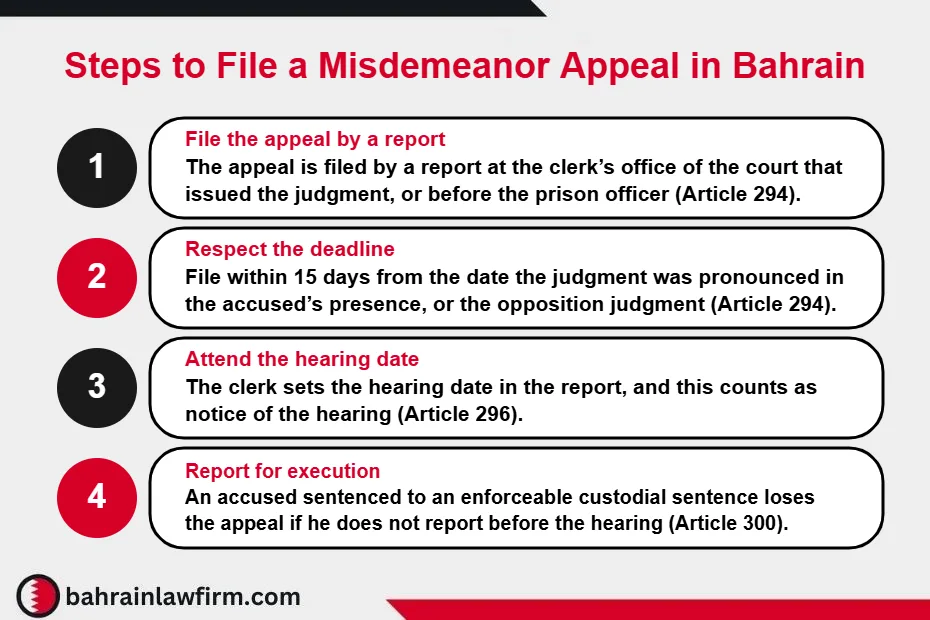
To file a misdemeanor appeal in Bahrain, follow these legal steps closely:
- File the appeal by a report. The appeal is made by a report at the clerk’s office of the court that issued the judgment, or before the prison officer (Article 294).
- Respect the deadline. The appeal must be filed within 15 days from the date the judgment was pronounced in the accused’s presence, or from the opposition judgment. For a default judgment, the period runs from the end of the opposition period (Article 294). The Attorney General may appeal within 30 days from the judgment, and the court may accept a late appeal for an acceptable excuse (Article 295).
- Know the hearing date. The clerk sets the hearing date in the report, and this counts as notice of the hearing. The date cannot be set before three full days have passed (Article 296).
- Wait for the hearing. The appeal goes to the competent court of appeal, which sets a hearing within 30 days at most from the date of the report. If the accused is detained, the earliest hearing is set and the appeal is heard urgently (Article 298).
- Report for execution. An appeal by an accused who was sentenced to an enforceable custodial sentence lapses if he does not report for execution before the hearing (Article 300).
Legal Basis of the Appeal in Misdemeanors
The appeal rests on specific provisions of the Criminal Procedure Law. These are the main ones:
- Article 292: the accused and the Public Prosecution may appeal judgments issued in the criminal case by courts of first instance.
- Article 294: the appeal is made by a report at the clerk’s office of the court that issued the judgment, or before the prison officer, within 15 days from the pronouncement of the judgment in the accused’s presence.
- Article 301: the court of appeal may hear the witnesses itself and complete any gap in the investigation.
- Article 302: it sets out the powers of the court of appeal to uphold, cancel or amend the judgment.
Powers of the Court of Appeal
When the court looks at an appeal, it has wide powers. They include the following:
- Upholding the judgment if it rests on sound legal grounds.
- An appeal by the Public Prosecution: the court may uphold, cancel or amend the judgment, against the accused or in his favour. It cannot increase the penalty or cancel an acquittal except by the unanimous vote of its judges (Article 302).
- An appeal by someone other than the Public Prosecution, such as the accused: the court may uphold or amend the judgment only in favour of the appellant (Article 302).
- Correcting a nullity in the procedures or in the judgment and deciding the case anew. It sends the case back to the court of first instance when that court ruled that it had no jurisdiction, or accepted a preliminary plea that stopped the case, and the court of appeal cancelled that ruling (Article 305).
Why Hire an Appeal Lawyer
A misdemeanor appeal needs a precise knowledge of the law and of the procedures. A specialised appeal lawyer in Bahrain plays a central role in these tasks:
- Analyzing the reasons of the first judgment and preparing strong defences.
- Preparing the evidence and documents that support the client’s position.
- Following the legal procedures and making sure the deadlines are met.
Hiring a lawyer can improve your chances and helps present the case professionally before the court. Contact Bahrain Law Firm now and leave the matter to us.
Frequently Asked Questions About Appeals in Misdemeanors
Here are short answers to common questions.
What is the deadline for a misdemeanor appeal?
The deadline is 15 days. The appeal must be filed within 15 days from the date the judgment was pronounced in the accused's presence, or from the opposition judgment (Article 294 of the Criminal Procedure Law).
Can new evidence be presented on appeal?
Yes. The court of appeal may itself hear the witnesses who should have been heard at first instance and complete any gap in the investigation. It may order any investigation or hearing of witnesses it sees as necessary (Article 301 of the Criminal Procedure Law).
How much does it cost to file an appeal?
In criminal cases the appeal is made by a report at the clerk's office of the court that issued the judgment, or before the prison officer (Article 294). The total cost, including lawyer fees, varies with the nature of the case and the agreement with the lawyer.
In conclusion, a misdemeanor appeal in Bahrain is a basic legal step that helps make sure judgments are correct, as long as the procedures and deadlines are respected. It gives people a real chance to have their cases reviewed.
To file a successful misdemeanor appeal in Bahrain, always ask an experienced lawyer for help. You can book a consultation through WhatsApp or by calling us.
For more information, read our guides on the Bahrain criminal procedure law, appeals in labour cases, the difference between appeal and challenge in Bahrain and the difference between appeal and cassation in Bahrain.

A Bahraini lawyer and the founder of a legal consultancy firm established in February 2019. He holds a Higher Degree in Sharia and Law from Al-Azhar University. He has extensive experience in court representation and providing legal advice in criminal, personal status, civil, and commercial matters. He is known for delivering clear, practical, and effective legal advice aimed at protecting his clients’ rights and interests, and has achieved tangible results in notable cases, including commercial litigation and inheritance matters
