

In one case handled by our office, an heir decided to waive his share of an inheritance in favor of his older brother. A short time later, he changed his mind and asked to recover the share he had given up.
Can he legally do that? And how does Bahraini law deal with Revoking an inheritance waiver? In this article, we answer these questions and explain the main legal points connected with this issue.
Contact us directly using the WhatsApp button at the bottom of the screen.
Table of Content
What Is an Inheritance Waiver and Can It Be Revoked?
An inheritance waiver means that an heir voluntarily gives up his or her inherited share. This is usually done through a written and legally documented agreement. The waiver may be made in favor of another heir or, depending on the legal circumstances, a third party.
Bahraini law may allow Revoking an inheritance waiver, but the legal position depends on the circumstances surrounding the waiver and the steps already taken after it.
- An heir who waived an inheritance share and later wishes to reverse that decision may have legal grounds to do so in certain cases.
- The rights and interests of the benefiting party must be considered. If the waiver has already caused financial consequences for that party, reversing it may become more difficult.
- The status of the ownership transfer is also important. If the waiver has been officially documented and ownership has already been transferred, revocation may require more complex legal procedures.
Conditions for Revoking an Inheritance Waiver in Bahrain
Several points should be considered when seeking to revoke an inheritance waiver legally:
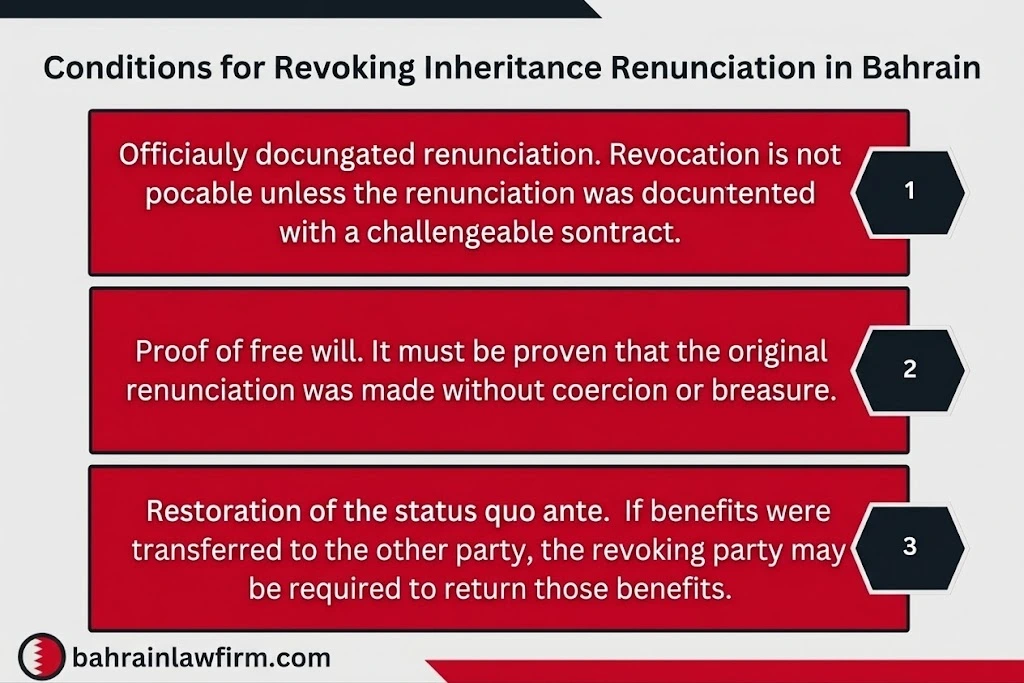
- The legal form of the waiver: The original waiver must be reviewed to determine whether it can legally be cancelled, challenged, or declared invalid.
- Free and valid consent: The original waiver should have been made freely, without coercion, undue pressure, fraud, or another defect affecting consent.
- Restoring the previous legal position: If the benefiting party received money, property, or other benefits as a result of the waiver, restoring those benefits may be necessary if the waiver is cancelled.
Detailed Procedures for Revoking an Inheritance Waiver
Revoking a waiver of an inheritance is a legal process through which an heir seeks to recover a share that was previously waived. The process requires careful legal steps to protect the rights of all parties and ensure compliance with Bahraini law.
Below is a detailed explanation of the main procedures:
1. Filing a Lawsuit Before the Competent Court
This may involve the following steps:
- Choosing the competent court: The case may be filed before a Sharia or civil court depending on the nature of the dispute and the legal basis of the claim.
- Preparing the statement of claim: The claim should explain the circumstances of the waiver, the reasons for seeking its cancellation, and any relevant issues such as coercion, mistake, or lack of proper understanding of the legal rights involved.
- Submitting supporting documents: Important evidence may include the inheritance waiver agreement, documents proving the transfer, and any other records that support the heir’s legal position.
2. Proving a Defect in the Waiver
The heir seeking revocation must generally provide evidence supporting the request. This evidence may include:
- Evidence of coercion or psychological pressure: If the waiver was made because of threats, pressure, or coercion, witnesses or other evidence may be presented to establish this.
- Evidence of a legal defect or sham transaction: A waiver may be challenged if it was incomplete, improperly documented, not officially registered when required, or otherwise legally defective.
- Evidence of exploitation: This may arise where another party took advantage of the heir’s lack of legal knowledge or a state of financial or psychological vulnerability.
3. Cancelling Agreements or Documents Related to the Waiver
If the waiver was formally documented, reversing it may require cancelling or invalidating the documented agreement.
The agreement should first be reviewed from a legal perspective to determine whether it contains a cancellation clause or whether it may be challenged because of a defect in one of its essential legal elements.
An application for cancellation may then need to be submitted to the authority involved in documenting the agreement, whether this is a court, notary public, or another competent authority. The legal grounds for cancellation should be clearly explained.
4. Negotiating With the Other Parties
Before going to court, it may be possible to resolve the matter through an amicable settlement.
The heir can negotiate with the benefiting parties to reach an agreement that restores the inheritance rights. If the other party has already benefited financially from the waiver, the parties may also negotiate compensation or an arrangement that restores them as closely as possible to their previous legal positions.
5. Attending Court Hearings and Following Up on the Case
The claimant or an appointed lawyer must follow the case and attend the necessary court hearings.
Appointing a lawyer who is experienced in inheritance disputes can make the legal process easier and help ensure that the claim, documents, and evidence are presented properly.
Before the judge, the circumstances that led to the waiver should be explained clearly, together with any evidence or witness testimony supporting the request.
If the court is satisfied with the legal grounds and evidence, it may issue a judgment allowing the heir to recover the waived share.
6. Enforcing the Court Judgment
After obtaining a judgment in favor of the heir, the next steps may include:
- Cancelling the waiver in the official records: Relevant inheritance documents and records may need to be updated before the competent authority.
- Reallocating the inheritance shares: If the waived share had already been transferred to another party, the legal position may need to be corrected so that the share returns to the original heir.
Several important points should also be kept in mind:
- Time can be important: Legal action should be taken without unnecessary delay, particularly where the rights of other parties may be affected.
- Bahraini law must be followed: All procedures should comply with the applicable legal requirements to avoid procedural problems with the claim.
- Working with an experienced lawyer is important: Inheritance disputes can involve several legal and factual issues, so professional legal support can be valuable.
Our office can provide legal assistance throughout these stages, from preparing the case to following up on the enforcement of the court judgment.
This helps protect your legal rights. You can also consult an experienced lawyer using the WhatsApp button at the bottom of the screen.
The Lawyer’s Role in Cases Involving Revocation of an Inheritance Waiver
A lawyer can play an important role in disputes involving the revocation of an inheritance waiver. Legal support may include:
- Reviewing the waiver agreement and identifying legal grounds that may support cancellation or revocation.
- Filing a lawsuit if the other party refuses to accept the revocation.
- Representing the heir before the competent courts and legal authorities to protect his or her rights.
Choosing an experienced lawyer from a law firm in Bahrain can improve the way the case is prepared and help the heir pursue the available legal remedies under Bahraini law.
Frequently Asked Questions
Here are some of the most common questions we receive about Revoking an inheritance waiver:
Can an inheritance waiver be revoked if it has been officially documented?
It may be possible to challenge or revoke a documented inheritance waiver if there is a valid legal ground, such as a defect in the documentation process, coercion, fraud, or another circumstance that affected the heir’s free consent.
Can an inheritance be waived verbally?
A verbal inheritance waiver may not be sufficient to create a binding legal transfer. Formal written documentation and compliance with the applicable legal requirements may be necessary under Bahraini law.
Our office provides comprehensive legal services in inheritance matters, including inheritance waivers and requests to revoke them. Our experienced legal team can provide advice and support to help protect your rights.
To contact one of our experienced lawyers, use the WhatsApp button at the bottom of the screen.
Revoking an inheritance waiver may be legally possible in specific circumstances under Bahraini law. Because the result depends on the wording of the waiver, the surrounding circumstances, and the legal steps already completed, it is advisable to consult a lawyer experienced in inheritance matters.
Feel free to contact us. Our office provides full legal support to help you pursue and protect your rights.
For more information, see:
Inheritance legal advice in Bahrain.
Legal details about irrevocable divorce in Bahrain.

A Bahraini lawyer and the founder of a legal consultancy firm established in February 2019. He holds a Higher Degree in Sharia and Law from Al-Azhar University. He has extensive experience in court representation and providing legal advice in criminal, personal status, civil, and commercial matters. He is known for delivering clear, practical, and effective legal advice aimed at protecting his clients’ rights and interests, and has achieved tangible results in notable cases, including commercial litigation and inheritance matters
