
Trademark law in Bahrain is the main legal framework that protects the rights of companies and individuals over their trademarks. Understanding it is the first step to answering a key question: why is protecting a trademark in Bahrain so important?
As business competition grows, owners need to know which types of marks the law protects, how to register a mark, and what penalties apply to infringement. This guide also shows practical steps to protect your brand and keep its reputation.
Is someone copying your brand? Protect your trademark before the damage grows.
Table of Content
What Is the Trademark Law in Bahrain?
At the heart of the system is the GCC Trademark Law, approved in Bahrain by Law 6 of 2014, which was issued on 17 February 2014. It replaced the earlier Law 11 of 2006 and is a core part of the country’s intellectual property law, which protects the different elements of industrial property.
The law has these main features:
- Competent authority: the Ministry of Industry and Commerce receives and examines the applications and keeps the register.
- Official register: the register records the marks, the names and addresses of the owners, the goods and services, and any transfer, license, pledge, renewal or cancellation. Any interested person may inspect it and ask for a certified extract (Article 6).
- Protection period: registration protects the mark for ten years, and the owner may renew it for similar periods (Article 20).
- Exclusive right: the owner of a registered mark has the exclusive right to use it and to stop others from using the same or a similar sign without consent, when this is likely to confuse the public (Article 17).
- Unified law: the same law applies across the GCC states, and it does not affect the bilateral and international agreements in force (Article 49).
This framework gives registered marks strong protection, and it makes the business environment fairer and more predictable.
Why Protecting a Trademark in Bahrain Matters
In a fast-growing market like Bahrain, protecting a trademark under the trademark law in Bahrain is a strategic need for several reasons:
- Stopping imitation: imitation can damage the reputation of a business and weaken the trust of its customers.
- Economic confidence: when investors and consumers know that a stable legal framework exists, the investment environment becomes more stable.
- International standards: Bahrain joined the Paris Convention for the Protection of Industrial Property (Decree-Law 31 of 1996) and approved its accession to the Madrid Protocol on international registration of marks (Law 18 of 2005).
- Innovation and investment: legal guarantees encourage people and companies to develop new products and services without fear of infringement.
- National development: protecting intellectual property supports economic and cultural growth.
Working with an intellectual property lawyer in Bahrain is a smart step to improve the chances of registering your mark and defending it in court.
Types of Marks the Law Protects
The trademark law in Bahrain covers a wide range of marks that suit different markets. Article 2 defines a trademark as any distinctive sign used to tell the goods or services of one business from those of others, and the main types are:
- Traditional marks: names, words, signatures, letters, numbers, drawings, pictures, shapes, packaging, colors and logos.
- Non-visible marks: the law states that a sound or a smell may also be a trademark.
- Collective and control marks: a collective mark is used by the members of a legal entity (Article 34), and a control mark shows that goods or services were checked for quality or source (Article 35).
- Well-known marks: a mark that is famous beyond the country where it was registered cannot be registered by others for the same or similar goods without the owner’s request or consent (Article 4).
Some signs cannot be registered at all, such as marks with no distinctive character, marks against public order or morals, flags and official emblems, religious symbols, misleading marks, and marks that are the same as or similar to an earlier mark (Article 3).
Trademark Registration in Bahrain
The registration stage under the trademark law in Bahrain is the key to full legal protection. For a detailed walkthrough, read our guide on trademark registration procedures in Bahrain.
1. Filing the Application
The owner or his representative files the application with the competent authority on the prescribed form (Article 8). The right to register belongs to citizens of the GCC states, foreigners who live in a GCC state and are licensed to do business, and foreigners from states that are members of the relevant international agreements (Article 5).
2. Examination
The authority must decide on a complete application within ninety days from the date of filing (Article 12). It may ask for restrictions or changes, and if it refuses the mark, it must give its reasons in writing. The applicant may file a grievance within sixty days (Article 13).
3. Publication and Opposition
If the authority accepts the mark, it publishes it by the means set in the executive regulations. Any interested person may file a written opposition within sixty days of the publication (Article 14).
4. Issuing the Certificate
If nobody objects within that period, the authority registers the mark at once (Article 16). The effect of registration goes back to the filing date, and the certificate shows the registration number, the dates, the owner, the image of the mark and the goods or services with their class (Article 17).
5. Protection Period and Renewal
Protection lasts ten years. The owner may apply for renewal in the last year, or within six months after the expiry (Article 20). Our guide on trademark renewal in Bahrain explains the steps.
Trademark Violations and Penalties
The trademark law in Bahrain sets both criminal penalties and civil remedies for the people who break its rules. The table below summarizes the most common violations.
| Violation | Example | Consequence under the law |
|---|---|---|
| Forging or imitating a registered mark, or using such a mark in bad faith | Using a name that copies a registered brand on similar goods | Imprisonment from one month to three years and a fine from 5,000 to 1,000,000 Saudi riyals (or the equivalent in GCC currencies), or one of the two (Article 42) |
| Selling, offering or keeping for sale goods with a forged or imitated mark | Importing a batch of bags that carry a fake luxury mark | Imprisonment from one month to one year and a fine from 1,000 to 100,000 Saudi riyals, or one of the two (Article 42). Customs may also suspend the release of the goods (Article 38) |
| Using a mark that belongs to someone else, including a well-known mark | Printing a famous mark on advertising material without a license | The penalty above, plus a court order to stop the use, compensation and seizure or destruction of the goods (Articles 40 and 41) |
| Registering a mark without right or in bad faith | Registering a mark similar to a known competitor’s mark to sell it to him or to block him | The authority or any interested person may ask the court to cancel the registration (Article 22). An earlier user may ask for cancellation within five years of registration (Article 7) |
| Not using a registered mark | A mark registered but not used for more than five years | The court may cancel the mark on the request of an interested person, unless the owner gives a valid reason for the non-use (Article 24) |
| Claiming registration without right, or using a misleading mark | Using a logo with a medical meaning on a beauty product to suggest a treatment effect | Imprisonment from one month to one year and a fine from 1,000 to 100,000 Saudi riyals, or one of the two (Article 42) |
A repeat offender faces up to double the maximum penalty, closure of the business for fifteen days to six months, and publication of the judgment at his expense. A person is a repeat offender if he commits a similar violation within three years of a final judgment (Article 43).
Civil Remedies
An owner who suffers direct harm may sue for adequate compensation, including the profits made by the infringer (Article 41). The court may also issue urgent orders to stop an infringement or to prevent an imminent one, and it must decide on such a request within ten days except in exceptional cases (Article 40).
If the owner fears that fake goods will be imported, he may ask customs in writing to suspend their release. The authority must give its decision within seven days, and the owner must file the main case within ten working days of the notice, or the decision lapses (Article 38).
How to Protect Your Trademark From Infringement
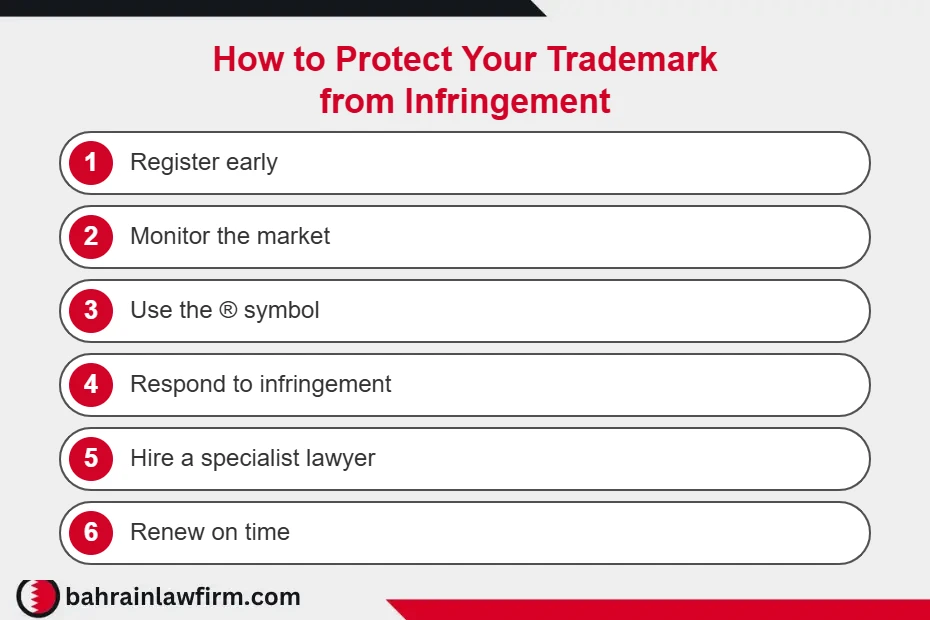
To protect your mark in an active and effective way, follow these steps based on the trademark law in Bahrain:
- Register early: official registration gives legal protection, and its effect goes back to the filing date.
- Monitor the market: watch online platforms, shops and suspicious sales, and follow the customs and industrial property services to spot goods that may violate your rights.
- Use the legal signs: put the ® sign only after your mark is registered, because showing a registration that does not exist is itself a violation (Article 42).
- Respond at once: send a legal warning or file an official complaint, and ask customs to suspend the release of suspicious goods.
- Use a specialist lawyer: a trademark registration lawyer follows the procedures on time, especially in complex infringement cases or when a well-known mark is copied.
- Renew on time: apply for renewal in the last year of the protection period to avoid cancellation and a gap in protection.
With these steps, your mark is better protected, and you can respond quickly to any attempt at infringement. For help with a commercial dispute, you can also contact a commercial lawyer in Bahrain.
Frequently Asked Questions
How long is a trademark protected in Bahrain?
Registration protects the mark for ten years, and the owner may renew it for similar periods. The renewal request is filed in the last year of the period, or within six months after it ends (Article 20 of the GCC Trademark Law).
Is a trademark protected outside Bahrain?
Registration in Bahrain protects the mark in Bahrain. To protect it abroad, register it in the countries you need, or use the Madrid system for the international registration of marks, since Bahrain approved its accession to the Madrid Protocol by Law 18 of 2005. Ask a lawyer or the Ministry about the current filing procedure.
Can I register a trademark in English?
Yes. A mark may be made of words or letters, so an English word mark can be registered if it has a distinctive character and does not fall under the refusal grounds of Article 3, such as marks against public order or marks that mislead the public. The authority may ask for more details under the executive regulations.
How much does it cost to register a trademark in Bahrain?
The fees are set by the executive regulations (Article 50) and may change, so ask the Ministry or your lawyer for the current schedule. A mark may be registered in one or more classes of goods or services (Article 9), and the total cost depends on the number of classes.
The trademark law in Bahrain is an effective legal tool to protect a business identity and support economic growth. Through proper registration, legal follow-up and the help of a specialist lawyer, the owner of a mark can secure his rights and expand his business with confidence.
Make sure you check the latest legal updates, and start protecting your mark today by asking a lawyer in Bahrain for advice through the WhatsApp button.
For more information, you can read:

A Bahraini lawyer and the founder of a legal consultancy firm established in February 2019. He holds a Higher Degree in Sharia and Law from Al-Azhar University. He has extensive experience in court representation and providing legal advice in criminal, personal status, civil, and commercial matters. He is known for delivering clear, practical, and effective legal advice aimed at protecting his clients’ rights and interests, and has achieved tangible results in notable cases, including commercial litigation and inheritance matters
