

Legal Review: This content was written and reviewed by the legal team at Abdulrahman Khalifa Law Firm.
Last Updated: 2026/09/2.
Category: Bahraini Corporate Law.
Establishing a Financial Consultancy Company in Bahrain starts with defining the type of service you plan to provide, rather than choosing a company name or obtaining a Commercial Registration.
If you intend to provide general advice on budgets, costs, or internal financial management, you may not need a specialised financial licence. However, if you plan to advise clients on buying, selling, or investing in financial instruments, you will most likely need a licence from the Central Bank of Bahrain (CBB).
The Central Bank of Bahrain regulates financial activities in the Kingdom. Therefore, obtaining a Commercial Registration from the Ministry of Industry and Commerce alone is not enough to provide regulated investment advisory services.
As part of our commitment to legal awareness, our team at Bahrain Law Firm will explain the key requirements for Establishing a Financial Consultancy Company in Bahrain, along with the main legal matters you should consider before starting the process.
Concerned about the complexity of Central Bank of Bahrain licensing requirements or choosing the wrong regulatory classification for your financial activity? Strict regulatory requirements do not have to stand in the way of your business plans.
Table of Content
What Are the Requirements for Establishing a Financial Consultancy Company in Bahrain?
The Central Bank of Bahrain requires companies to meet a range of financial, professional, and regulatory conditions when setting up a company in Bahrain. Each application is assessed according to the size of the business, its risk profile, and the nature of its clients.
1. Define Your Business Model Clearly
Explain how the company will operate before submitting your application. Clearly identify:
- The services you will provide.
- The types of clients you intend to serve.
- The financial instruments covered by your advice.
- How your fees will be calculated.
- The countries and markets you plan to target.
- How the service will be delivered, whether from an office or through a digital platform.
- The third parties your company will deal with.
- The risks that may arise from the business activity.
2. Choose the Right Legal Structure
Subject to the approval of the relevant authorities, the company may operate through a legal structure accepted by the Central Bank of Bahrain,
Choosing a legal structure alone is not enough. The CBB also reviews the identity of shareholders and ultimate beneficial owners, the source of funds, and the company’s ownership structure.
3. Provide Sufficient Capital and Liquidity
The minimum capital required for Establishing a Financial Consultancy Company in Bahrain varies depending on the licence category and the scope of the proposed activities. For Category 3 Investment Firms, the published minimum capital requirement is BHD 25,000, based on the regulatory requirements applicable when this guide was prepared.
The company must also maintain enough liquidity to cover part of its operating expenses. The CBB may require additional financial resources if it considers the proposed business model to involve a higher level of risk.
The financial commitment does not end with the minimum capital requirement. You may also need to budget for:
- Management and compliance staff costs.
- Licensing and registration fees.
- External audit fees.
- Professional indemnity insurance.
- Technology and cybersecurity systems.
- Office and operating expenses.
Prepare a realistic budget before starting the process of Establishing a Financial Consultancy Company in Bahrain. Do not base your financial planning on the minimum capital requirement alone.
4. Appoint Qualified People to Key Positions
The Central Bank of Bahrain requires prior approval before certain individuals can be appointed to sensitive or controlled positions.
These positions may include:
- Members of the Board of Directors.
- The Chief Executive Officer or General Manager.
- The Compliance Officer.
- The Money Laundering Reporting Officer.
- Financial or investment advisers.
- Heads of departments and other key functions.
The CBB assesses each individual based on their experience, qualifications, professional reputation, and legal record.
It also considers whether the candidate is genuinely capable of carrying out the responsibilities of the role, rather than looking only at their job title.
Is a CFA Qualification Required?
A CFA qualification is not a fixed requirement for every role or every financial consultancy company.
However, it can strengthen the profile of an adviser or manager where it is relevant to the nature of their work. The regulator may also accept other suitable professional qualifications and relevant experience.
Focus on building a team with genuine experience in investment, compliance, and risk management, supported by appropriate academic and professional qualifications.
5. Appoint a Compliance Officer
The Compliance Officer monitors whether the company complies with applicable laws, regulations, and licensing requirements as part of the preparations for Establishing a Financial Consultancy Company in Bahrain.
The Compliance Officer also reviews internal policies, advertisements, client agreements, and the procedures used to provide advice.
Give the Compliance Officer clear authority and proper access to senior management. The role should also have enough independence to report potential breaches without undue pressure.
6. Appoint a Money Laundering Reporting Officer
The Money Laundering Reporting Officer, or MLRO, plays a central role in any financial business.
The MLRO monitors unusual activity, reviews suspicious cases, and communicates with the relevant authorities when required.
The role also oversees customer identification procedures, verification of ultimate beneficial ownership, and checks relating to the source of funds.
In some smaller companies, the same person may be permitted to serve as both the Compliance Officer and the MLRO. However, this normally requires regulatory approval and must not create a conflict of interest.
7. Prepare Anti-Money Laundering Policies
Put a clear Anti-Money Laundering and Counter-Terrorist Financing framework in place before starting operations.
The framework should cover:
- Verifying the client’s identity.
- Identifying the ultimate beneficial owner.
- Understanding the source of funds.
- Classifying clients according to their level of risk.
- Applying enhanced measures to higher-risk clients.
- Screening names against sanctions lists.
- Monitoring business relationships and transactions.
- Reporting suspicious transactions or activity.
- Keeping documents and records.
- Providing employees with regular training.
Do not simply copy a generic policy from another company. Your policies should reflect your company’s actual services, clients, target markets, and method of delivering those services.
8. Protect Clients and Manage Conflicts of Interest
Provide advice based on the client’s needs and interests.
Do not direct a client towards a particular product simply because its provider will pay your company a commission.
Explain the following clearly to the client from the outset:
- The scope of the service.
- The amount of the fees and how they are calculated.
- The risks associated with the investment.
- The limits of the company’s responsibility.
- How the client can submit a complaint.
- Any relationship that could affect the independence of the advice.
Keep a record of the information the adviser relied on when making a recommendation. This record helps protect both the client and the company.
9. Put Proper Governance and Control Systems in Place
Define responsibilities within the company clearly.
Separate, as far as reasonably possible, the people providing the service from those responsible for reviewing compliance.
Prepare policies covering:
- Risk management.
- Protection of client data.
- Cybersecurity.
- Document retention.
- Complaint handling.
- Business continuity.
- Conflicts of interest.
- Review of advertisements and marketing materials.
- Monitoring the quality of advice.
- Dealing with external service providers and other third parties.
Make these policies practical and usable. A lengthy policy has little value if employees do not know how to apply it in their day-to-day work.
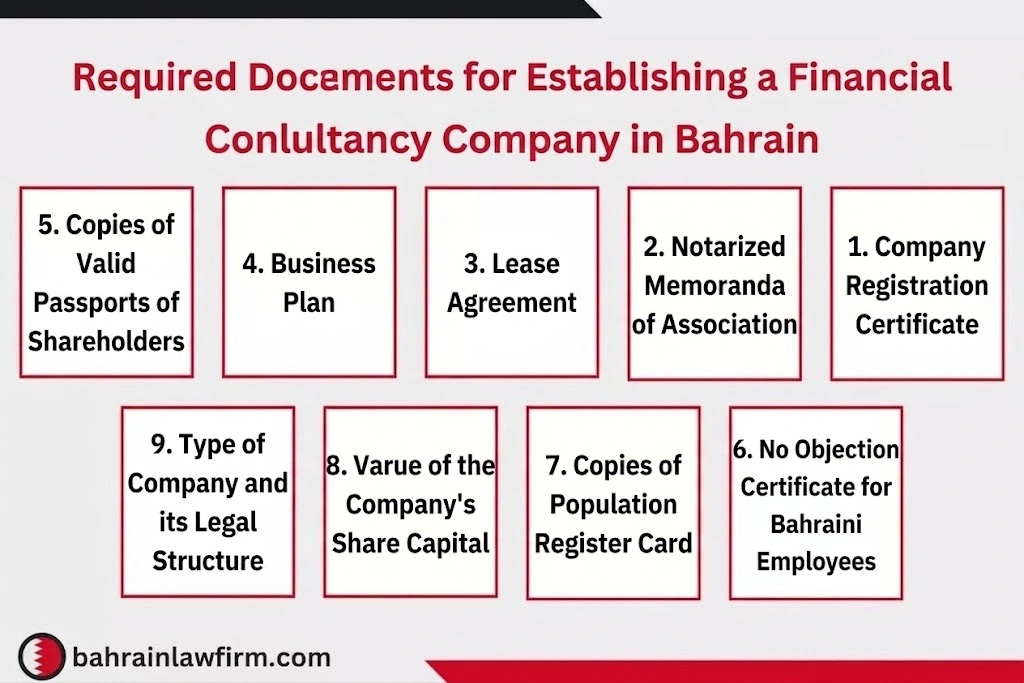
Documents Required to Establish a Financial Consultancy Company
When Establishing a Financial Consultancy Company in Bahrain, you will generally need to provide a set of documents, including:
- Company registration certificate: You will need to provide the relevant company registration certificate to show that the business has been legally registered.
- Certified documents: Certified corporate or supporting documents may be required to verify identities, signatures, and other relevant information.
- Lease agreement: The lease should include details about the location of your office, the duration of the lease, and other relevant terms.
- Business plan: Submit a detailed business plan explaining the company’s objectives, operating model, and plans for growth.
- A copy of a valid passport for each shareholder in the company.
- A No Objection Certificate, where applicable to employees in Bahrain.
- Copies of the relevant population or identity cards for shareholders, where available.
- Details of the capital with which the company will begin operations.
- Details of the type of company and its proposed legal structure.
When Do You Need a Licence from the Central Bank of Bahrain?
Look first at the service you intend to provide before taking any further step towards Establishing a Financial Consultancy Company in Bahrain.
If you intend to provide an opinion or recommendation to a client about buying a share, bond, unit in an investment fund, or another specific financial instrument, your activity may be classified as advising on financial instruments.
If your business model goes beyond advice and includes arranging deals or carrying out transactions in financial instruments as a core part of the service, that activity should be assessed separately to determine the appropriate scope of financial licensing.
If brokerage or arranging transactions will be the company’s main activity, you can review our guide on establishing a financial brokerage company in Bahrain to understand the requirements that apply to this type of business.
If your services are limited to activities such as preparing feasibility studies or budgets, or helping companies improve their internal cost management, the regulatory classification may be different.
Do not rely on the phrase “financial consultancy” alone. The term can cover a wide range of services, while the Central Bank of Bahrain looks at what the company will actually do for its clients.
Which Licence Category Is Suitable for a Financial Consultancy Company?
The Central Bank of Bahrain determines the appropriate licence category after reviewing the nature of the activity and the proposed business model.
Category 3 Investment Firm Licence
Category 3 may cover a number of regulated investment services. For a company whose main business is providing financial or investment consultancy, the key regulated service to be assessed is advising on financial instruments.
Depending on the nature of the business model and the approvals required, the scope of the licence may also cover other financial services. Define the company’s actual activities carefully rather than assuming that every business using the description “financial consultancy” carries out the same range of services.
Companies operating under this type of licence are generally expected to act independently. They are also prohibited from holding client money or client assets. Restrictions may also apply to commissions received from providers of investment products, as such payments could affect the independence of the advice given to clients.
Is Category 4 Suitable for Financial Consultancy Companies?
Category 4 is more closely associated with managing, operating, and marketing certain investment funds intended for accredited investors.
For that reason, Category 4 is not automatically suitable for every business using the term “financial consultancy.”
If you only plan to provide advice without managing an investment fund, Category 3 may be closer to the nature of your business. However, the final classification remains subject to the Central Bank of Bahrain’s assessment.
What Are the Steps for Setting Up the Company?
Follow these steps in a clear order:
1. Define Your Services
Prepare a detailed list of the services you intend to provide and determine whether any of them involve advising clients on specific financial instruments.
2. Identify the Appropriate Licence Category
Review your business model against the Central Bank of Bahrain’s regulatory requirements, and obtain legal or regulatory advice if there is any uncertainty about how the activity should be classified.
3. Prepare the Business Plan
Explain your target market, services, expected revenue, expenses, risks, and management structure.
Include realistic financial projections for the first few years of operation.
4. Select the Key Personnel
Nominate the individuals who will hold positions subject to Central Bank of Bahrain approval.
Collect their CVs, qualifications, details of professional experience, and the required disclosures.
5. Prepare the Required Policies
Prepare policies covering compliance, Anti-Money Laundering, risk management, client protection, and cybersecurity.
6. Submit the Licence Application
Submit the required forms and documents to the Central Bank of Bahrain and respond to any questions or requests for clarification raised during the review process.
7. Complete the Commercial Registration
Complete the company’s registration procedures with the Ministry of Industry and Commerce after obtaining the required approvals.
8. Meet the Conditions for Starting Operations
Put the required capital, premises, staff, systems, insurance, and audit arrangements in place, then begin operating once final approval has been issued.
Need your business model reviewed?
An early legal assessment can help you determine whether your activity requires a financial licence, which licence category is likely to be the most suitable, and which documents should be prepared before submitting the application.
Frequently Asked Questions About Establishing a Financial Consultancy Company in Bahrain
Some of the most frequently asked questions include:
What Are the Requirements for Licensing a Financial Consultancy Company?
The main requirements for licensing a financial consultancy company include:
1. Having sufficient financial capacity to establish and operate the proposed business.
2. Ensuring that the founders and persons responsible for managing the company have the necessary qualifications, competence, and relevant experience.
3. Submitting a comprehensive feasibility study together with a well-prepared business plan.
4. Establishing the company under the legal form required by the applicable laws and regulations.
5. Having no previous record of rejection or regulatory sanctions resulting in the cancellation of a licence by the relevant authorities.
6. Having appropriate systems and procedures in place to protect sensitive information and maintain its confidentiality.
What Is a Financial Consultancy Company?
A financial consultancy company is a business that specialises in providing financial advice and guidance to individuals and companies across various financial matters. Its purpose is to provide professional advice and financial solutions that help clients make informed financial decisions and achieve their financial objectives.
Is a Commercial Registration Sufficient to Provide Financial Consultancy Services in Bahrain?
No. A Commercial Registration alone is not sufficient if the company intends to provide advice relating to financial instruments or other regulated financial services. In such cases, approval from the Central Bank of Bahrain must also be obtained.
Which Authority Licenses Financial Consultancy Companies in Bahrain?
The Central Bank of Bahrain licenses regulated financial activities, while the Ministry of Industry and Commerce is responsible for company registration procedures and the issuance of the Commercial Registration.
What Is the Minimum Capital Required for a Financial Consultancy Company?
The published minimum capital requirement for Category 3 Investment Firms is BHD 25,000. Additional requirements may also apply in relation to liquidity and operating expenses. These requirements may vary depending on the nature of the activity and any subsequent regulatory updates.
This brings us to the end of our guide on the requirements for Establishing a Financial Consultancy Company in Bahrain, where we covered the main legal points involved in setting up this type of business.
We also discussed the main requirements and procedures involved, explained what a financial consultancy company does, and outlined the conditions that may apply when obtaining the relevant company licence under Bahraini corporate and financial regulations.
Contact a corporate lawyer in Bahrain if you need further legal guidance.
You may also be interested in: Steps and Requirements for Setting Up a Company in Bahrain for Foreign Investors.

A Bahraini lawyer and the founder of a legal consultancy firm established in February 2019. He holds a Higher Degree in Sharia and Law from Al-Azhar University. He has extensive experience in court representation and providing legal advice in criminal, personal status, civil, and commercial matters. He is known for delivering clear, practical, and effective legal advice aimed at protecting his clients’ rights and interests, and has achieved tangible results in notable cases, including commercial litigation and inheritance matters
